

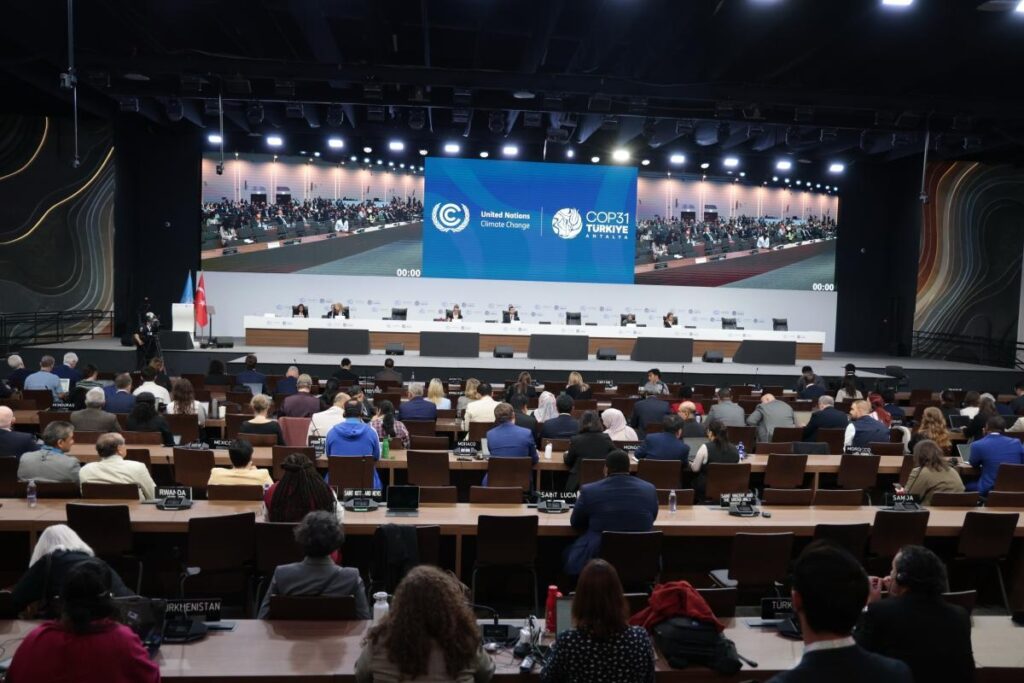
At the end, the climate summit in Antalya failed to reach consensus on the cover decision - the overarching political declaration. For me, the COP process and its failure are personal.
In different capacities and functions, I have followed these negotiations since my university days. COP31 in Antalya was my 17th summit in person, meaning I have spent roughly half a year of my life inside halls and negotiating rooms convened by the UN Climate Secretariat.
I understand the jargon, I can anticipate country positions and interests, and I understand how different agenda items interlock.
But most importantly, I understand the urgency of the climate crisis. I see what its impacts mean for human and environmental security, as well as its deep ties to economic resilience, energy sovereignty and global development. The climate crisis is accelerating.
At the same time, I also know that the climate process is about justice and the power of collective action under the Paris Agreement – creating economic opportunity while avoiding the short-term tragedy of nations remaining locked in the fossil fuel age.
I travelled to COP31 overland from Germany to Türkiye via a series of trains and ferries. That journey gave me time to reflect on what to expect. From the outset, COP31 lacked a single, high-stakes, overarching negotiation mandate. By and large, the Paris Agreement and its rulebook are already agreed upon.
At the same time, it is painfully clear that global climate action remains grossly inadequate compared to what science demands. In 2026, for the first time, it became undeniable that we will overshoot the 1.5°C temperature limit, against the backdrop of indicators pointing toward one of the strongest El Niño events ever recorded.
Even my journey to Antalya was interrupted by heavy flooding in Rhodes. And there were dark clouds for much of the route. I felt a degree of anxiety: how could this COP advance technical work, bridge the growing gap between science and national ambition, and send a strong signal to the world when relatively little was formally on the negotiating table?
The dual presidency of Turkiye and Australia responded to this challenge by branding COP 31 as the "Implementation COP," pairing a substantive climate action agenda with an ambitious cover decision designed to confront the 1.5°C overshoot head-on. After two weeks of deliberation among heads of delegation and ministers, that cover decision failed to reach consensus and could not be adopted in the final plenary.
The battle over the Paris Agreement’s red lines
Why did the cover decision collapse? It is easy to point to the contentious paragraphs. Ultimately, the EU, joined by several Small Island Developing States, Panama, the United Kingdom and Norway, objected to the text. A primary sticking point was the omission of language calling for a transition away from fossil fuels.
While that commitment was part of the landmark outcome of the first Global Stocktake at COP28 in 2023 in Dubai, negotiators have failed to reaffirm it at every summit since – including now in Antalya.
Other flashpoints included the role of carbon capture technologies – which in some formulations risk being used for enhanced oil recovery in depleted wells, hardly a choice justified by climate urgency – alongside disputes over referencing the Intergovernmental Panel on Climate Change (IPCC) and acknowledging the International Court of Justice’s (ICJ) advisory opinion on climate change.
Behind these textual battles lies a fundamental clash over how to interpret the Paris Agreement. Many countries treat it strictly as a bottom-up agreement, anchoring all climate decisions entirely within national discretion.
While Nationally Determined Contributions (NDCs) are indeed a central pillar of the Paris architecture, they do not exist in a vacuum. The agreement pairs national plans with top-down guardrails: the Global Stocktake to assess collective progress, and binding principles of "no backsliding" and "highest possible ambition" for domestic policy.
At COP31, fossil-fuel-producing nations and major emitters employed a concerted strategy to keep any new top-down elements out of the cover decision. This included blocking references to the IPCC – whose assessment timelines have yet to fully align with the Global Stocktake – as well as sidelining the ICJ legal opinion that further details countries’ obligations under international law.
Yet the reasons for this deadlock run even deeper. Throughout 2025 and 2026, climate finance suffered a string of setbacks. COP31 failed to break that trend: it secured no major new public climate finance pledges and offered no credible roadmap for achieving the goal of tripling adaptation finance.
Each COP should provide progress, however small it might be. Ultimately, the lowest common denominator decision tabled in the last hours of the COP failed to provide this and was refused by a coalition of developed and developing countries – a process without precedent in the UNFCCC.
Building momentum for Addis Ababa
Still, COP31 was not void of progress, and it should not be judged by its negotiated text alone. The “Implementation COP” delivered new coalitions that move forward on a global electrification goal, strengthened commitments under the methane pledge, and other high-level climate commitments.
The task now is to look forward and build on that real-world momentum. Implementation cannot wait for consensus in a plenary room. If governments are serious about the climate crisis, they must be willing to spend real capital – both financial and political – to accelerate the clean energy transition at home and abroad.
When I say the COP process is personal, I do not just mean the six months of my life spent inside UNFCCC halls (actually it is quite a bit more with other technical meetings) or storms that interrupted my overland journey to Antalya.
It is personal because the outcomes of these rooms dictate the livability of the world we all inhabit. Next year, the summit moves to Addis Ababa, Ethiopia, the first Least Developed Country to host a COP, and a nation already demonstrating real green economy leadership.
COP32 presents a fresh chance for world leaders to treat the climate crisis personally and to rise up to the challenge.
