
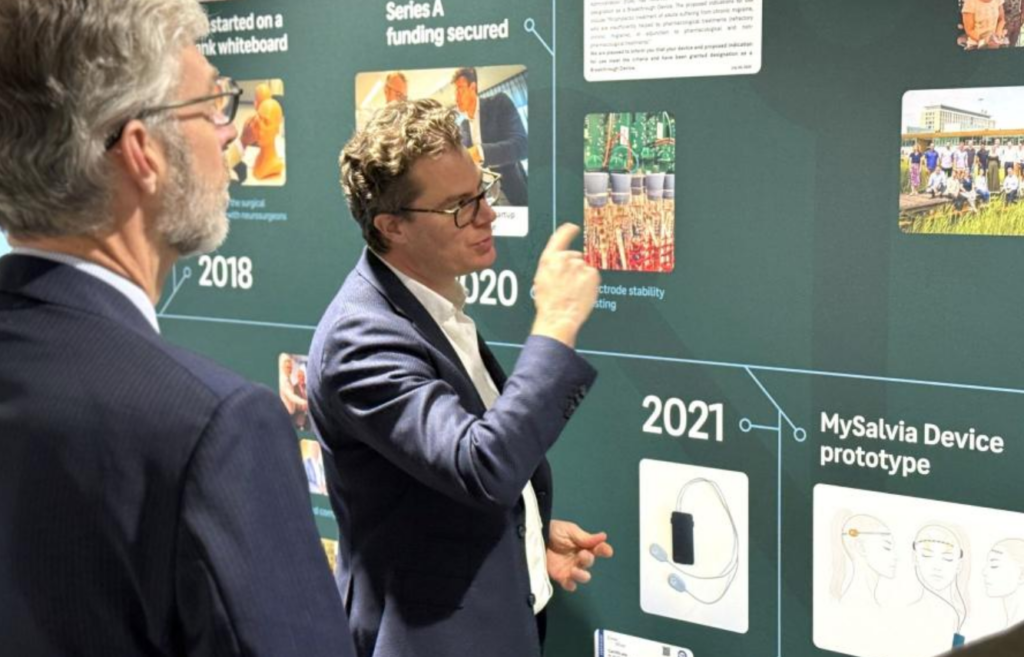
Salvia BioElectronics, a medical device company based in Eindhoven in the Netherlands, has signed a €25 million venture debt agreement with the European Investment Bank to support clinical development of its investigational MySalvia System for people living with resistant migraine.
The funding is backed by the European Commission’s InvestEU programme, which supports innovation and growth in Europe, the EIB announced on Tuesday.
Resistant migraine is a condition in which significant disability continues despite multiple preventive treatments.
The MySalvia System is a minimally invasive, implantable neuromodulation therapy — meaning it uses electrical stimulation to influence nerve activity — that is being evaluated as a potential treatment option for people with resistant migraine.
The system combines two ultra-thin implants placed just beneath the skin with a small wearable device to deliver targeted electrical stimulation to nerves involved in migraine.
Trials under way in Europe and the US
Clinical studies of the device are under way in Europe and the United States, according to the European Investment Bank.
A pivotal US study called RECLAIM-II is assessing the system’s safety, durability and efficacy in adults with resistant migraine, and is intended to support potential future regulatory submissions.
Salvia BioElectronics is also exploring the potential of its neuromodulation platform in chronic cluster headache, a separate condition, according to the European Investment Bank.
Robert de Groot, vice-president of the European Investment Bank, said migraine places a heavy burden on patients and can affect “quality of life, education, and employment”.
Hubert Martens, co-founder and chief executive of Salvia BioElectronics, noted that the agreement supports continued development of the MySalvia technology designed specifically for migraine.
