
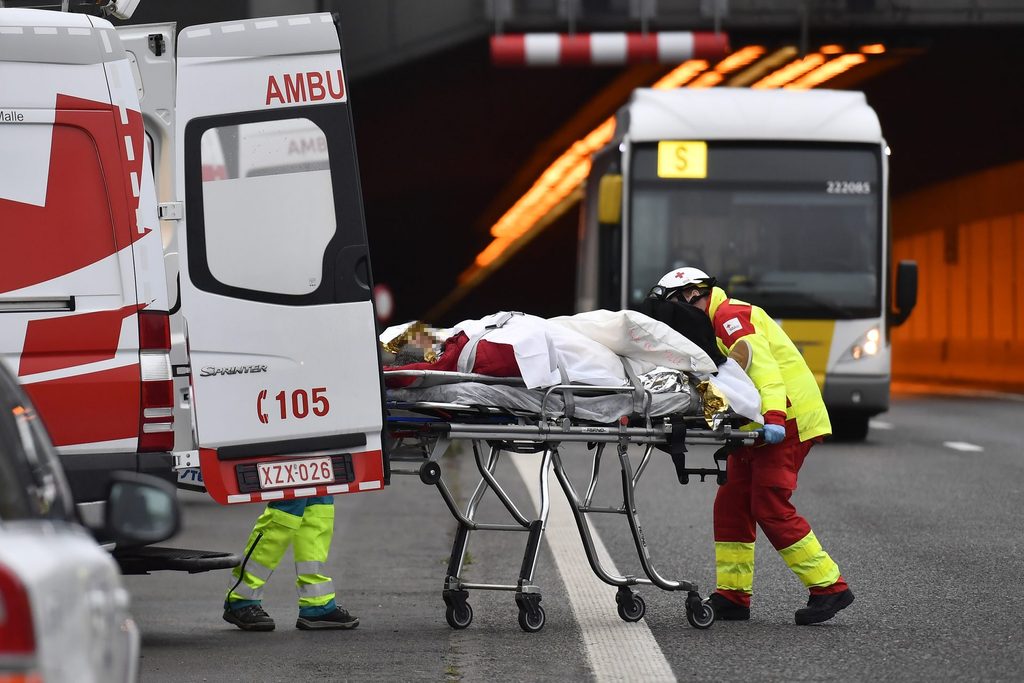
After a girl was killed by a bus in Genk, federal MP Nawal Farih (CD&V) bitterly watched a new reflex take hold: when something terrible happens, people film it. Now she tells The Brussels Times she wants the law to forbid that.
On Tuesday morning, a serious crash on the E411 motorway near Wavre left a car turned on its roof. Within minutes, photos of it were all over social media. For Farih, group leader of the Flemish Christian Democrats in the federal parliament, this was nothing new.
Two years ago, in her home city of Genk, a girl on her way to school was hit by a bus at the station. It was one of the busiest places in town at that hour, full of teenagers heading to class. She remembers what happened next.
“A lot of those young people took their phones and filmed the little girl who was in need of help, who was fighting for her life, instead of calling the emergency services,” Farih said. The girl, 15 years old, did not survive.
That memory is the reason Farih has now tabled a bill that would make it a criminal offence to film or photograph victims of road accidents, and to share the images.
The Genk accident was only the start for Farih. After she began speaking about the issue, emails arrived from victims’ organisations and from people who had lost someone in traffic. Some came from parents.
"I had some testimonials of parents who said: we were at work, and suddenly we had videos of our kids under a bus, under a train, in very difficult situations,” she recalled. “They said, I don’t think it’s respectful to the family and the victim, to be spreading those images.”
It is the part of the story that stays with her: before anyone calls a family, a video might already be circulating.
What she calls a new reflex
Farih described a change she has seen, particularly among younger people. “It’s very much normalised with the new generation, while it shouldn’t be,” she said. “A lot of things being posted the internet shouldn’t be there.”
She presented the bill as a modest first pushback. “This is a first step, and we will see further up if there is a majority to do more.”
She cannot say how widespread the behaviour is. No one keeps track of it, because it is not an offence.
“I don’t think there are any numbers yet, because there’s no registration of it at this moment,” she said. “With the penalty, there will be a registration, and then we can see in the future.”
Grey legal zone
What bothers her most is the vagueness of the current rules. A driver can be fined for using a phone at the wheel, but only when caught holding it. Footage from a dashcam or a passer-by carries no penalty at all.
Other legal tools exist, Farih said, but they leave too much to chance.
“It’s in the grey zone. It depends on whether the judge who takes the file is severe or not," she said. "I did not want any grey zone anymore. I just wanted black and white.”
Her rule is simple: “When there is an accident, the first thing you should do is call for first aid.” The job of gathering evidence belongs to the police, she said. And the subject of any image “should never be the victim.”
The bill would cover both taking the picture and passing it on. “It’s also not okay for the dignity of the victim and the family,” she said.
The figure that made headlines – up to €20,000 and 120 hours of community service – was not chosen by Farih, she said. It is simply the maximum for that category of offence under the new Criminal Code. A judge would then decide what is fair, looking at whether the person has a record, acted in good faith or shows remorse.
The bill is due to be discussed in parliament next week, then put to a vote. If it wins a majority, it will join the new Criminal Code.
Farih knows a law cannot catch everyone, but her aim is a signal. “There is no excuse for filming victims."
