
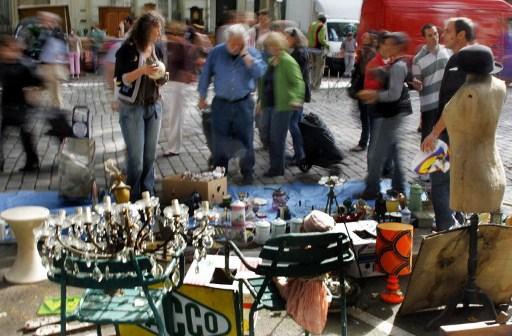
It’s coming back! Eagerly awaited after a two-year absence due to Covid-19, the Lille Braderie, considered the largest in Europe, is redeploying its 80 kilometers of stalls, with some 8,000 exhibitors, for “two to three million visitors.”
For 34 hours, from 8.00 a.m. on Saturday to 6.00 p.m. on Sunday, the city will be transformed into a huge garage sale, with tens of thousands of seats in restaurants, expanded terraces open until 2 a.m., and food-trucks, to enjoy a beer or the essential mussels and fries.
“We will be able to shop around at will again, stroll around, do good business, consume and enjoy ourselves,” Deputy Mayor Jacques Richir said at a press conference on Wednesday.
“Yes, it will smell of mussels, fries and pee (…) That’s the clearance sale, and let those who don’t like it leave town or close their windows,” Mayor Martine Aubry had said in July.
Spread over 180 hectares closed to traffic, thousands of residents of Lille, Lomme and Hellemmes as well as traders, along with 600 professional second-hand and antique dealers, will offer antiques, second-hand clothes, toys and myriad other objects.
The braderie dates back to the Middle Ages, when it allowed servants to sell their masters’ old things. It has since become international and is organised every first weekend of September.
After two years of cancellations with a very small ‘merchant sale’, “we expect a big edition”, with “two to three million visitors, French, but also Belgians, English and Dutch ones,…” said Mr. Richir.
Hotels and rentals “have been taken by storm”, “the SNCF says trains will be full”, and on the registration side, “we are full,” he added.
“The event is in the image of the city”: “festive, good-natured, safe, accessible,” he said, and “adapted to our era of circular economy”. Entry is free. There is only one downside: the threat of public transport strikes.
The Braderie wants to be “eco-responsible”: since 2017, the sale of new objects is prohibited, except for sedentary traders. The shells of the 500 tonnes of devoured mussels are recycled, mainly into tiles and decorative objects.
The city has been “scrutinising” the weather for a week. “The sky seems to be clearing. It should be good, not too hot,” said Mr. Richir.
Concrete blocks, chicanes and barriers will allow “a perfect closure” of the perimeter, “entirely emptied of cars” from Friday evening. Establishments will be able to broadcast music, but not organise concerts.
In 2016, the sale had to be cancelled due to the terrorist threat. It returned in 2017 in a reduced perimeter, enlarged in 2018, accompanied by a large security system comprising 3,000 police, gendarmes and soldiers, renewed each year since.
This return “is good for the economy and morale,” said Laurent Rigaud, president of the Chamber of Trades and Crafts. “We will renew acquaintance with the large tables,” with “regional products and international visitors; it will be exceptional.”
The event “has an impact throughout the metropolis,” Rigaud explained. “Many residents invite family and friends”, who “go out, consume. AFor a butcher like me, located 10 kms. away, it’s 20% more turnover.”
