
The European Commission adopted on Wednesday its 2022 Enlargement Package, providing a detailed assessment of the state of play and the progress made by the Western Balkans and Turkey on their respective paths towards the EU.
The package has a particular focus on implementing fundamental reforms, as well as clear guidance on the reform priorities ahead, but this has always been the read thread in previous reports. As in the previous package, the candidate countries continue to be scored as “transitional or hybrid regimes” and “partly free” on indicators to the status of democracy and good governance.
This year both the EU member states and the candidate countries face a new reality marked by Russia’s war of aggression against Ukraine. According to the Commission, this has once again put EU enlargement to the fore of the European agenda after years of enlargement fatigue in the EU, backsliding in the reform process in the candidate countries and unsolved bilateral problems between them.
The candidate countries are supposed to show solidarity with Ukraine and to align their polices with the EU Common Foreign and Security Policy, including with its sanctions against Russia. The majority of them have done so but not Serbia and Turkey to date.
Turkey is as special case because it acts as mediator, with some success, between Russia and Ukraine, but Serbia is expected, as a matter of priority, to fulfill its commitment and align with EU’s policy. Furthermore, the accession process with Turkey has effectively come to a standstill and been suspended.
The package consists of specific country reports on each candidate country – Turkey and the six candidate countries in the Western Balkans (Albania, Bosnia and Herzegovina, Serbia, Montenegro, North Macedonia and Kosovo) – and a Communication which summaries EU’s enlargement policy and the findings and recommendations per country.
Three countries are missing in the package. Last June, the European Council followed the Commission’s recommendation and decided to grant Ukraine and Moldovia candidate country status and offered Georgia a European perspective. A Commission spokesperson told The Brussels Times that the three countries will be included in the annual enlargement package as of next year.
“In addition, by the end of 2022, we’ll present our technical assessment on the ability of Ukraine, Moldova and Georgia to assume the obligations of EU membership. These are the so-called acquis reports to complete the Opinions.”
Presenting this year's Package, Commissioner for Neighbourhood and Enlargement, Olivér Várhelyi, said: "The enlargement policy of the European Union is a geostrategic investment in our European continent's peace, stability, security, and socio-economic growth. There is no alternative, and it is in our common interest to accelerate the integration process, starting with the Western Balkans.”
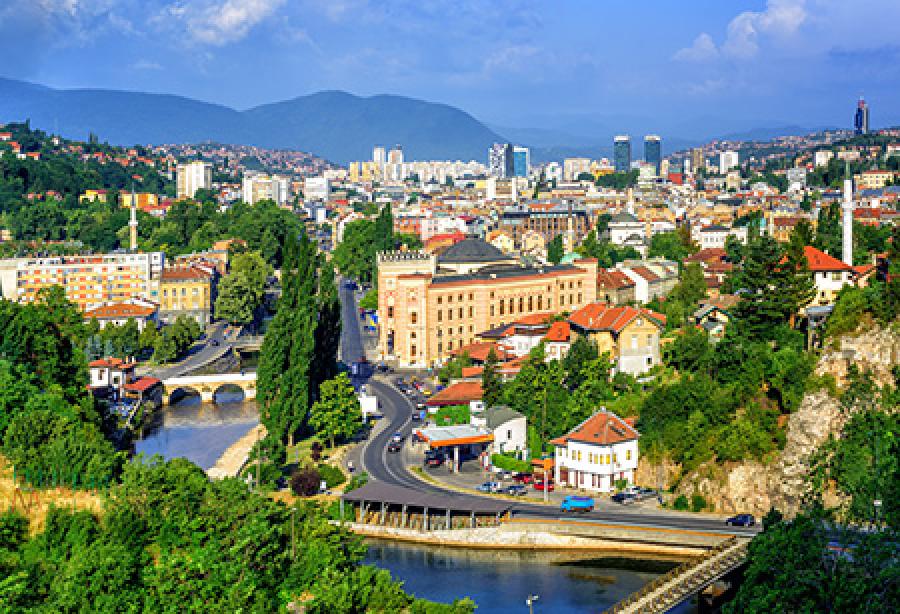
Candidate status to Bosnia and Herzegovina
He highlighted the Commission’s recommendation to the Council to grant candidate status to Bosnia and Herzegovina (BiH), “on the understanding that a number of steps are taken to reinforce democracy, functionality of state institutions, rule of law, the fight against corruption and organised crime, guarantee media freedom and migration management in the country.”
The recommendation to grant candidate status is a historic moment for the citizens of Bosnia and Herzegovina, he added. He told the European Parliament that it was an offer to the people of Bosnia and Herzegovina, accompanied by high expectations from the politicians and authorities in the country to make the full use of it and restart the work on reforms, in particular 14 key priorities from 2019.
The offer of candidate status may have come as a surprise in view of the Commission’s own critique of Bosnia and Herzegovina. “Political polarisation and obstructions led to a standstill in the work of democratic institutions and in reforms along the EU path,” the Commission writes in its report, with national institutions blocked and policy dialogue meetings with the EU suspended until 2022.
However, at the press conference (12 October), Commissioner Várhelyi argued that there has been some progress and that he favors using EU’s positive leverage on Bosnia and Herzeqovina.
Until now the country was expected first to implement 14 key priorities. Does the recommendation imply that the Commission has changed policy or that the candidate status is conditional?
“This recommendation for candidate status is not conditional,” the Commission spokesperson assured. “Following the recent elections, we now expect legislatures and executives to be swiftly set up at cantonal, entity and state level and focus their work on reforms on the EU path, as the political leaders committed themselves to do.
While the eight steps outlined in the Commission recommendation for candidate status are in line with the 14 key priorities set out in the 2019 Opinion, Bosnia and Herzegovina still needs to fulfil all 14 key priorities before the Commission may recommend the Council to open EU accession negotiations with the country.
The spokesperson referred to the elections in Bosnia and Herzegovina on 2 October. The Office of the High Representative (OHR) in Sarajevo decided very late or during the election day to amend the constitution and the election law. The office is an international institution mandated to oversee the implementation of civilian aspects of the Dayton Peace Agreement which ended the civil war in 1995.
The High Representative Christian Schmidt used his powers as a last resort, following the political deadlock in the country. However, the international election observation mission to Bosnia and Herzegovina wrote in its preliminary report that the late introduction of the amendments did not allow for enforcement mechanisms to be fully established and that certain provisions challenge legal certainty.
The Commission took note of the amendments, a decision taken by the High Representative alone, and was not informed in advance of the contents and timing of the decision.
What are the most urgent amendments of the constitution which need to be done before or directly after candidate status has been granted?
“We want BiH to move decisively on its EU path,” the spokesperson replied. “It’s high time to move from Dayton to Brussels. We trust that BiH leaders will live up to their responsibilities and seize the opportunity to finally move forward on BiH’s European path.”
“Bosnia and Herzegovina needs to fundamentally improve the institutional framework, including at constitutional level. In order to ensure equality and non-discrimination of citizens, notably by addressing the Sejdić-Finci case law of the European Court of Human Rights.”
In this ruling from 2009, the court confirmed the discriminatory nature of the electoral system in Bosnia and Herzegovina, preventing those not belonging to its “constituent peoples” (Bosniaks, Croats or Serbs) from standing for election. Jacob Finci, one of the two plaintiffs in the case, told The Brussels Times in an interview that it is strange that the court decision has not been implemented yet.
The Commission’s recommendation also notes that constitutional and electoral reform should be advanced as an utmost priority. The new parliament, as soon as it is established, should start adopting the necessary reforms. Solutions should be in line with EU values and standards, and not lead to further divisions.
Unfinished business in other candidate countries
The Commission issued also pertinent recommendations for the other Western Balkans countries. For Montenegro, the priority for further overall progress in negotiations remains the fulfilment of the rule of law interim benchmarks.
There has been no progress in this area for three years, Commissioner Várhelyi explained. To reach the milestone, Montenegro needs to intensify its efforts to address outstanding issues, such as freedom of expression and media freedom, the fight against corruption and organised crime, and credibility of the judiciary. This requires the establishment of a stable government in the country.
Serbia should as a matter of priority establish a government, firmly committed to the EU strategic direction and reform path. Further work and political commitment are needed to continue and deepen reforms and address shortcomings, in particular in the key areas of the judiciary, fight against corruption and organised crime, media freedom, freedom of assembly and the domestic handling of war crimes.
Kosovo needs to intensify its efforts to strengthen democracy, public administration, the rule of law and to fight corruption. The Commission stands by its 2018 assessment that Kosovo has fulfilled all visa liberalisation benchmarks but the decision is in the hands of the Council. According to the Commission, the proposal should be treated as a matter of urgency.
As regards Serbia and Kosovo, they both share the responsibility that no concrete progress was made in the EU-facilitated dialogue on the normalisation of their relations. The Commission urges them to engage constructively and with no further delay in negotiations on a comprehensive and legally binding agreement if they want to advance in the accession process.
On a positive note, Albania and North Macedonia opened a new phase in their relations with the EU following the first intergovernmental conferences on accession negotiations on 19 July 2022. However, they need both to further intensify efforts in key areas of rule of law, the fight against corruption and the fight against organised crime.
Turkey needs to reverse years of a negative trend in its relations with the EU that have led to that the accession negotiations have effectively come to a standstill. While Turkey remains a key partner for the EU, the Commission is concerned about its trade and financial relations with Russia and states that it needs to avoid actions that go against the objective to join the EU.
M. Apelblat
The Brussels Times
