
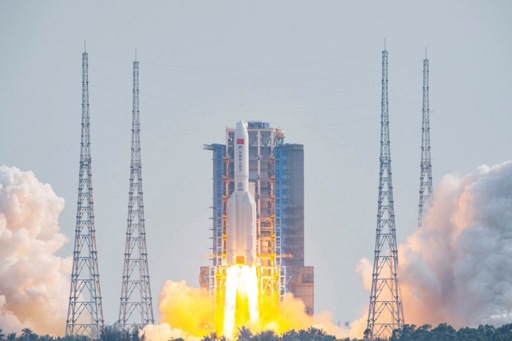
Debris from a Chinese rocket that launched the last module of the Tiangong space station that China is building is making an uncontrollable return to Earth.
Some of it is expected to burn up as it enters the atmosphere but, with the process out of control, larger fragments could land on the Earth’s surface. Usually, debris lands in a controlled manner at sea.
The debris arrived over the Spanish region of Catalonia, whose airspace was closed Friday morning as a precaution. After flying over Spain, the rocket parts are expected to pass over the Mediterranean Sea and the Arabian Peninsula on their way to the Indian Ocean.
When a spacecraft is in orbit around the Earth, the parts that got it off the ground are no longer needed. In some cases, they receive a push so that they fall back under the influence of gravity. They then plunge into the Pacific Ocean between Chile and New Zealand, the furthest place from any land (some 2,700 kilometres).
In other cases, the fragments are pushed upwards and remain in orbit around the Earth, meaning thousands of pieces of space junk are currently orbiting the planet.
