
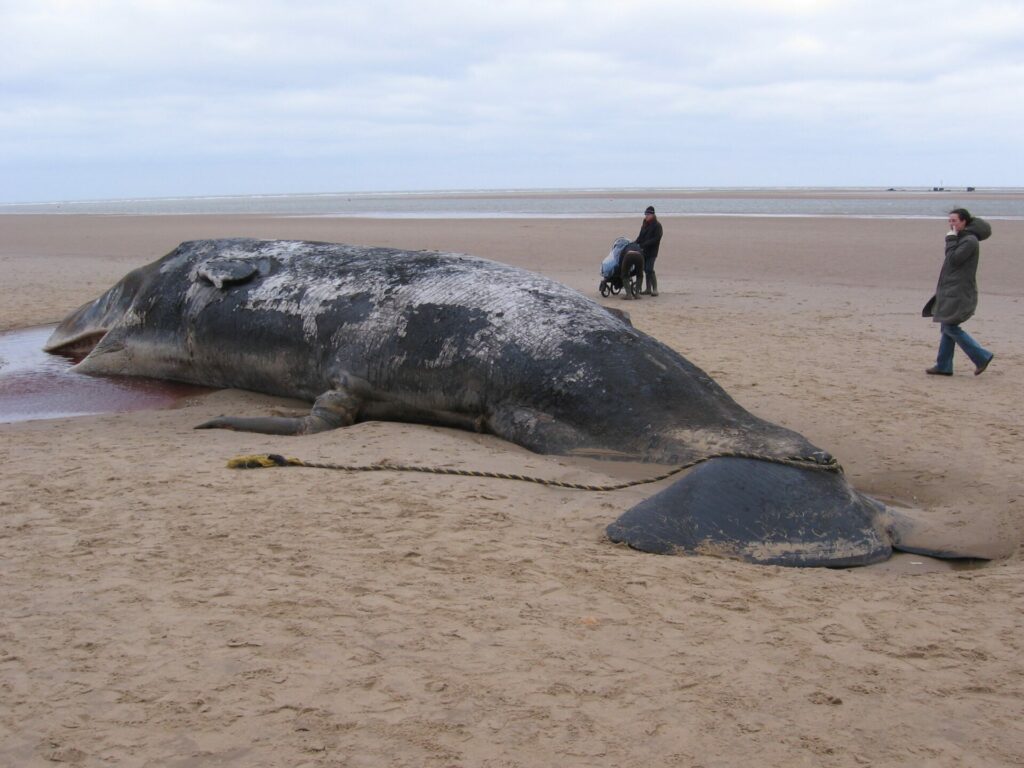
The beachings of large marine mammals are becoming more and more regular, but is this a consequence of global warming?
A washed-up beaked whale on the shore of Pas-de-Calais on Monday is the latest episode to a morbid series that began six months ago. At least once a month since last May, a cetacean has come ashore, far from its natural habitat. Le Soir spoke to Thierry Jauniaux, Professor of marine mammal biology at the University of Liège, to try to answer the questions raised by these increasingly frequent beachings.
Upsurge in cetacean beachings
According to the expert, it would seem that we are witnessing an upsurge in cetacean beachings, particularly when looking at recent increased reports of marine mammals stranded on Dutch, Belgian, French and Portuguese beaches.
Even if these phenomena are not unusual, their frequency seems to be accelerating. Jauniaux acknowledged that beachings have increased in recent months but also that they had observed species that were not frequent before, such as the beaked whale that was beached in the Pas-de-Calais on Monday. For the region, it's the first one that has been reported.
Is this enough to stop talking about isolated cases? "We are trying to link them together, to find a common point between all these incidents," explained the oceanologist, "but it is complex."
Is this phenomenon caused by global warming?
Jauniaux believes it is difficult to prove so. Waters that are warming do not directly affect marine mammals. At the top of their food chain, large cetaceans feed on small fish, which in turn feed on micro-organisms, which are much more sensitive to changes in temperature.
"The whole food chain is then disrupted," Jauniaux pointed out. "Many people would like us to be able to demonstrate that these population movements are the impact of global warming. It's much more complex than that because it's difficult to demonstrate. What is happening at the global level is happening on a temporal and spatial scale that is impossible to reproduce in an experimental setting."
Impact of human activity
According to Jauniaux, the link with human activity is clear, expert panels have already demonstrated several interactions between human activities and these events.
There are areas where human activity has affected marine life, although indirectly. Global warming caused the opening of the Northwest Passage in 2007. Located between the North Pole and Canada, it had always been icebound. The melting ice made the passage passable by ship, allowing a 4,000-kilometre shortcut for sea journeys between Europe and Asia. Continuous ship traffic keeps this passage open.
"Grey whales, which are Pacific animals, will follow this opening and come into the Atlantic," explained Jauniaux. "From time to time, grey whales even get lost in the Mediterranean. This is proof of the impact of human activity on cetacean movements."
Coast proximity is lethal
When a large marine mammal is beached, it is so heavy that it is impossible to get it back into the water. "The only solution would be to avoid beaching," explained the oceanologist from the University of Liege. "The problem is that with animals of this size, it is almost impossible. Some people sometimes suggest pulling them by the tail. This would kill them directly by dislocating their spine."
"In our regions, when an animal of this size runs aground, in 99 cases out of 100, there is no chance of saving it. In the last case, if we manage to put it back out to sea, it would disappear into the sea and die anyway elsewhere," he concluded.
