
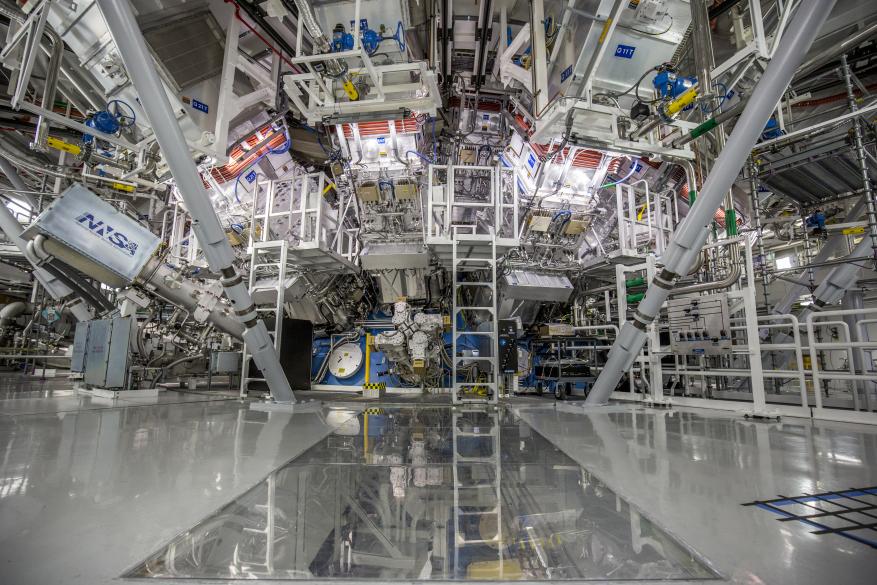
Scientists in California have crossed a long-awaited milestone in reproducing the power of the sun in a laboratory which has been hailed as "a major scientific breakthrough which has been decades in the making" that will pave the way for advancements in the future of clean power.
The US Department of Energy (DOE) and DOE’s National Nuclear Security Administration (NNSA) announced the achievement of fusion ignition at Lawrence Livermore National Laboratory (LLNL) in California, marking the first fusion reaction in a laboratory setting that produced more energy than it took to start the reaction.
“This is a landmark achievement for the researchers and staff at the National Ignition Facility who have dedicated their careers to seeing fusion ignition become a reality, and this milestone will undoubtedly spark even more discovery,” said U.S. Secretary of Energy, Jennifer M. Granholm, following the announcement.
Flip side to a success story
Between the sun and stars, fusion continually combines hydrogen atoms into helium, which produces sunlight as well as warmth that bathes the planets.
In nuclear fusion, the nuclei of several atoms are fused together in a reactor, the reverse effect of nuclear fission. This man-made process has huge potential as an energy source because there are large quantities of light nuclei on Earth, particularly hydrogen, meaning the fuel is virtually infinitely available. The fact this releases no greenhouse gases and much less radioactive waste than nuclear fission is another advantage.
At the laboratory, 192 laser beams were focused on a small amount of hydrogen, in a capsule a few millimetres in size. The beams heated the hydrogen to more than 3 million degrees, which required 300 megajoules of energy to make the lasers deliver 2.05 megajoules of energy to the target. The fact that several hundred megajoules of energy had to be injected first is the flip side of the success story.
Essentially, the energy output is ultimately a fraction of the input, Tony Roulstone of the University of Cambridge told Belga News Agency. To generate electricity, at least twice the amount of energy invested must be produced. The LLNL can only achieve the result of producing more energy than it used once a day, while a fusion power plant would have to do it 10 times a second.
There is still a long way to go before the solution is industrially and commercially viable. According to Kim Budil, director of LLNL, it could take several decades more, mainly due to technological challenges.
Related News
- Energy crisis has turbocharged renewable power, IEA reports
- Flanders Energy Minister's nuclear plans meet opposition
However, Justin Wark of Oxford University is optimistic. "The basic science is pretty well understood and that should encourage further investment." In the meantime, this historic experiment will provide invaluable insights into the prospects of clean fusion energy.
