
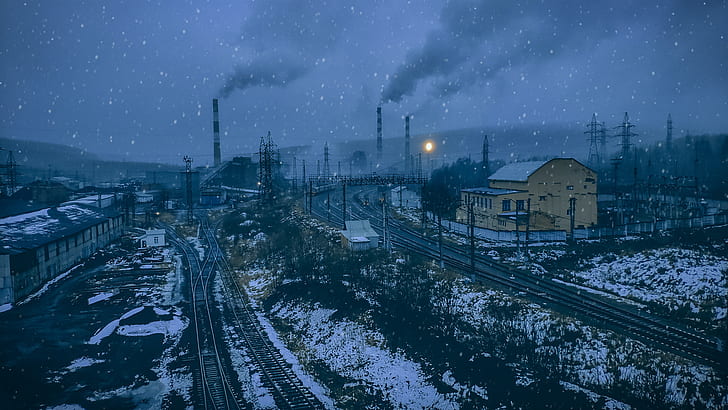
The combination of the cold and incoming humidity in Belgium recently led to a flurry of what is known as industrial snow. The Charleroi, Fleurus and Wavre regions were all affected by a thin film of snow that covered the lawns and even some secondary roads.
If you have never heard the term, industrial snow is a type of snow caused by emissions, especially of water vapour and fumes, from industrial plants.
Industrial snow is formed when there is fog or low stratus cloudiness combined with a pronounced temperature inversion (increase in temperature with altitude) near the ground, minor air movement, and temperatures below the freezing point.
When it is foggy, as it was on the day that areas of Belgium experienced the phenomenon, and water vapour is emitted by industrial plants, the air moisture condenses to small dirt particles in the air, which are not visible to the human eye.
Most of these particles are combustion residues from industrial facilities, private wood heating systems and the exhaust fumes from cars. When the temperature then drops below the freezing point, this dust-water mixture freezes and falls to the ground. Basically, this “snow” is man-made frozen, fine dust. In some cases, near industries where the concentration of moisture in the air is high, the accumulation can be up to 5 cm of snow.
This weather phenomenon is usually very localised. It can snow in one place while a few hundred meters away, nothing will fall. A city can even be cut in two with some suburbs experiencing a fall while others will not.
This led to many motorists on Belgium’s roads being very surprised. Coming from non-snow-covered areas and landing suddenly in places where snow fell in large flakes, sometimes accumulating between 6 and 7 cm.
Most of the time, precipitation radars do not detect this industrial snow most of the time and that it is difficult to predict because of its extremely local presence.
