
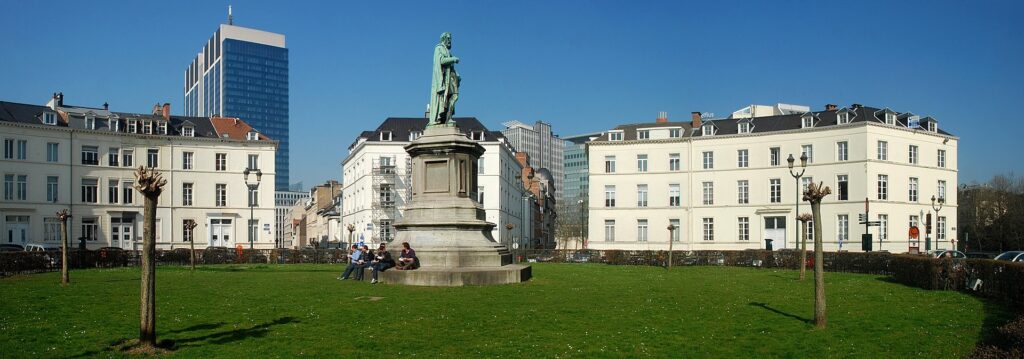
A statue of Vesalius stands in the middle of the Place des Barricades in Brussels. But the famous doctor was born a few kilometres to the west in a street in the Marolles (now vanished) called Ruelle de l’Enfer, or Hell Lane.
The inscription on the statue gives his date of birth as 31 December 1513, but some scholars argue that it was 1 January 1514. Vesalius grew up in the shadow of the Galgenberg, or gallows’ hill, where criminals were hung. According to a local legend, he removed the rotting corpses and hid them under his bed so that he could dissect them.
His father sent him to study medicine at the universities of Leuven and Paris, but Vesalius found his anatomy teachers hopelessly inadequate. They tended to rely on ancient Greek texts and considered dissection beneath their dignity. They left this messy work to the local butcher or barber.
Vesalius eventually moved to the university city of Padua, where he was appointed Professor of Surgery. It was here that he published the famous anatomy textbook De Humani Corporis Fabrica in 1543.
Vesalius was appointed court physician to Charles V and cured the Emperor’s gout. He also followed armies into battle in France to treat the wounded soldiers. When Charles V moved to Madrid in 1555, Vesalius went with him. He died there in 1564 after returning from a pilgrimage to Rome.
Derek Blyth’s hidden secret of the day: Derek Blyth is the author of the bestselling “The 500 Hidden Secrets of Belgium”. He picks out one of his favourite hidden secrets for The Brussels Times every day.
