
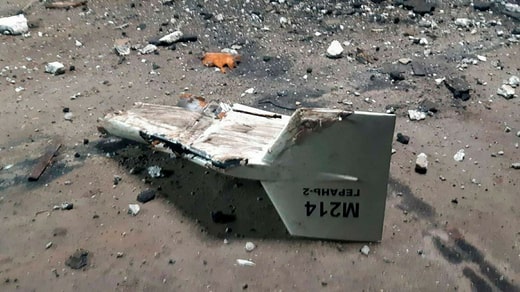
Despite a ban on the export of components to Iranian drones, Russia continues to use them in its indiscriminate attacks against civilian infrastructure in Ukraine.
According to recent reports in The New York Times, Iran continues to produce the drones, or rather unmanned aircraft with fixed wings (UAVs), and supply them to Russia. The UAVs are equipped with components from the US and EU member states in violation of UN sanctions against Iran. Western countries are now pressing the Antonio Guterres, the UN secretary general, to open an investigation.
The British minister of defense, Ben Wallace, confirmed already in December that Iran has become one of Russia’s top military backers in return for Russian military equipment. He mentioned that Iran had delivered more than 300 kamikaze drones to Russia and the number is probably much higher by now. Russia and Iran might also establish a joint production line of UAVs in Russia.
As already reported, the EU decided before Christmas on a new package of sanctions to step up the pressure on Russia - including a ban on export of drone engines and other dual-use goods and technology. The ban applies to the direct exports of drone engines to Russia, as well as to exports to any third country, including Iran, where there is a clear risk of diversion and military use in Russia.
The Commission repeats that the task of implementing and enforcing restrictive measures (sanctions) is in the hands of member states. The Commission monitors the proper enforcement of sanctions throughout the EU, and the relevant competent authorities of each member state oversee adherence to the regime and carry out assessments.
A Commission source told The Brussels Times that the Commisssion and the national competent authorities work in close contact with EU operators and provide them with guidance and support to ensure that any business subject to EU sanctions remains lawful. “The effective implementation and enforcement of EU sanctions remain a priority for us.”
The Commission declined to disclose any information about the member states concerned and what European companies have been selling components to the Iranian UAVs. While the Commission and the member states share information on a regular basis, the information is confidential and cannot be disclosed publicly, according to the Commission.
Ukraine is currently using expensive missiles to shoot down the cheap Iranian UAVs. An UAV or drone can cost as little as $20,000 to produce while a missile can cost hundreds of thousands of US dollars and therefore should be used for the protection of critical infrastructure.
Is it possible to use attack UAVs to shoot down the Iranian UAVs used by Russia in the war against Ukraine?
“There have been some attempts in Iran and Russia to develop UAVs that can carry air-to air-missiles, among others to shoot down hostile UAVs,” replied Dr Uzi Rubin, an expert on missile defense at the Jerusalem Institute for Strategy and Security (JISS). In the past he played leading roles in Israel’s defense programs.”
“But I'm not aware of any operational system like that at this time. In any case, the cost of the air-to-air missile far outstrips the cost of the Iranian suicide UAVs used by Russia, so I'm not sure that there is any cost saving in this solution. As for real drones - small quads or multi-copters - there are now anti-drone drones in development in many countries. But this doesn’t solve the problem of the Iranian suicide UAVs.”
M. Apelblat
The Brussels Times
