
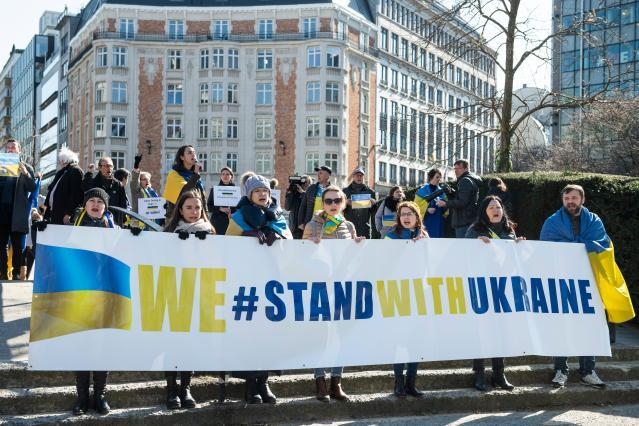
The European Commission adopted on Wednesday a Communication on the Temporary Protection Directive which was activated in response to Russia’s invasion of Ukraine to help people fleeing the war and to manage what would become the biggest population movement in Europe since WWII.
The Directive (TPD) was triggered for the first time on 4 March 2022 and was complemented on 28 March with a 10-Point Plan on stronger European coordination on welcoming people fleeing the Russian aggression against Ukraine. Temporary protection has already been extended until March 2024 and can be further extended until 2025.
“Since day one of the full-scale Russian invasion, the EU stood firmly on the side of Ukrainian people,” said Margaritis Schinas, Vice-President for Promoting our European Way of Life, at a press briefing in Brussels.
“European solidarity has been epitomised by the granting of immediate protection status to over four million people, with families in the EU opening their homes, schools welcoming new students, hospitals and medical services assisting those in need and over a million people displaced from Ukraine joining our workforce.”
He promised that the EU will support Ukraine for as long as it takes and added that it was clear that “this valuable instrument should remain in the EU’s toolbox in the future”.
"One year on, temporary protection is a testament to the Union’s unity and solidarity with people fleeing the Russian aggression against Ukraine," said Ylva Johansson, Commissioner for Home Affairs. "The EU responded rapidly and provided a safe haven for those in need."
This Communication takes stock of the Directive's implementation over the last year, draws the lessons learned and identifies priority areas where continued efforts are needed. According the statistics, more than 16 million entries from Ukraine and Moldova into the EU have been recorded, out of which 14 million were Ukrainian nationals.
Out of them, more than 11 people have returned which leaves almost 4 million people still in EU member states under protection. Of these, 47% are women and more than one third are children. Almost half of them are hosted in Germany and Poland, followed by Czechia, Italy, and Spain. Estonia, Poland and Czechia host the highest number of beneficiaries of temporary protection per capita.
Asked by The Brussels Times if the return of the majority of people indicates any “protection fatigue” in the member states, the Commission replied that other factors were behind the figures such as improving economic conditions in Ukraine despite the on-going war and the willingness of refugees to join the fight for their country’s independence.
The implementation of the Directive has not been without challenges but thanks to the continued efforts of the EU institutions and Member States, the Directive continues to successfully deliver, according to the Commission.
Two areas of concern in the implementation of the Directive are education, where only half a million Ukrainian children were enrolled in education systems across the EU at the beginning of the school year 2022/2023, and health care where there still are barriers to access to care, especially mental care.
In both cases the Commission promised to work with the member states to overcome the barriers and scale up enrolment in schools and facilitating access to healthcare.
The Directive provides immediate protection while reducing formalities to the minimum. It includes a comprehensive set of rights, such a special protection for children, access to education and vocational training, access to healthcare and social benefits, access to jobs, and access to accommodation and housing.
Asked why the temporary protection mechanism was not applied for other refugees fleeing wars in their home countries, Vice-President Schinas explained that the Directive had been adopted in 1990-ies during the Balkans war to manage the massive flow of refugees from ex-Yugoslavia but had never been used until 2022.
Ylva Johansson added that the mechanism is intended for situations where almost 100 % of the refugees are expected to be granted protection without any individual assessment. For other situations, there is a migration and asylum system put in place which currently is under revision (New pact on migration and asylum).
M. Apelblat
The Brussels Times
