
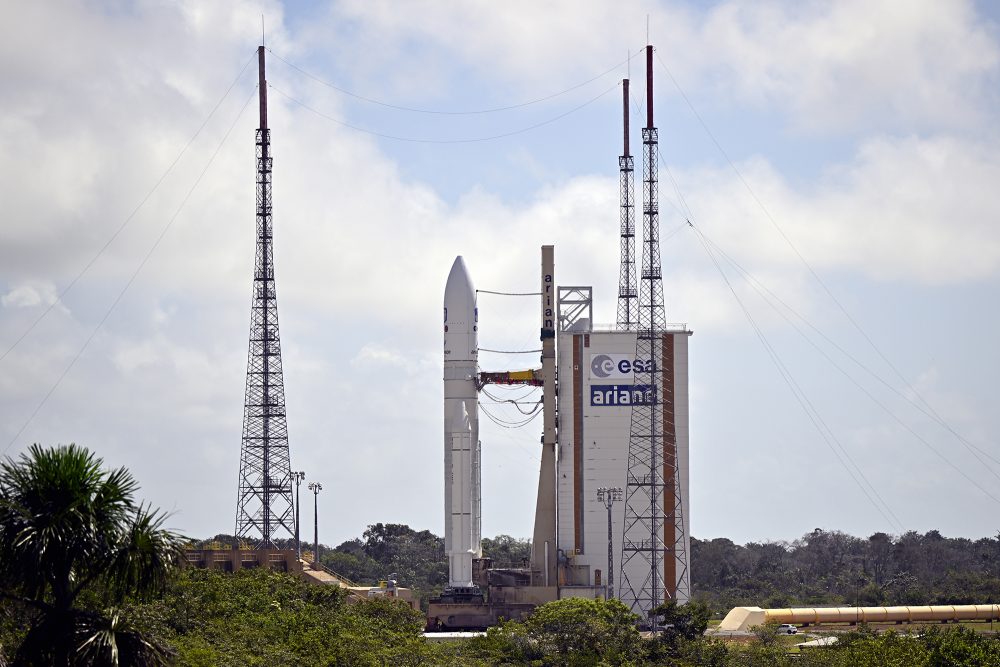
The European satellite called "Juice" (short for Jupiter Icy Moons Explorer) that was due to launch today at 14:15 (Belgian time) in French Guiana, has been postponed due to lightning risks.
The trip will set the craft on course to Jupiter to investigate whether life is possible on one of its icy moons, but terrestrial conditions have proved the first obstacle. The European Space Agency (ESA) launch site in French Guiana was prepared for takeoff on Thursday, with even Belgium's King Philippe making the journey to witness the departure.
Due to lightning risk, however, the launch is being postponed until Friday, ESA announced on its social media.
The Ariane 5 rocket would have needed to take place at exactly 1 second after 14:15 to hit its required trajectory. Normally there is more leeway with launch times, but Juice has a singularly complicated course to take.
The rocket must first pass the Earth, Moon, and Venus before twice more circumnavigating Earth (a trip that will last nearly eight years) before being at the correct velocity and orientation to fly towards Jupiter. For everything to work out, the position of Earth relative to the other celestial bodies must be exactly right at the time of launch. The next opportunity is at 14:15 on Friday.
'As Belgians, we can be proud'
Earlier this week, King Philippe and Prince Gabriel travelled to French Guiana in South America to see the launch. State Secretary for Science Policy Thomas Dermine, as well as several Belgian scientists and companies involved in the mission are also in attendance.
The rocket will have ten scientific instruments on board for its investigation, several of which have been developed with the cooperation of Belgian scientists, institutions and companies.
"Belgian research groups play an important role in the design and testing of multiple instruments," planetary scientist Hans Huybrighs, who is also involved, told VRT.
"The Belgian Institute for Space Aeronomy or the Royal Observatory has been involved and space company Antwerp Space has contributed to Juice's communication system. Various Belgian scientists and engineers work behind the scenes as world experts," Huybrighs added. "As Belgians, we can be more than proud."
The entire mission will cost around €1.6 billion. With €305 million per year over the period 2023-2027, Belgium is ESA's fifth largest investor. The space sector in Belgium represents approximately 3,620 full-time jobs and an annual turnover of approximately €710 million.
