
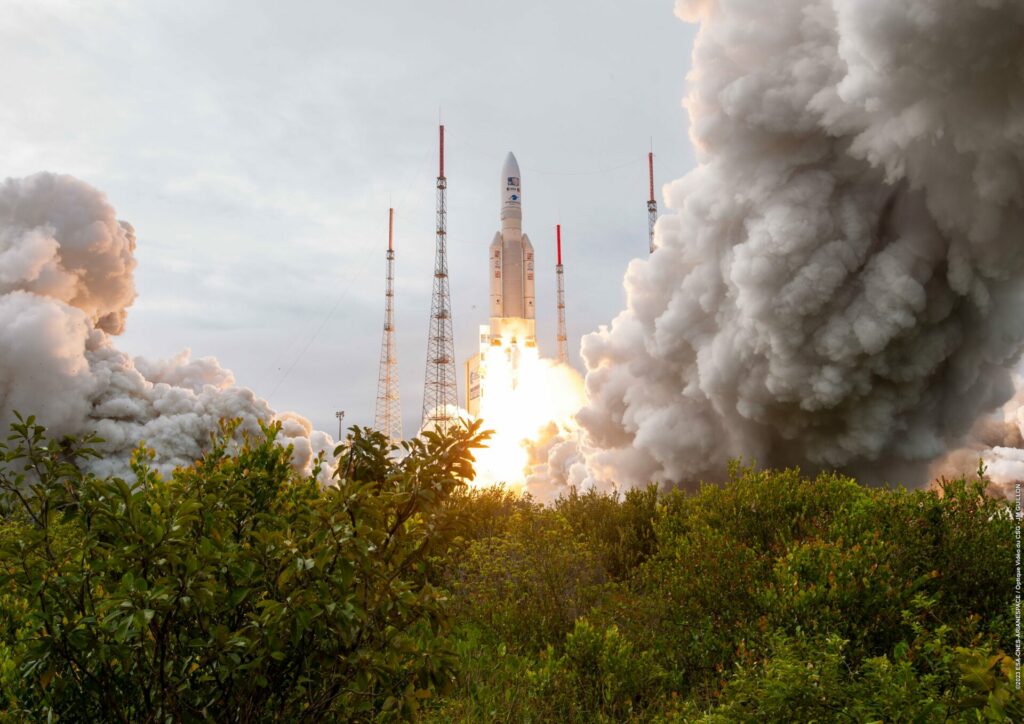
One day after the first attempt was called off, the European Space Agency (ESA)'s satellite called "Juice" (short for Jupiter Icy Moons Explorer) was launched successfully on Friday.
The launch happened a little past 14:14 (Belgian time) on Friday in French Guiana, with Belgian King Philippe and Prince Gabriel on-site to witness the launch live.
The first attempt to launch Juice was called off due to lightning risk on Thursday. On Friday, the second attempt took place about half a minute earlier: at 14:14 and 29 seconds. At that precise moment, the Ariana 5 rocket took off, because the position of the Earth at that moment was perfect for the complicated orbit Juice will follow towards Jupiter.
The takeoff went exactly as planned, announced ESA.
The rocket must first pass the Earth, Moon, and Venus before twice more circumnavigating Earth (a trip that will last nearly eight years) before being at the correct velocity and orientation to fly towards Jupiter. For everything to work out, the position of Earth relative to the other celestial bodies had to be exactly right at the time of launch.
Juice will study Jupiter more closely and scan the three icy moons (Callisto, Europa and Ganymede) around the planet to see if life is possible there. Beneath the thick ice crust on those moons, there are presumed to be deep oceans of liquid, salty water.
The probe will fly past the moons some 35 times to see how thick the ice cover is, whether there is effectively an ocean beneath it and how it is composed. Based on that, scientists want to find out whether or not life is possible in those oceans.
