
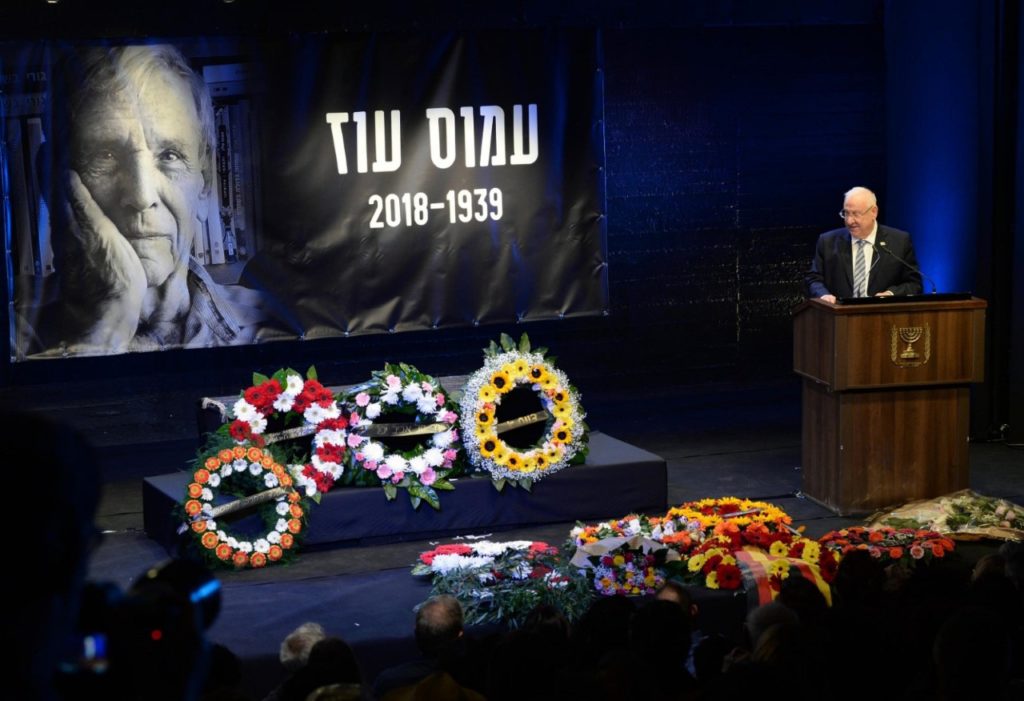
World-known Israeli author and peace activist Amos Oz died of cancer last Friday at the age of 79. His funeral took place yesterday at Kibbutz Hulda where he had been living in the past. Amos Oz was born in Jerusalem in 1939 and belonged to Israel’s founder generation. At the age of 14, after his mother’s suicide, he changed his surname from Klausner to Oz (“courage” in Hebrew) and moved to a Kibbutz Hulda in central Israel. In 1986 he moved from the kibbutz to the desert town Arad because of his son’s asthma. In recent years he was living in Tel Aviv.
Amos Oz was one of Israel’s most known and translated writers and much admired in Europe. He wrote more than 20 books of fiction or narrative prose, as he preferred to call his novels because his ambition was to write about truth and not the opposite.
“I believe that every good literature is provincial in a certain sense. A novel takes place in certain town, street, house,” he said when he was interviewed in January 2013 in Flagey Arts Center in Brussels. “The more provincial a novel is, the more universal it may become.”
“The real world is everywhere, even in a small kibbutz. I discovered that all the secrets are the same – love, hatred, fear, loneliness – all the great and simple things of life and literature,” he said in another interview. What made him a universal author was his talent in capturing the psychology of the characters in his novels.
He received many literary prizes and was often mentioned as a candidate to the Nobel Prize in literature. Unfortunately the prize was cancelled last year because of a crisis in the Swedish Academy that decides on the awarding of the prize.
His breakthrough as author came in 1972 with “My Michael” about a love story in Jerusalem in the 50-ies. The book was special because as a young male author he described the feelings of a fragile woman.
He wrote many good books but his memoir, “A tale of Love and Darkness”, published in 2002, is considered his masterpiece. A film adaption of the book was released in 2015 with the Israeli-American actress Natalie Portman directing and starring as his mother.
He was also a public intellectual who became Israel’s conscience and its cultural ambassador abroad, representing what is beautiful in the country, with his essays and opinion articles on occupation and peace.
In his lectures in literature at the Hebrew University in Jerusalem, he hypnotized the audience. As a biblical prophet, he was admired for his mastery of the Hebrew language in speech and writing but he was not always accepted in his own country and even considered a traitor by right-wing extremists.
“You, Amos, were not only never afraid of being in the minority, you weren’t even afraid of being called a ‘traitor’. In fact, you saw the term as a badge of honor,” said Reuven Rivlin, Israel’s president and his friend from the school years in Jerusalem, in a eulogy yesterday (31 December).
Early on, after the six-days war in 1967, Amos Oz warned his fellow-citizens against the on-going occupation of Palestinian territories and argued for a two-state solution. He believed strongly in dialogue with his political opponents. Since he wrote a fascinating travel book in 1982, “In the Land of Israel”, from visits to settlements in the West Bank, the situation has deteriorated.
Still, Amos Oz never lost hope. In 2016, at the funeral of Israel’s former president Shimon Peres, he said: “Peace is not only possible, it is necessary, because we are not going anywhere. The Palestinians also are not going anywhere. They have nowhere to go…Where are the brave leaders who will stand up and realize this?”
Asked in a recent interview book if he feared death, Amos Oz replied that “death is perhaps not so terrible” and quoted Job in the Bible: “Naked I came from my mother’s womb and naked I shall return there.” He enjoyed life and was curious until his last day. In the interview he says that he wrote his memoir among others to invite the dead to his home but absolutely not to let them stay.
“And what will we do now, Amos, now that you are gone? asked Rivlin in his eulogy. “Who will tell us about ourselves? Us? In your last book you said that ‘the way to bring the dead back to life is to invite them to join us from time to time, to make them a cup of coffee, to remember a few things with them, to try and make up with them a little, and to send them back to the darkness to wait for us patiently.’”
“I hope you come when we invite you, Amos, to drink coffee, to read reality with us, love us, Amos.”
M.Apelblat
The Brussels Times
