
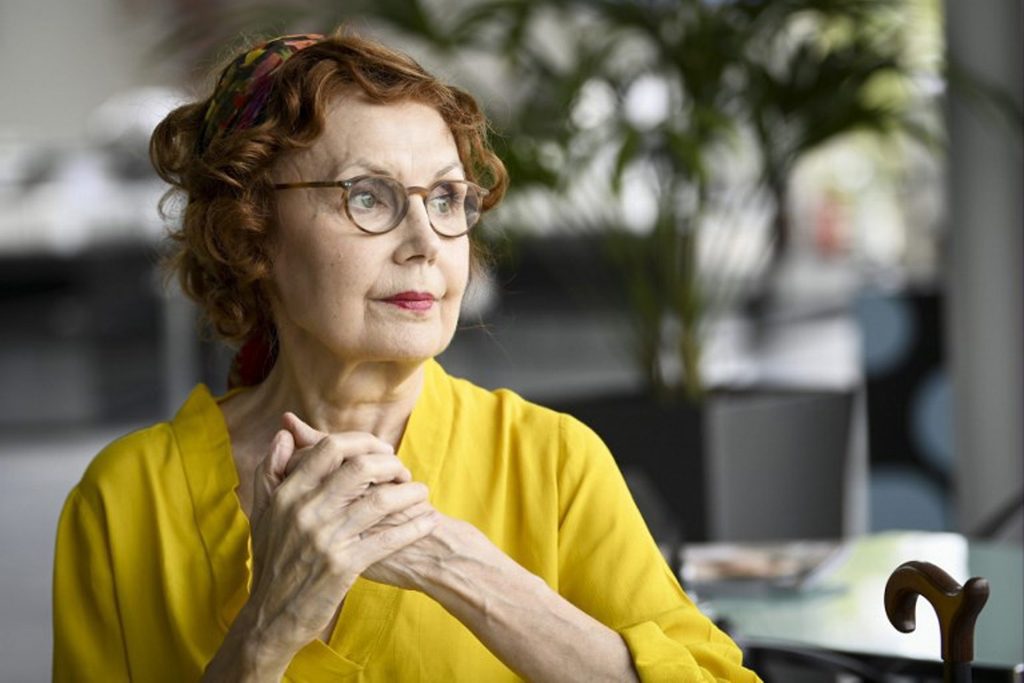
Finnish contemporary music composer Kaija Saariaho, considered one of the greatest of her time, died on Friday in Paris at the age of 70, her family and music publisher Chester Music announced in separate statements.
“Kaija battled illness with all her strength and grace,” Chester Music said. Her family said she died “in her bed, at home in Paris.”
One of the few women to break the glass ceiling in a male-dominated environment and figurehead of a generation of Finnish artists, Kaija Saariaho won the 2022 Victoires de la musique classique award in France for her opera 'Innocence,' about a school shooting.
This operatic thriller in several languages had caused a sensation at the Festival d’art lyrique d’Aix-en-Provence in 2021.
It had taken her seven years to give birth to this work, in which two of her compatriots participated: novelist Sofi Oksanen ('Purge') who wrote the original libretto and conductor Susanna Mälkki.
Prior to this, Kaija Saariaho made a name for herself with another creation, 'L’Amour de loin' (2000), based on a libretto by the writer Amin Maalouf, which was subsequently revived at the Met in New York.
This was followed by 'Adriana,' also based on a libretto by Amin Maalouf, premiered at the Opéra Bastille in 2006 and 'Only The Sound Remains,' premiered in Amsterdam and revived in 2018 at the Paris Opéra.
Although her works were recognised as early as the 1980s, it was not until the beginning of the 21st century that the Finnish composer became a leading figure in contemporary music and opera.
Born Kaija Anneli Laakkonen on 14 October 1952 in Helsinki, she grew up in a family with no connection to music. As a child, she learned to play the piano and the violin, and went on to study composition at the Sibelius Academy in Helsinki, then in Germany.
She moved to Paris in 1982 to study at the Ircam musical research institute. Two years later, she married French composer Jean-Baptiste Barrière.
In March 2023, Finnish President Sauli Niinistö presented Kaija Saariaho with the honorary title of Academician of the Arts, held by only a handful of artists (11 at the time).
