
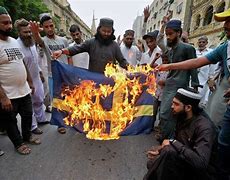
Sweden, its image severely damaged in the Muslim world after several desecrations of the Quran were authorised on its soil, decided on Thursday to raise its terrorist alert level, believing that the threat of attacks “will persist for a long time.”
“I have today decided to raise the terrorist threat level from high to critical,” i.e. to 4 on a scale of 5, the head of the Swedish Security Service (Säpo), Charlotte von Essen, said at a press conference.
For several weeks, politicians and security services have been presenting the country as a “priority target” for potential attacks.
“Over the course of the year, the threat to Sweden has gradually increased,” Ms. von Essen added, stressing that her decision was not linked “to any specific event.”
Swedish intelligence and Swedish Prime Minister Ulf Kristersson are advising people to “continue living as usual” and to be particularly careful of misinformation and rumours.
“We have ruled out planned terrorist acts,” Prime Minister Kristersson said at a separate press conference, adding that “people have been arrested.”
This is the first time in seven years that Sweden has raised its alert level. The last time it did so was from 18 November 2015 to 2 March 2015, when the alert level was increased to 4.
At the time, the decision was taken, among other things, because the jihadist group Islamic State (ISIS) regularly made terrorist threats against the European continent.
The security situation in the usually placid Nordic country is now being affected by desecrations of the Quran on its soil, committed by a wide range of people, from far-right militants to refugees and even artists.
At the end of July, two men set fire to a copy of Islam’s holy book in front of Parliament in Stockholm, repeating a gesture already made a month earlier in front of the Swedish capital’s largest mosque.
These incidents “have contributed to Sweden’s image as a country hostile to Muslims,” Ahn-Za Hagström, director of the National Terrorist Threat Assessment Centre, said at the press conference.
They were followed by sharp tensions in the Muslim world. In particular, the Swedish embassy in Baghdad was set on fire before being temporarily repatriated to Stockholm.
The hostility expressed towards Sweden led the country to intensify its border controls.
Last week, a Molotov cocktail was thrown at the Swedish embassy in Beirut, but the projectile did not explode. And over the weekend, the terrorist group al-Qaeda called for terror attacks in the Scandinavian country.
Several countries have also updated their recommendations for travellers wishing to visit Sweden.
UK, US also on the lookout for terror attacks in Sweden
On Sunday, British diplomacy said terrorist attacks there were now “very likely.”
The United States had also advised travellers on 26 July to exercise “increased caution” in Sweden because of the risk of “terrorism.”
The Swedish authorities are considering ways of limiting the organisation of demonstrations planning to burn the Quran while respecting freedom of expression. However, the parliamentary majority now seems hostile to such a change.
Disinformation campaign casts Sweden as anti-Muslim
The image of Sweden as hostile to Muslims is not new: at the beginning of 2022, the Swedish authorities, accused of systematic “abductions” of Muslim children from their families, had denounced a vast online disinformation campaign.
According to these allegations, which quickly went viral, the Nordic country was kidnapping Muslim children to give them to Christian families, where they were forced to drink alcohol and eat pork.
Asked by French news agency AFP in February 2022 about this, the Immigration Minister had denied it, pointing a finger at “malevolent forces that want to exploit frustration (…) and sow mistrust and division in Swedish society.”
These same “forces” were again mentioned on Thursday.
“We know that extremist groups and foreign powers willingly use this type of situation Sweden finds itself in today,” noted Susanna Trehörning, deputy head of counter-terrorism at Säpo.
