
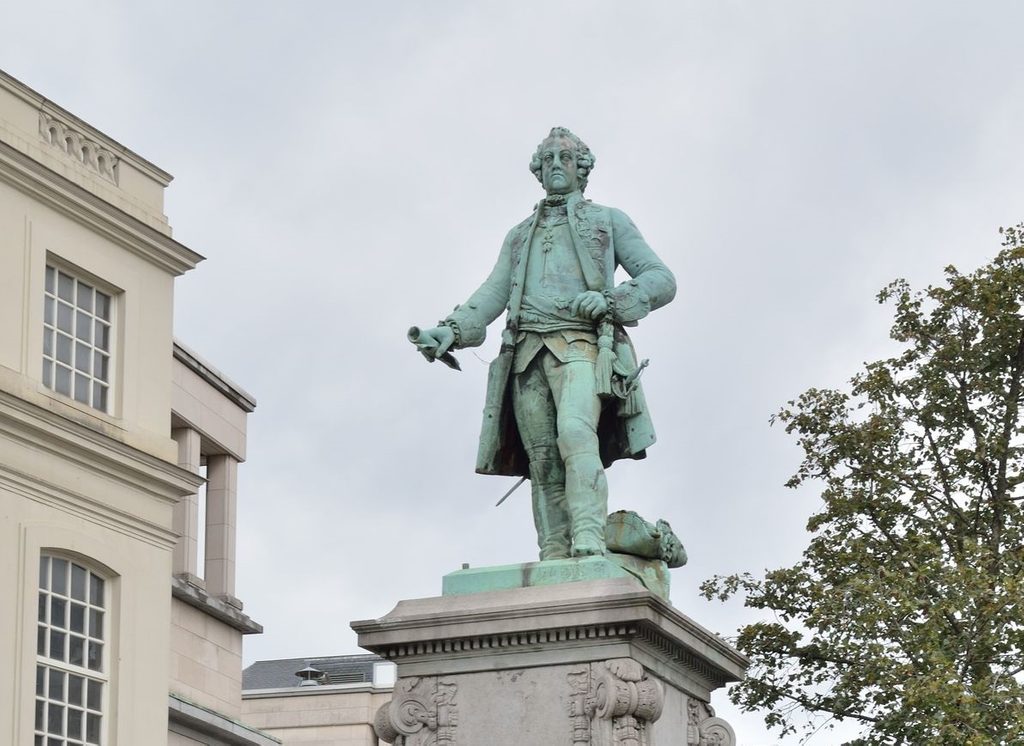
No name. No date. This baffling statue on the Mont des Arts in Brussels shows a man in 18th-century military uniform carrying a rolled document. Another rolled document lies at his feet.
The statue has been forgotten. Yet the man you see here was once the most powerful person in this region. He governed the Austrian Netherlands for 36 years on behalf of Maria Theresa of Austria and built the huge palace on the Place du Musée.
Charles of Lorraine had married the younger sister of Empress Maria Theresa of Austria. In 1744, Charles and his wife were appointed joint governors of the Austrian Netherlands. But Charles’ wife died while he was off fighting in a war, and he returned to Brussels as the sole governor.
Charles brought the enlightenment to Brussels. During his rule, the city was transformed into a vibrant centre of art and philosophy. He was responsible for some of the city’s most impressive architectural landmarks, including Place Royale and the Parc de Bruxelles. He also extended the old Nassau palace in an elegant neoclassical style.
On 17 January 1775, a statue of Charles was put up in the middle of Place Royale. It was removed by French revolutionaries in 1792 and eventually destroyed. The city commissioned a new statue of Charles in 1848. It is an affectionate portrait of an appealing governor who won the admiration of the Brussels people.
The statue originally stood in the middle of the palace courtyard, but poor Charles had to move again when the Museum of Fine Arts added an underground extension below the square. The statue ended up on a raised platform in the corner of the courtyard. Forgotten by almost everyone.
Derek Blyth’s hidden secret of the day: Derek Blyth is the author of the bestselling “The 500 Hidden Secrets of Belgium”. He picks out one of his favourite hidden secrets for The Brussels Times every day.
