
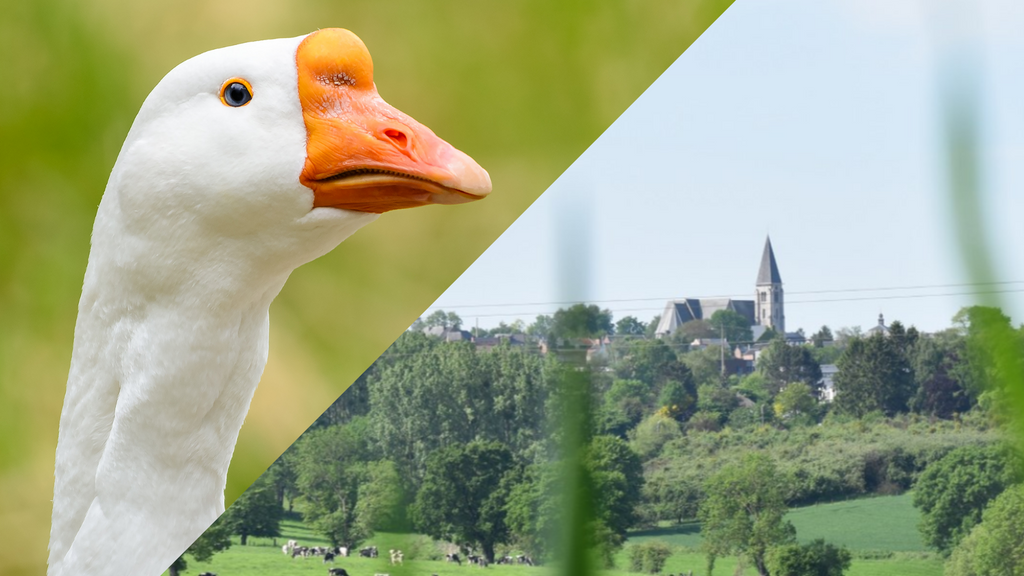
On Tuesday, a local festival in the village of Mortier in the municipality of Blegny, in the Province of Liège, ended its celebrations with its historic tradition: the decapitation of a goose.
Blindfolded volunteers armed with sabres took turns slashing at a dead goose hanging upside down from ropes like a gruesome piñata—except for the goal here is to sever the goose's head from its body, and the winner gets to take the rest home for his or her next meal.
The roots of this tradition, known as goose pulling (or the more on-the-nose goose neck tearing), are ambiguous, but allegedly originated in 12th-century Spain and was spread throughout Europe by an elite Spanish military unit.
The Middle-Age blood sport reached Belgium, England, the Netherlands and even North America via Dutch settlers, and rapidly branched into different variations of the same idea: beheading a goose. Some early versions unfortunately included a live geese and bare-handed decapitation by a participant on horseback.
In Volume 2 of his 1855 Dictionnaire historique des institutions moeurs et coutumes de la France, French historian Adolphe Cheruel writes: "In country festivals, sometimes a goose was suspended in the air as a shooting target."
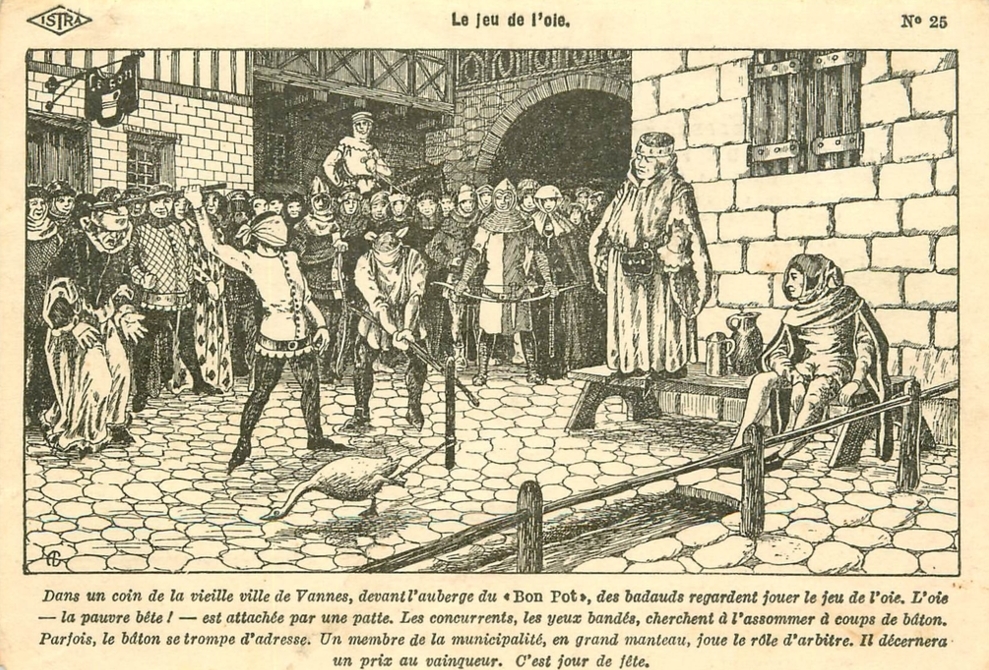
An old postcard of a Middle-Age version of goose pulling in Vannes, France. Credit: Public Domain via Wikimedia Commons
"Goose-pulling was still an honourable game in the 17th century. The Cardinal of Retz described Parisian style during The Fronde civil wars as short and frizzy-haired, wearing black shoes and silk stockings, like people on that go goose pulling," he continued.
The custom is evidently still alive – though rare – in some places in Europe, including the Basse-Meuse region in Belgium.
Indignation from animal rights groups
The use of a live goose was outlawed in Belgium in the early twentieth century, but animal rights groups continue to protest against the disrespect for the animal in these customs.
Animal Welfare Minister Céline Tellier in the Government of Wallonia took a particularly clear stance in reaction to this week's festivities. "The Minister for Animal Welfare also condemns any action that disregards the respect and dignity of animals. This is the case of these 'games' with animal corpses," her office told SudInfo.
Related News
- Animal rights group wants Saint-Josse horse race blocked
- ‘EU needs an Animal Welfare Commissioner to enforce new legislation,’ say MEPs
But Blegny Mayor Arnaud Garsou contextualised the custom in an effort to preserve tradition: "I understand that it may seem barbaric to outsiders. In some villages, this tradition still applies, as in Saint-Remy or Mortier. It's local folklore."
Garsou is also not sure when the custom was exactly when it started. "Those who want to see it attend, and those who don't don't go. You have to be aware that the animal is dead, and whoever manages to cut off its head takes the goose home to cook. The animal doesn't suffer, because it's already dead. I think that traditions, when they don't put anyone in danger, should endure," he told SudInfo.
