
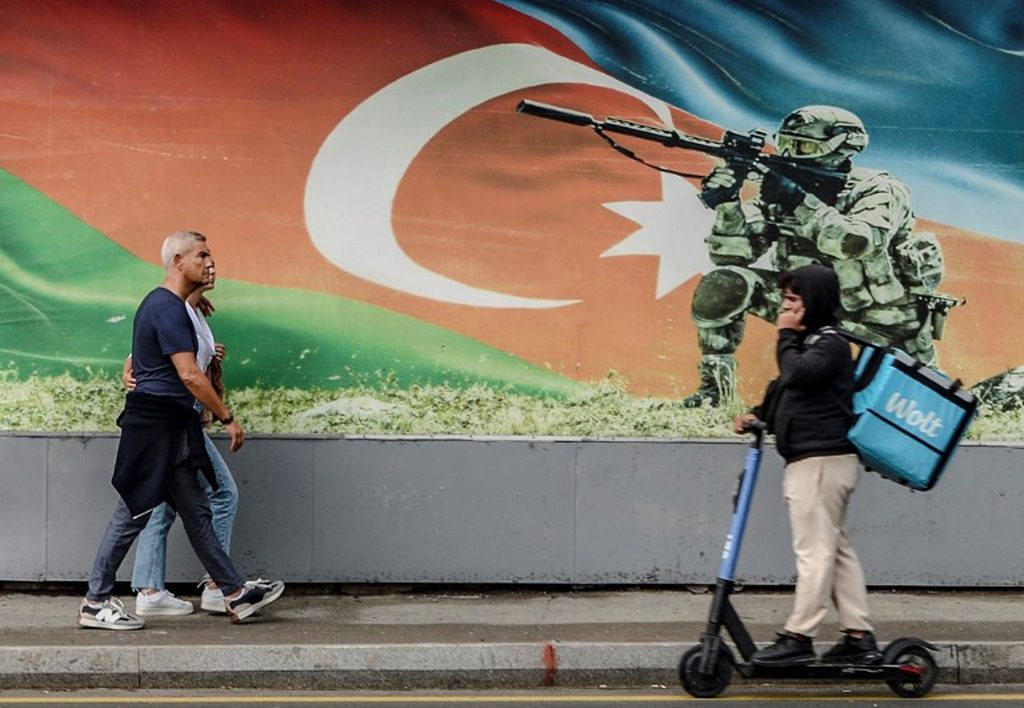
Belgian Foreign Minister Hadja Lahbib has called for de-escalation in the region of Nagorno Karabakh after Azerbaijan resumed hostilities on Tuesday against the ethnic-Armenian governed enclave.
"We are closely following the events in Nagorno Karabakh," Lahbib said in a statement. "The only valid path to peace is through dialogue and compromise. Belgium calls for de-escalation and a political solution that takes into account the well-being of the population."
Azerbaijan announced on Tuesday that it had launched "anti-terrorist operations" targeting Armenian forces in Nagorno-Karabakh. Explosions were heard in the region's capital Stepanakert; two civilians have been reportedly killed and 23 wounded.
"The reported number of civilian casualties is two," stated Gegham Stepanyan, Human Rights Ombudsman of the region on social media. "Civilian infrastructures are also being targeted" by the Azerbaijani army, he asserted.
'Peaceful coexistence'
Belgium and its EU partners have said they "deplore the loss of lives" caused by the military escalation, and say they remain fully engaged to facilitate a peaceful dialogue.
Lahbib recently travelled to the region to meet both Armenian and Azerbaijani representatives in a bid to help ease tensions. However, Azerbaijan President Ilham Aliyev cancelled their meeting in protest over Lahbib's statements on the Nagorno-Karabakh conflict while in Armenia.
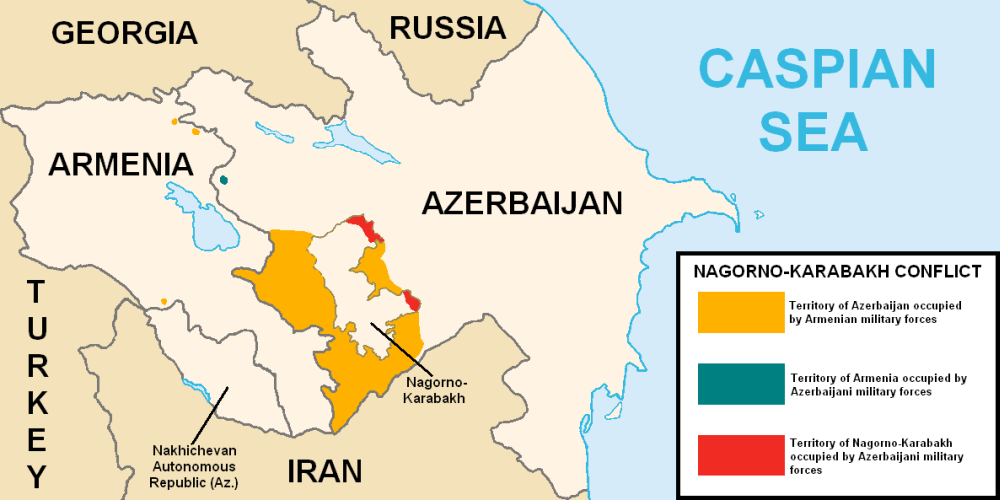
Baku justified its military operation by citing the deaths of four policemen and two civilians when mines exploded at a roadworks site in Nagorno Karabakh. They accused Armenian separatists of the disputed region of committing these acts of "terrorism."
"Tragic reports of loss of Azerbaijan lives from mine explosions today. However, ongoing military action will only worsen the situation," said the EU Special Representative for the South Caucasus, Toivo Klaar. The EU official also called for an immediate ceasefire to "allow genuine dialogue" and "achieve peaceful coexistence."
These words were echoed by the EU High Representative for Foreign Affairs Josep Borrell, who stated that military escalation must not be "used as a pretext to force the exodus of the local population."
30 years of conflict
Nagorno Karabakh, the scene of two wars between Armenia and Azerbaijan in the early 1990s and again in the autumn of 2020, is one of the most heavily mined regions of the former Soviet Union. Explosions regularly claim victims.
This Armenian-majority mountainous region of Azerbaijan proclaimed its independence from Baku when the Soviet Union dissolved, with the support of Yerevan, which led to an armed conflict won by the separatists.
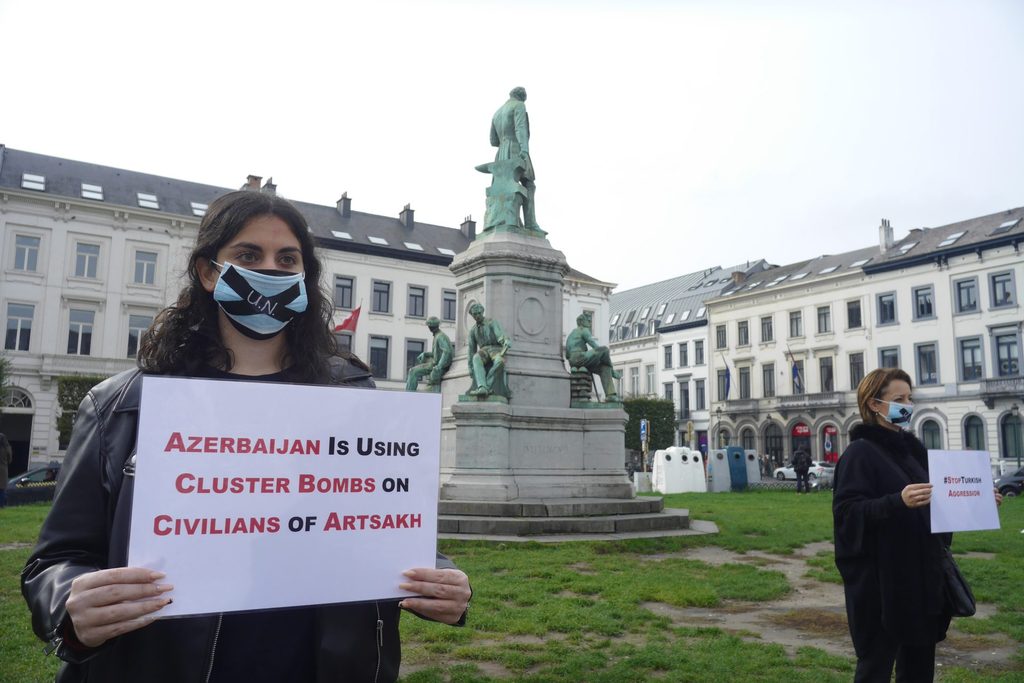
A flash-mob organised by the committee of Armenians in Belgium during the 2020 war. Credit: Belga / Ophelie Delarouzee
In the autumn of 2020, Azerbaijani armed forces recaptured significant territory in the region. The war ended after mediation by Russian President Vladimir Putin and the deployment of a Russian peacekeeping mission. But the truce has always been fragile, punctuated by armed incidents.
These new incidents come as Yerevan accuses Baku, which denies the allegations, of causing a humanitarian crisis in Nagorno-Karabakh by blocking the Latchine corridor, the only route between Armenia and the mountainous enclave, since late 2022.
