
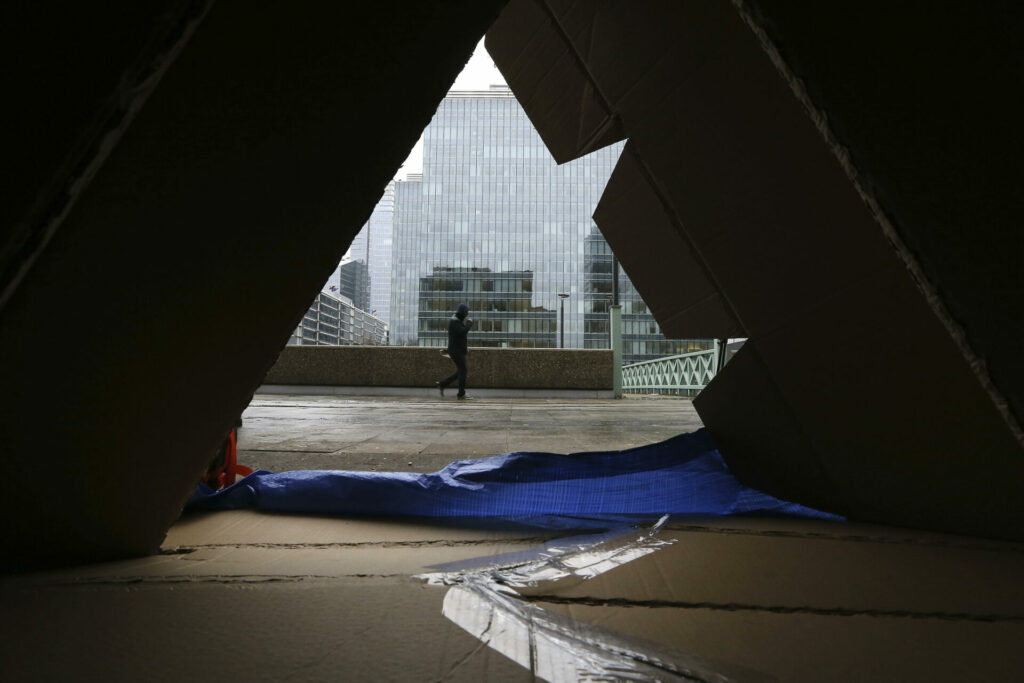
Brussels has a growing homeless population, but also a large number of vacant sites. However, the lack of an operational legislative framework is resulting in these going unused instead of being a solution to the problem.
Researchers working on the pilot project 'Solidarity Mobile Housing' sought to find and transform Brussels' so-called "pause landscapes" (built-up or unbuilt public and private sites that have been abandoned by a previous owner and are waiting to be repurposed) into temporary housing sites for the rising number of homeless people.
At the end of 2022, a total of 7,134 people were recorded as being homeless or finding themselves in precarious housing situations (at risk of eviction or being temporarily housed with third parties) in Brussels.
These vacant sites are potential places where new forms of social housing can be tried and tested, such as mobile housing units. However, a study published in the academic journal 'Brussels Studies' highlighted that there are a number of elements that are putting a spanner in the works.
Lack of structure and cooperation
In theory, it makes sense to use vacant buildings as part of the solution to combat homelessness, but in reality, the search for these optimal locations for mobile housing units for homeless people is proving to be a challenge.
Firstly, Brussels municipalities do not keep records of vacant sites or buildings within their own municipal boundaries, meaning it takes an enormous amount of time to find sites that are available. Work has been done to create a useful inventory of these sites, but there is little progress being made and the database is not up to date.
Moreover, many owners refuse to cooperate in the co-creation of temporary housing for the homeless. Both public and private owners prefer to offer their space to trendy and profitable 'pop-up' alternatives.
Some elements have shifted in Brussels in recent years when it comes to the temporary commissioning of such zones in the city. For instance, a counter for "temporary use" of buildings was set up by perspective.brussels and Citydev, and there have been calls for a number of sites to be used for this purpose.
Related News
- 'Waiting for years': Social housing waiting list lacks transparency
- 'Hidden homelessness' in the Brussels Region exposed in new report
However, the authors found that there is a chronic lack of an operational legislative framework for the reallocation of these numerous "pause landscapes" in the capital, meaning initiators looking to set up such temporary housing have to operate in a legal grey zone.
"This makes negotiating with the owners of the sites much more complicated," said Aurelie De Smet, one of the authors of the study. She added that Brussels should look to the Walloon Region, where 'Habitat Leger', a flexible legal framework for temporary and alternative housing, has been put in place. She called for the development of a clear legal framework for temporary housing of vulnerable target groups in the city.
De Smet and the social work organisation SAAMO stressed that "everything possible must be done" to create more housing units, "even if they are only temporary." These structures allow people to get a fresh start and no longer rely on shelter.
