
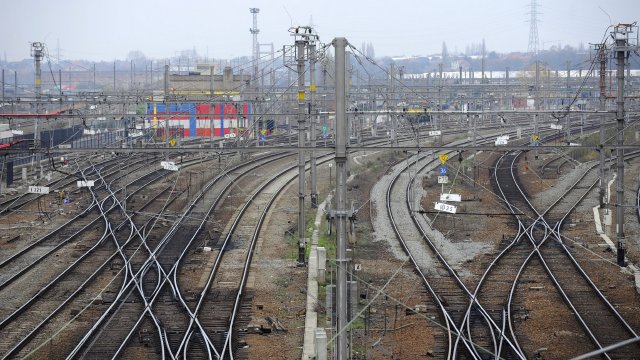
From next year, the port of Brussels will again be connected to the rest of the European railway network, with planning permission secured on Wednesday following the agreement reached by the Federal and Brussels governments.
Each Brussels inhabitant generates the transport of about 40 tonnes of goods a year, making logistics a lifeline for Brussels. But whilst freight transport caters to around 17% of the capital's supply needs, it is responsible for 29% of the Capital Region's greenhouse gas emissions in the sector, 30% of particulate emissions and 41% of NOx emissions.
"The return of rail freight to the port of Brussels was one of my objectives to reduce air pollution from road traffic," said Brussels Minister for Climate Transition and Environment Alain Maron.
"With the expansion of the container terminal, the development of urban distribution centres and now this rail link, we will greatly improve the supply of Brussels while reducing the number of trucks on our roads to make Brussels a more pleasant place to live." Maron stressed that the projects fit into the regional, national and European climate strategy.
Revitalising rail
To carry out the necessary work Federal Mobility Minister Georges Gilkinet will include the budget in railway company Infrabel's multi-annual investment plan. "Renewing the connection between the railway line and the port of Brussels will provide new logistics opportunities for all companies that want to reduce their ecological footprint and reduce congestion throughout Brussels."
This connection at the heart of Belgium and Europe is part of the Federal Government's aim to "revitalise" rail in the country. "The goal is clear: by 2030, we want to double the volume of goods transported by rail. This new route will fully contribute to that while ensuring the economic development of the port."
Once complete, the improved infrastructure will mean that up to 18,500 fewer trucks will use Brussels' roads every year, Gilkinet emphasised. "That is good for the economy, for the climate, for road safety and for the quality of life of Brussels residents."
Thanks to the collaboration between the Federal Government, the Brussels-Capital Region, the Port of Brussels, Infrabel and SFPIM Real Estate, the Port of Brussels will be reconnected to the railway by 2024. The route will also open up the Schaerbeek-Formation site, ensuring the long-term development of the area.
Related News
- Agreement reached to continue works on metro line 3, project delayed by five years
- Brussels-Berlin night train review: Niche nostalgia or rail for the future?
In terms of economic development, Brussels businesses will now have access to a trimodal (water-rail-road) offer to supply their raw materials and/or ship their products. The container terminal will offer direct rail connections to the rest of Belgium and Europe.
Thanks to the expansion of the container terminal and this new connection, the Port aims to double the volume of containers transported, said Gert Van der Eeken, CEO of the Port of Brussels. He said that the project "is something that for years, we have been striving for. After all, there is no denying that multimodality is one of the main assets of a port. This agreement will strengthen that asset."
