
Most Belgians underestimate their wealth, according to the results of a new test published on Wednesday.
The test calculated participants' status as rich, middle class or poor compared to other Belgians by taking into account family composition, income, assets and debts.
Participants were then placed on a graph showing the distribution of wealth per adult in Belgium – each bar representing 1% of the population – and categorised as poor, lower middle class, core middle class, upper middle class or rich.
On Thursday, De Standaard queried its readers and reported that most participants underestimated how rich they were and were surprised by the test results. To be part of the wealthiest 5% of the population, a person's net worth must be more than €700,000.
The test also revealed that for the question "Do you feel rich enough?" nearly half of respondents answered "No".
The comments that followed ranged from some readers saying that they often cannot buy food to pay their bills, to others claiming that they are not rich as long as they have to justify any expenses.
'Beggars are not jealous of millionaires'
Despite possible response biases, studies show that wealthy people around the world generally underestimate their economic class, whereas lower classes overestimate it. Perceived inequality is lesser than what it actually is. Why does this happen?
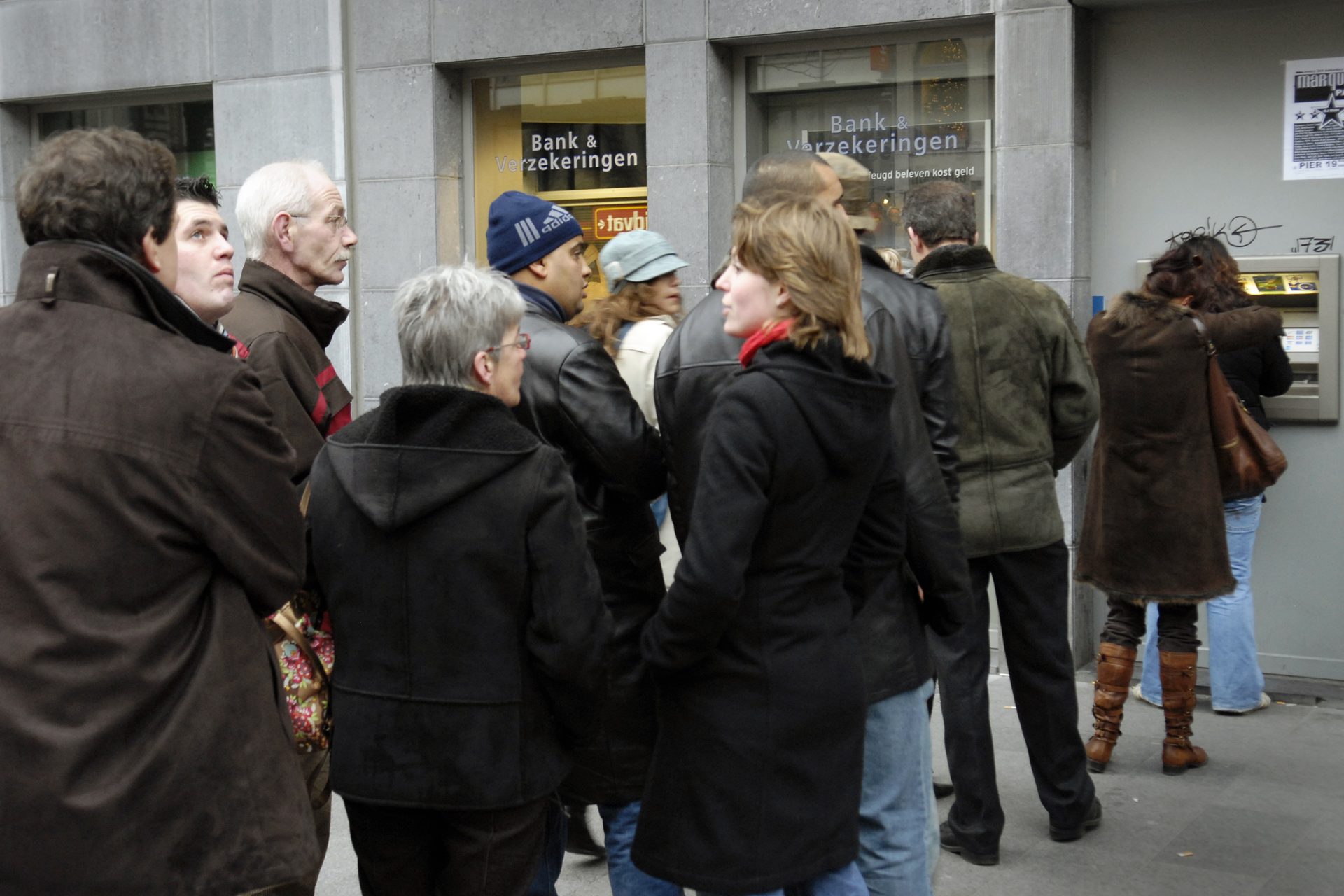
People queuing in front of a cash machine in Antwerp. Credit: Belga / Dirk Waem
De Standaard quotes psychology professor Keith Payne from the University of North Carolina in the US to address this distorted perception. In his book The Broken Ladder, he writes, "as you move up the ladder, your points of comparison also change."
In other words, when an individual becomes wealthier, they likely join social circles of other more affluent people. Surrounded by people of similar higher incomes, the individual's perception of average living is distorted. They are now comparing themselves to their new peers, whereas if they compared themselves to their previous social circle, they would be more aware of their increased wealth.
According to the professor, this scrutiny of one's peers to determine one's economic status also applies to individuals from low-income classes. "Beggars are not jealous of millionaires," Payne also writes, "But they are jealous of other beggars who are more successful."
