
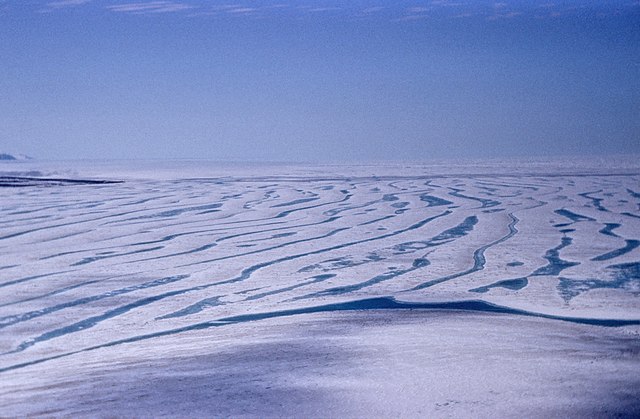
Floating ice platforms in northern Greenland, central to regulating freshwater disbursal into the ocean, have lost over a third of their volume since 1978, a study published on Tuesday warns.
The research, conducted by teams in Denmark, the USA, and France, utilised thousands of satellite images. These images were combined with ground measurements and modelling to reconstruct the evolution of the platforms, which extend over the water from the glaciers.
“Since 1978, the North Greenland ice platforms have lost more than 35% of their total volume, with three out of the eight in the region collapsing entirely,” the authors note in the journal Nature Communications.
The main reason is said to be the platforms’ melting from beneath due to warming ocean waters, says Romain Millan, a researcher at the French National Centre for Scientific Research and the University of Grenoble, and the study’s lead author.
“We have observed a significant increase in melting since the 2000s, clearly correlating with rising ocean temperatures in this region and during this period,” he notes.
These melting platforms do not directly contribute to rising sea levels. However, they do perform a ‘dam’ function by controlling how much frozen freshwater from the ice cap is released into the ocean, which contributes to this phenomenon.
The loss of these natural ‘dams’ has significant implications for the glaciers. Their anchor points on the ground are receding, and they are depositing more ice than before.
“For example, the Zachariæ Isstrøm glacier, which lost its platform in 2003, almost doubled the amount of ice it was discharging into the ocean,” says Millan.
