
Europe's social services sector is experiencing a transformation. In 2022, this sector employed nearly 5% of the entire European Union workforce. This growth is unprecedented with a 15.5% increase in the last decade, double the EU average, making social services one of the fastest-growing sectors in the EU. These statistics reflect more than just numbers, they reveal the profound changes shaping our societies, with social services at their core.
Staff shortages or lack of quality jobs?
Beneath these numbers lies an urgent reality. Europe is grappling with an ageing population and ageing workforce, and by 2050, we'll need over 1.6 million additional care workers just to maintain current standards. Take the Dutch example - a report from the Dutch Scientific Council for Government Policy (WWR) argues that by 2040, 1 in every 4 people will need to work in the health and care sector, rising to 1 in 3 by 2060. Dutch social care employer Actiz underlines that with unchanged policies, the shortage of staff in elderly care will increase from the current shortage of 26,000 to 240,000 in 2050. These figures are similar for many other EU countries.
This demographic shift is compounded by the struggles of health and care workers who, despite being hailed as heroes during the COVID-19 pandemic, face persistent undervaluation, precarious jobs (especially in-home care), low pay, and overwhelming workloads - adding up to create a highly in-demand sector that is struggling to recruit and retain workers. There is a lack of quality jobs and many workers are not covered by a collective agreement.
The European Federation of Public Service Unions (EPSU) have been sounding the alarm on these issues for many years - and several of these concerns are reflected in the European Care Strategy - but there is always more to do.
Care workers take action
Workers in Europe’s health and social services sector have been making their voices heard, and a wave of strikes and industrial actions has swept across Europe in recent years, including a European demonstration of health and care workers. Workers who were once applauded as our heroes and paid a heavy price now find their real wages eroded by rampant inflation. Burnout and exhaustion force many to leave, with those remaining facing insurmountable workloads and the anguish of being unable to provide the quality care they aspire to deliver.
But this movement isn't just about strikes, it's about the capacity of collective bargaining and social of dialogue to deliver. It's about putting together employers and trade unions - the social partners - through the mechanism of EU Sectoral Social Dialogue to contribute to good collective agreements, achieve decent levels of pay, more equality and to stop the haemorrhage of workers from the sector.
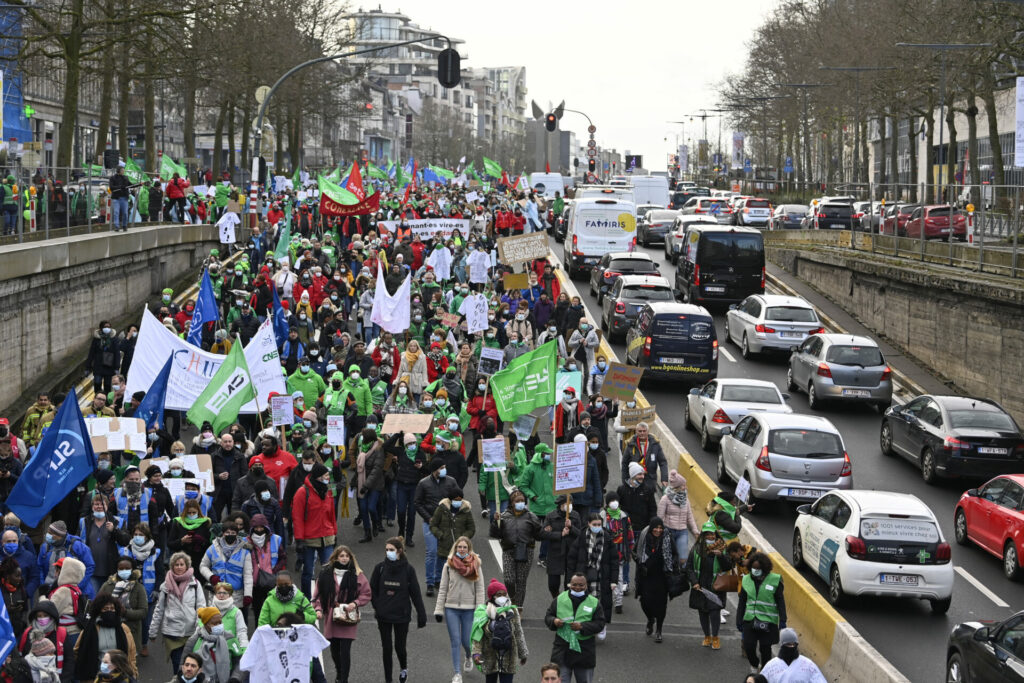
Credit: Belga/Eric Lalmand
EU level industrial relations
EU Sectoral Social Dialogue is a mechanism for European trade unions and employer organisations of specific economic sectors to engage in social dialogue and collective bargaining at European level. This structured dialogue empowers those on the ground to discuss crucial issues, such as employment, working conditions, vocational training and more.
To understand the potential outcomes, it's important to look at past successes. EU Sectoral Social Dialogue Committees have achieved real, tangible change. They have shaped working time regulations for seafarers, protected health workers from injuries, and improved working conditions for many. Crucially, their agreements can become law for everyone in the sector if employers and trade unions agree and they campaign sufficiently for it, making a tangible difference in the lives of workers.
When you consider the potential of these committees, the establishment of the EU Sectoral Social Dialogue Committee for Social Services becomes an extraordinary landmark. It's not merely another committee, it's the first EU Sectoral Social Dialogue Committee created in over a decade. It’s not just a turning point for the social services sector - it’s a turning point for European sectoral social dialogue. EPSU, the European Public Services Union, has been the leading engine of this achievement with over ten years of work to make it happen together with our employer counterpart, the European Social Service Employers.
The work programme
The new EU Sectoral Social Dialogue Committee for Social Services presents a unique opportunity. Social partners are in agreement - the sector is facing a crisis, and the new social dialogue committee will focus on advancing training and skills, improving working conditions and making care jobs more attractive. It will monitor the implementation of the EU’s Long-term Care Strategy and the Recommendations adopted by the Council. For EPSU, the representative European federation for social services workers, our vision is clear - we seek a future where social service workers enjoy collective agreements, improved working conditions, better career prospects, and the recognition they rightfully deserve.
Our objectives include:
1. Adequate public funding and investment to enable workers to provide high-quality care.
2. Advocating for enhanced protection against occupational health and safety risks, including psychosocial risks.
3. Calling for any profits made on health and care to be reinvested for the benefit of workers and service recipients.
4. Supporting stronger collective bargaining and sectoral agreements that guarantee adequate, needs-based staffing, fair wages, good working conditions, and trade union rights.
From Ireland to Italy and across Europe, social service workers are demanding change. Their concerns resonate across Europe as inflation soars, salaries stagnate, and policymakers ignore the issues which brought the sector to its knees three short years ago. The new EU Sectoral Social Dialogue Committee is a welcome new tool in the belt of workers pushing to improve not just their working conditions, but the sector itself. After all - without a strong social services sector, who will care for Europe when Europe needs it most?
By Jan Willem Goudriaan, General Secretary, European Federation of Public Service Unions (EPSU)
