
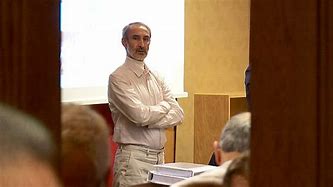
A Swedish appeal court on Tuesday upheld the life sentence given to former Iranian prison official Hamid Noury for his role in mass executions ordered by Tehran in 1988.
The Svea Court of Appeal confirmed the initial judgement, sentencing Noury to life for “serious breaches of international humanitarian law and murder,” according to a statement.
Robert Green, a judge on the appeal court, was cited in the statement as saying that the case was “robust and broadly convincing.” He said the district court was right to consider the prosecutors’ accusations to be largely founded.
Noury, now 62, was arrested in 2019 at Stockholm’s airport. Iranian opposition groups claimed they had lured him there, enabling his arrest under the universal jurisdiction for the most serious crimes in Swedish law.
In July 2022, he was convicted of “aggravated crimes against international law” and “murder.”
In 1988, Noury had worked as an assistant prosecutor in a prison near Tehran, but claimed to have been on leave at the time of the events. A lower court found him guilty of involvement, in collusion with others, in the executions, ordered by a fatwa issued by the Supreme Leader of Iran, Ayatollah Khomeini.
Although the accused had a subordinate role, it was the first time an Iranian official had been tried and convicted for the bloody purge, which mainly targeted members of the armed opposition People’s Mujahedin (MEK) movement, reviled by Tehran.
The case is also particularly sensitive, as Iran’s current president, Ebrahim Raissi, is accused by human rights organisations of participating in the “death committees” that carried out the executions.
NGOs estimate that at least 5,000 prisoners were executed in the summer of 1988, as a result of mass executions carried out by these “committees.” The MEK put the figure at 30,000.
Noury's trial, which began in August 2021, has strained relations between Sweden and Iran and raised fears of reprisals against Western prisoners held by the Islamic regime.
In April 2022, Tehran arrested Johan Floderus, a 33-year-old EU diplomat who was completing a trip to Iran with friends. On 9 December, he was put on trial for “corruption on land,” one of the most serious charges in Iran, and could face the death penalty.
Iranian-Swedish academic Ahmadreza Djalali, arrested in Iran in 2016 and sentenced to death on similar charges, remains under threat of execution.
