
Whilst the overall population of the Brussels-Capital Region is growing slightly, disparities between communes are growing, with some increasingly populous whilst others record significant reductions in residents.
Latest figures from the National Register database show that the region's population measured just over 1.244 million people in January 2024 – a slight increase from the 1.235 million last year. Yet population changes in some communes have been remarkable, especially over a larger timeframe.
The region's overall population has risen by 85,000 since 2014, though some areas have seen far more significant influxes than others.
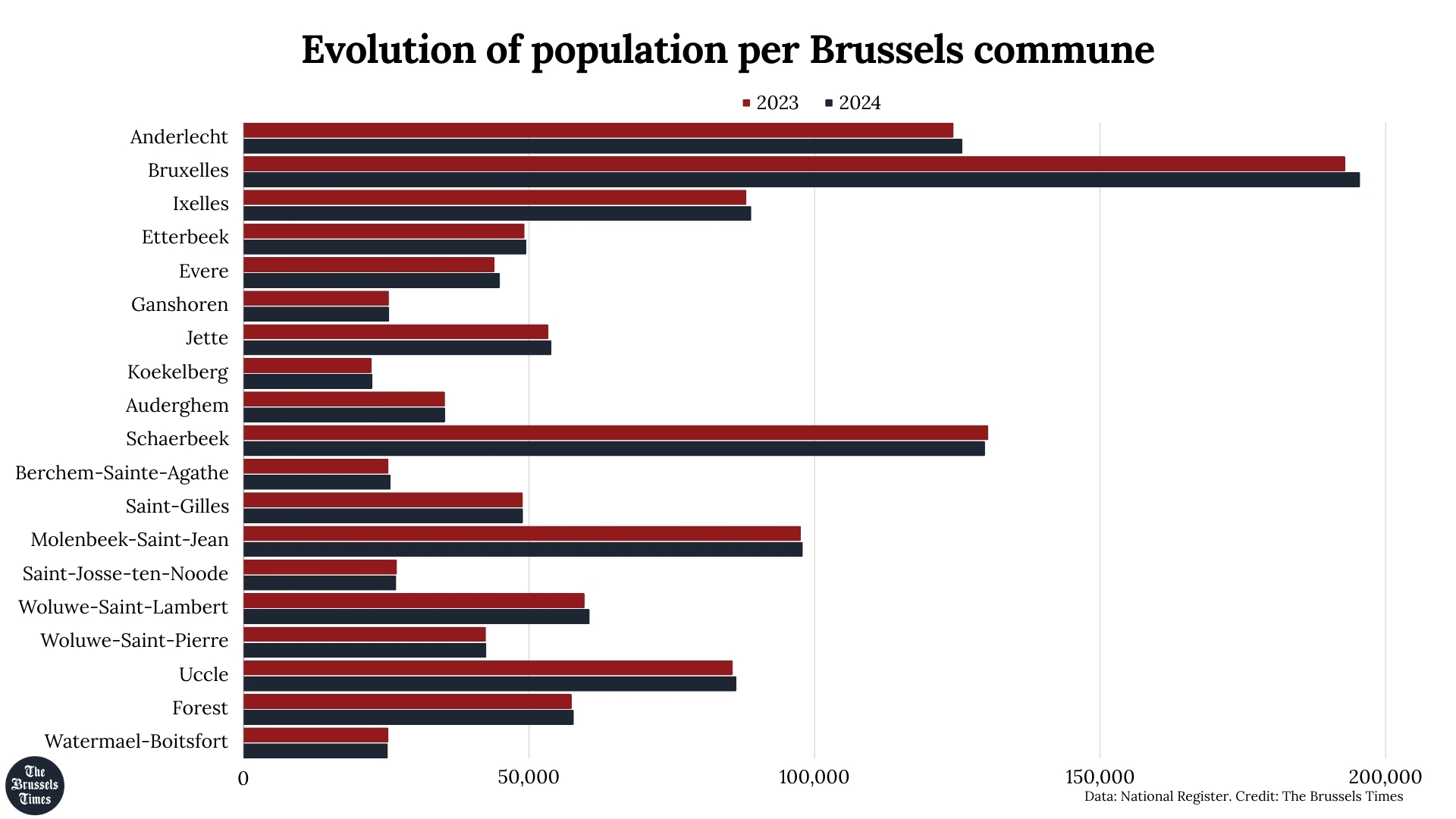
The most pronounced increase in the number of people per commune was seen in the City of Brussels, which saw a 16% increase from 114,478 in 2014 to 125,883 people this year). It was the most populated commune in 2014 and remains so in 2024. Second place was Evere, where the population grew by almost one-fifth from 37,830 to 44,918 in ten years.
In the same period, Woluwe-Saint-Lambert grew from 53,139 in 2014 to 60,622 – an almost 15% rise. This was followed by Anderlecht, which saw a rise of almost 10% increase from 114,478 to 125,883.
During the same period however, no change was recorded in the total number of people living in Schaerbeek (129,525 in 2014 and 129,853 this year). Moreover, Saint-Gilles and Saint-Josse-ten-Noode actually contracted – both by -2%. In Saint-Gilles, the number of residents dropped from 49,927 to 48,950, while in Saint-Josse-ten-Noode this figure went from 27,275 to 26,749.
Understanding changes
Demographer Patrick Deboosere (VUB) told Bruzz that these big differences can be explained by the housing stock, with new construction or higher vacancies of buildings carrying the most weight. He pointed to Evere, where many offices have been converted into housing.
The municipalities that are shrinking are also those that were historically most densely populated (both in Brussels and on a national level), meaning there was little room for further growth.
While fewer people are living in Saint-Gilles and Saint-Josse, the number of households has not necessarily dropped in the same way, meaning families here are becoming smaller. In Saint-Gilles, single-person households account for about 60% of all housing.
Saint-Josse's mayor Emir Kir (independent) told Bruzz that the rise of Airbnb also plays a role in the declining population, impacting the number of flats available to locals. In Saint-Gilles, a recent study highlighted that this has resulted in a significant increase in average rents.
