
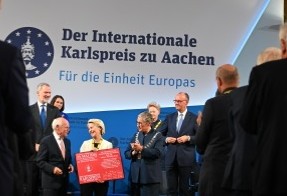
European Commission President Ursula von der Leyen called for a truly independent Europe while in Aachen, Germany, where she on Thursday received the Charlemagne Prize which recognises outstanding contributions to European unity and integration.
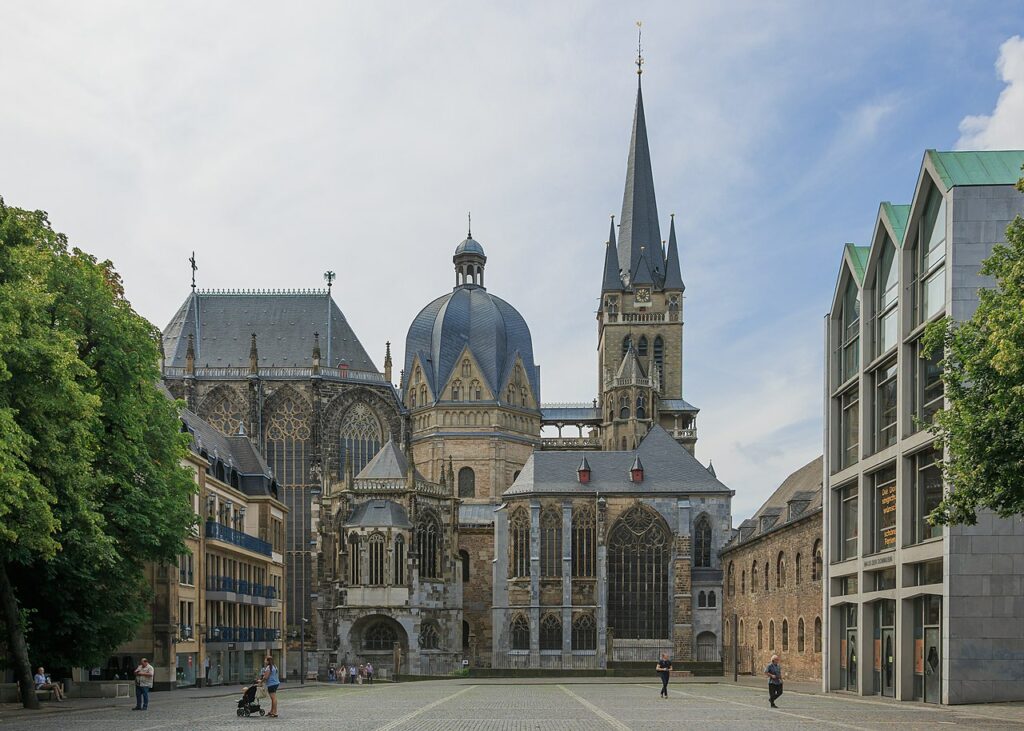
In a passionate speech, she said that the prize and the city of Aachen stand out as symbols of a united Europe, referring to three monuments in the centre of Aachen that “speak powerfully about history and the importance of Europe”.
The first is the Aachen Cathedral, Germany’s first UNESCO World Heritage Site. The cathedral is the best-preserved building from the Carolingian period. Since the 10th century it served as the coronation church of the Roman-German kings. The Palatine Chapel, which forms part of the cathedral, is the final resting place of Charlemagne (748 – 814), the ruler of the Carolingian empire.
The Commission president paid tribute to Charlemagne who united most of Western and Central Europe, although not by peaceful enlargements but military campaigns.
Learning from the past
“His idea of Europe was about creating a space where science and culture, education and justice would flourish. Where people pursue knowledge and common values. He believed that Europe's future should be built on the foundations of its past . . . In the same way that our future will always be built on our past. Culture and knowledge. History and values, this is what Europe means to me.”
The second place in Aachen which is crucial to understanding Europe is one that no longer stands – the synagogue. Contrary to for example Erfurt, who’s still standing synagogue building dates to the 11th century, the ‘old’ synagogue in Achen was built in 1862 and destroyed by the Nazis during the Kristallnacht in November 1938.
“Exactly 100 years ago – in May 1925 – the Old Synagogue of Aachen saw a young lady start her married life. A young woman full of hope for the future. Edith Holländer.” She had to flee with her family to Amsterdam. Her youngest daughter was Anne Frank, famous for her diary, which became “a testimony to the life of an adolescent girl, caught between hope and fear.”
“Backed into a corner, hidden from the Nazis, threatened with imprisonment and death, Anne Frank wrote”: ‘And yet when I look up at the sky, I somehow feel that everything will change for the better, that this cruelty will end, and peace and tranquillity will return once more. In the meantime, I must hold on to my ideals. Perhaps the day will come when I will be able to realise them.'
Today Aachen has a new synagogue. “A symbol of rebirth but also of remembrance. A sharp reminder for Europe to be vigilant and uncompromising towards all those who seek to sow hatred and division in our society. It is a road that Europe knows only too well. We know it to be one that inevitably leads to ruin. Never, ever may we go down that path again. For me, those words of Anne Frank are a lesson in humanity.”
The third place she talked about was the town hall where the award ceremony took place. Here, 75 years ago, the European ‘pioneer’ Richard Coudenhove-Kalergi was the first to be awarded the Charlemagne Prize for funding the pan-European movement. He condemned antisemitism and his books were burnt in Nazi-Germany. His ideas have inspired the European project although some may be outdated now.
But his vision of Europe outlives him: “A Europe bringing people together through shared culture and values, through freedom and human dignity. A Europe inspired by big ideas and big ambitions. And by and large the history of the last 75 years has proven him right. The generation of the founding fathers and mothers of our Union sought to create peace and security in a continent ravaged by war.”
For Ursula von der Leyen, these three places or symbols tell us something about what it means to be a European. And what that means for our future. “They show us that our history – brutal and beautiful in equal measure – binds us together as Europeans and as generations. We share not only common dreams but also common nightmares. And that binds us together.”
Credit: European Commission
Building an independent Europe
After the establishment of the EU, next step is to rally around a new unifying European project – building an independent Europe, she said. “At its core it is about freedom. As the peoples of central and eastern Europe have long known, personal liberty is possible only when there is collective independence. We must face the reality of the moment.”
Things will not go back to how there were before. “If only the war (Russia’s war of aggression against Ukraine) would end, or a tariff deal (with the Trump administration) be struck, or the next elections have a different outcome. No, they will not. Because the geopolitical cross-currents are strong. What we once relied on as an international order has rapidly descended into an international disorder.”
The first to do, when building an independent Europe, is to develop a new form of Pax Europaea for the 21st century – one that is shaped and managed by Europe itself. “We all know the vital role that NATO and our transatlantic partners have played in protecting our security and freedom on our continent. And this will continue in future.”
But thanks to NATO people thought that times of relative peace were here to stay. “Adversaries of our open democratic societies have rearmed and remobilised. There is no greater example of that than Putin's brutal and ruthless war against Ukraine. Russia and others will continue to scale up their war economy. The need to invest in our security is therefore becoming ever more urgent.”
The second priority is to put innovation and competitiveness at the heart of Europe's renewal. Europe has all it takes to lead the global economy of tomorrow, she stressed. “We want the business world to Choose Europe. We are witnessing countries from around the world come to us to do business together – because we are reliable and follow common rules.”
“The third imperative for an independent Europe is working on the next historical reunification of our continent,” von der Leyen said, referring to the enlargement process and the candidate countries, from Ukraine, Turkey, Western Balkans, and Eastern Partnership countries, who want to join the EU. Some of them are making progress, some are struggling and others are backsliding in their reforms.
“This is not just a moral necessity for Europe. It is a prerequisite for a stronger Europe – at home and geopolitically in the world. A larger, reunified European Union will strengthen our voice in the world. It will help reduce our dependencies. It will ensure that democracy, prosperity and stability are strengthened across Europe.”
Strengthening democracy
The fourth imperative is to renew and strengthen our democracy. “We all know that our democracies have come under attack, she said, referring to the rise of extremist parties or illiberal tendencies across Europe. “For many people in Europe, life without democracy is still a lived experience. Our modern democracies are still young. Democracy is not carved in stone. It must be reinvigorated every day.”
How can this be done? “We do not defend our democracy by defending the status quo. We must be the drivers of change. It is only by showing that democracy works for people and that it delivers.” Democratic governments that respect the rule of law and human rights work better and deliver more than authoritarian and illiberal regimes. Furthermore, democracies do not wage war against each other.
On a personal note, she recalled her childhood years in the European School in Brussels, where she studied with children of different nationalities. “I understood that we were all in the same place – all connected to one another. A few decades may have passed, but I still see Europe through those same eyes. And I believe that this connection between us – as diverse and different as we are – that is what Europe is.”
As Europeans we have more than one identity, she concluded, questioning conservative think tanks and populist politicians who stress the national identity and continue to admire their national heroes despite all their faults.
“We are all proud children of our countries. But our roots do not stop at national borders. Our souls have been shaped by the tales and experiences of our fellow Europeans. We are not only Italian, French or German. Not only Swedish or Spanish. Not only Portuguese or Polish. We are European,” united in diversity and common values.
