
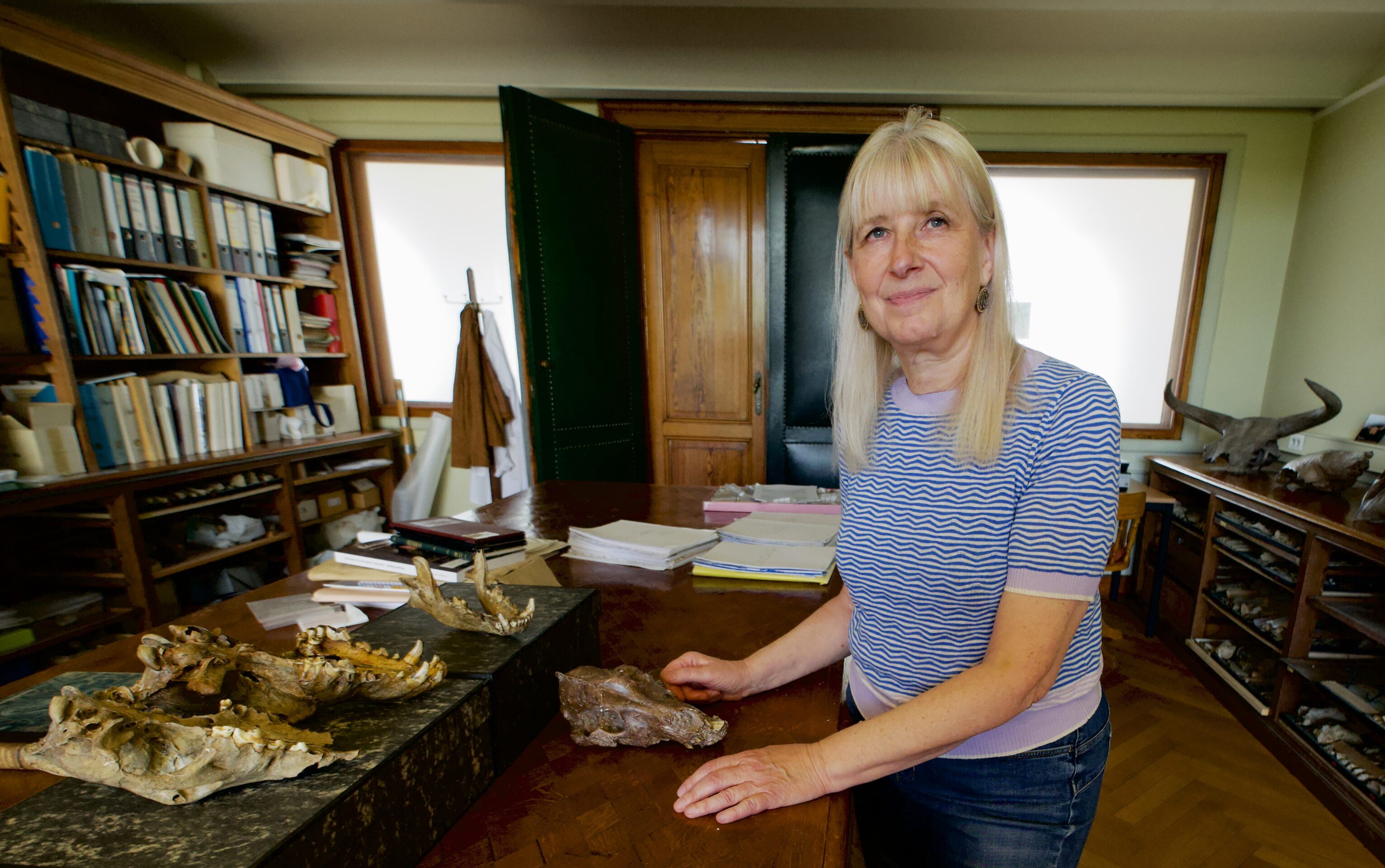
A wolfish skull in a Belgian cave may be the earliest evidence of humanity’s bond with dogs.
In a quiet basement beneath the Dinosaur Gallery in the Museum of Natural Sciences is a fossil that could rewrite the story of humankind’s oldest companion.
For more than a century, the battered skull sat unnoticed, mislabelled as just another Ice Age wolf. But when palaeontologist Mietje Germonpré re-examined it in the early 2000s, she realised she was staring at something extraordinary: not quite wolf, not quite dog, but possibly the very first sign of domestication anywhere on Earth.
The skull was originally unearthed in the 1860s by geologist Edouard Dupont in a cave near the village of Goyet, not far from Namur. Dupont’s digs produced a jumble of Neanderthal bones, mammoth remains – and this peculiar canine skull. For decades, it languished in storage until Germonpré took a second look.
“It was relatively small compared to typical wolves, and the snout was shorter and wider,” she recalls. The proportions reminded her less of a wild predator and more of the prehistoric dogs known from sites thousands of years younger. Curious, she ran radiocarbon tests. The result: 35,000 years old. “That was a huge surprise,” she says.
That date set the scientific world buzzing. If correct, the Goyet specimen represents the oldest evidence of humans taming wolves – far earlier than the accepted timeframe of 15,000 to 17,000 years ago. Published in the Journal of Archaeological Science in 2009, Germonpré’s claim challenged orthodoxies and sparked fierce debate.
Messy prehistory
Sceptics argue it is simply an unusually shaped wolf skull, an anomaly or evolutionary dead-end with no link to the dogs that later padded into our homes. Germonpré disagrees. “It is truly outside the normal wolf variation. Of course, it’s not a modern dog – it’s something in between,” she says.
This “something in between” hints at a fascinatingly messy prehistory. Far from being a single Eureka moment, dog domestication now looks like a series of experiments. Across the Ice Age, humans may have repeatedly scooped up wolf pups – sometimes to raise for their pelts, sometimes simply out of curiosity.
Most of these early proto-dogs, including the Goyet specimen, probably went extinct before leaving descendants. But somewhere, in one of these human-wolf entanglements, the seeds of companionship took root.
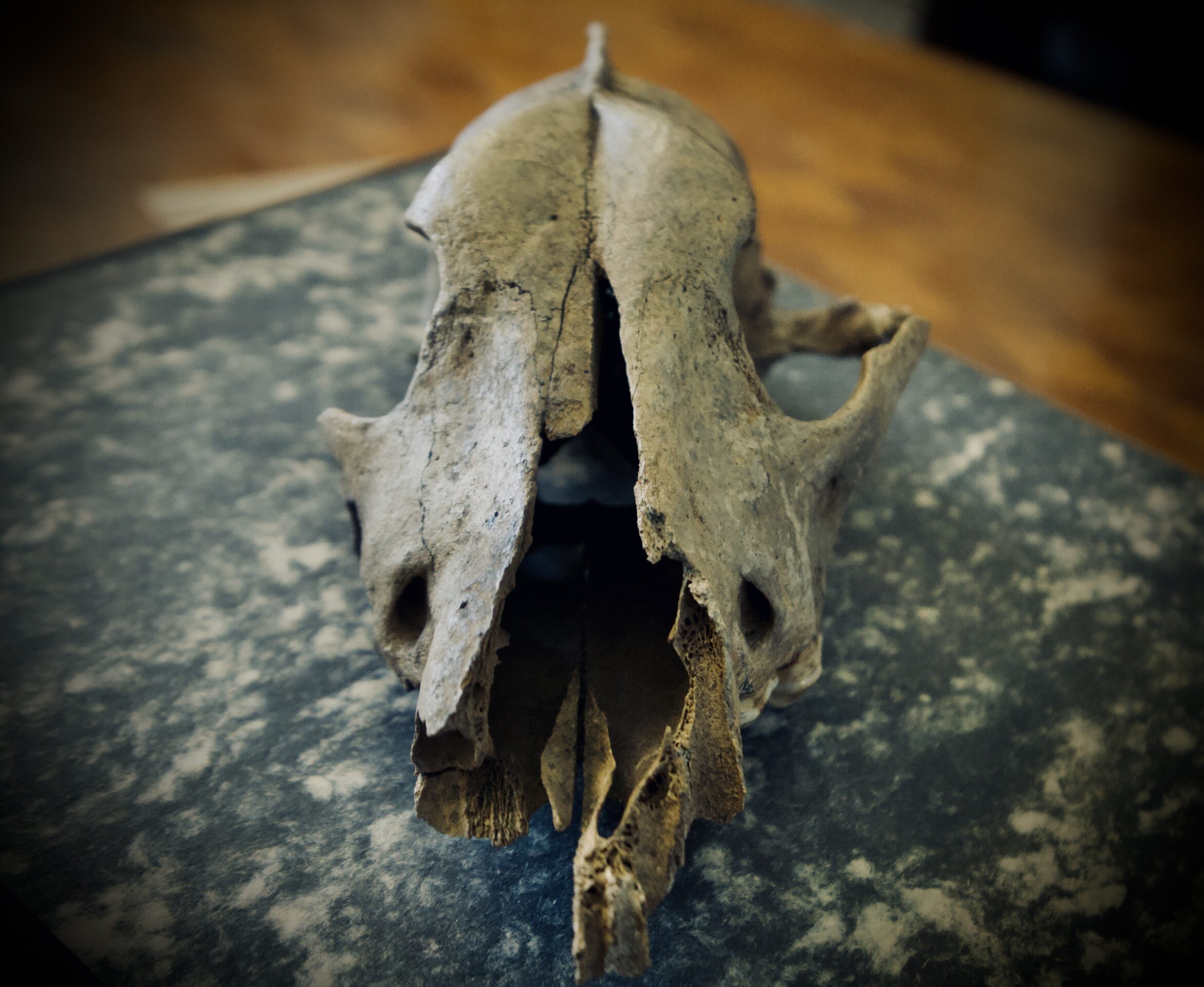
The Goyet dog’s skull
“We think people took wolf pups into captivity for various reasons – possibly for their fur, which is highly insulating,” Germonpré says. “They may have raised them until winter, then harvested the fur. Sometimes, perhaps, a less aggressive pup wasn’t killed. And over generations, these wolves may have bred and gradually become more dog-like.”
Today, scientists use genetics, isotopes, and behavioural studies to tease apart the tangled story. What is increasingly clear is that dogs were not an agricultural afterthought, bred like cows or sheep once farming began. They were with us much earlier – shaping, and shaped by, our Ice Age ancestors.
The Belgian skull may never yield absolute certainty. Perhaps it is the oldest dog; perhaps just an odd wolf. Either way, its discovery underscores something profound: long before villages, long before writing, long before beer or bread, people and wolves were already circling one another – sniffing at the possibility of friendship.
And if Germonpré is right, that circle began 35,000 years ago in a cave in Goyet – making Belgium the cradle of the oldest bond of all.
Latest edition of The Brussels Times Magazine is out now!
