
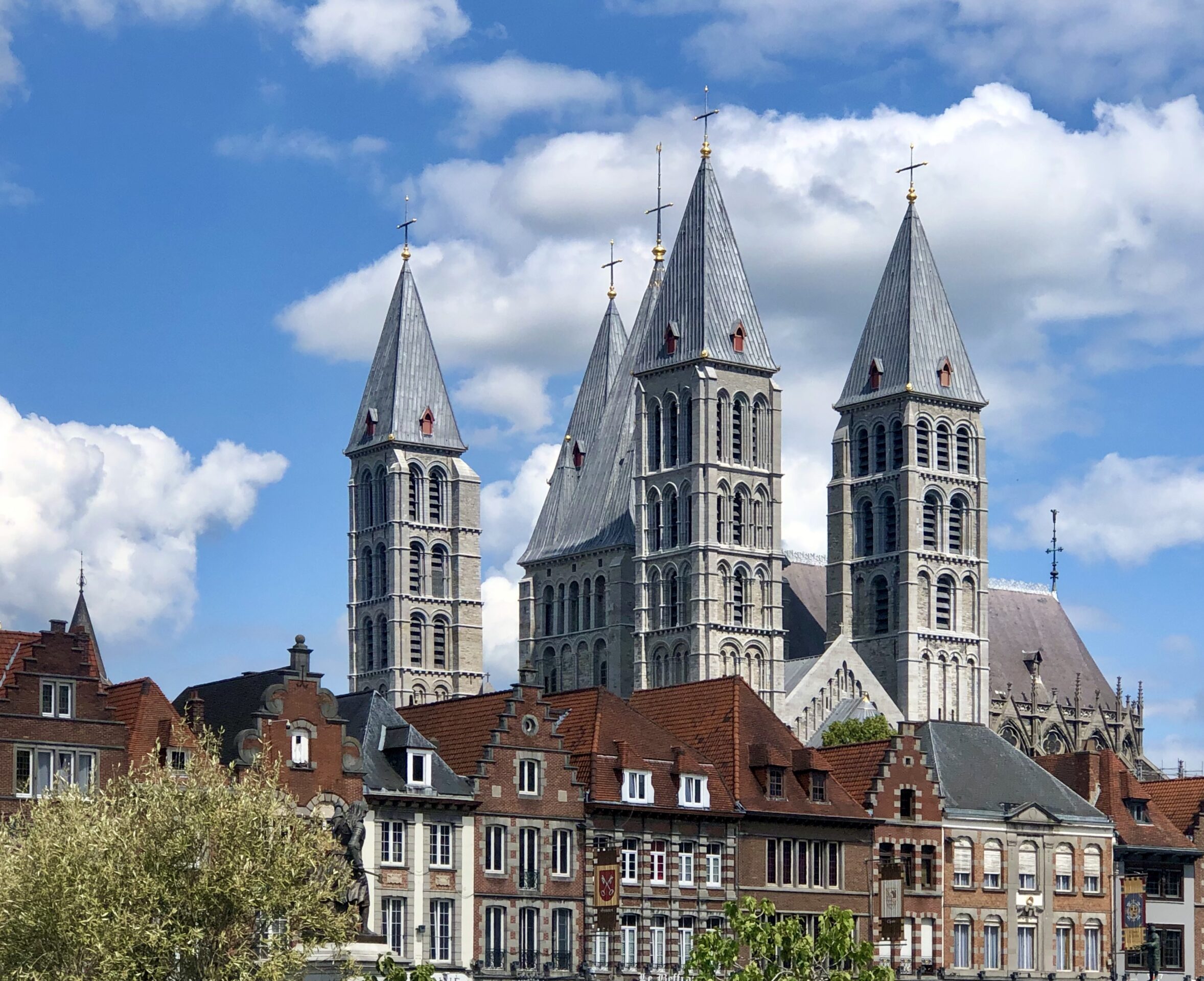
Tournai whispers its ancient secrets through stone towers, cobbled lanes and a skyline bristling with spires. Just an hour by train from Brussels — and five minutes from France — it rewards the curious with a mix of grandeur and intimacy: cathedrals that scrape the clouds, market squares full of chatter and riverside strolls that feel timeless.
Few places in Belgium can rival its pedigree. Tournai’s story begins more than two millennia ago, when Roman settlers laid down roots in what was then called Tournacum. In the fifth century, it became the first capital of the Frankish kingdom, cradle of a dynasty that would one day give birth to France. Since then, its strategic perch has ensured that kings, emperors and generals all left their mark.
The result is a city shaped by a cast of unlikely landlords: English monarchs, Spanish Habsburgs, Austrian archdukes, Dutch royals — not forgetting several French kings. Each left behind an imprint, whether in stout fortifications, elegant townhouses or the shifting symbols on the city’s coat of arms.
Yet for all its layers of history, Tournai is no dusty relic. Restored façades glow in the afternoon light, festivals spill across the cobbles, and the convivial rhythm of café terraces reminds visitors that this is a city that has survived, adapted and carried on living with gusto.
For those driving there, parking is free in the city centre every Saturday from 12:30pm to Monday at 9am. Otherwise, three car parks (Esplanade de l’Europe, Hall des Sports and Maison de la Culture) offer free spaces just a five-minute walk from the centre.
History in brief
Beginning as the Roman town of Tournacum, Tournai was taken over by the Franks for nearly three centuries, with Clovis I entrusting its government to a bishop, making the city an episcopal seat. It then changed hands with dizzying frequency. From the 12th to 16th centuries, it was French, its belfry a gift from Philippe Auguste. The fleur-de-lys still lingers on its coat of arms, proof of how French this Belgian city once was.
England tried twice to take it: Edward III failed, but Henry VIII succeeded in 1513 – a teenager then, he installed his own bishop and even gave Tournai a seat in the House of Lords — before selling it back to France.
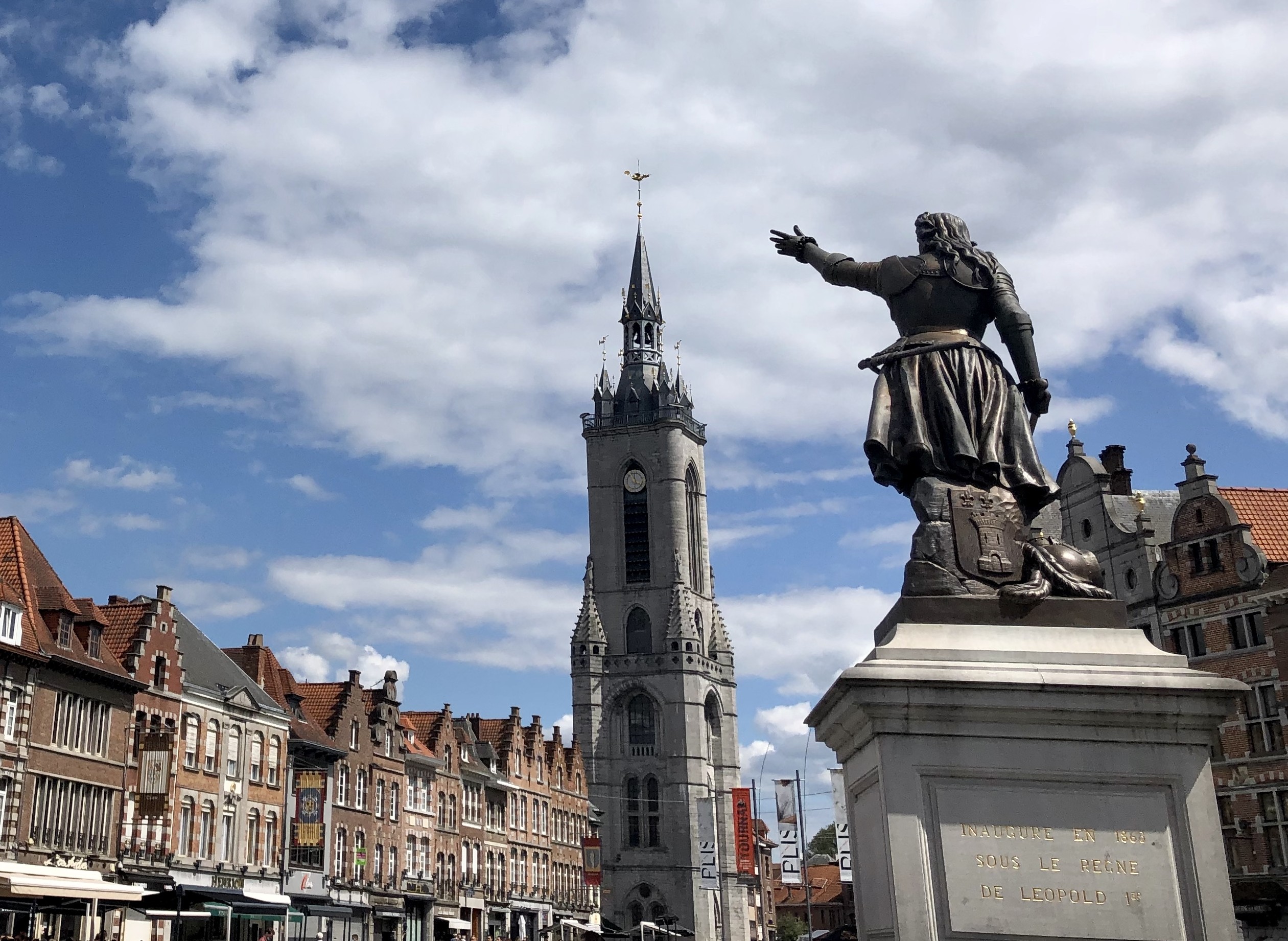
Belfry of Tournai and Christine Lalaing sculpture. Credit: Angela Dansby / The Brussels Times
The Habsburgs arrived in 1521: Charles V took the city, and his son Philip II folded it into the Spanish Netherlands. For nearly 150 years, it was Spanish, until Louis XIV claimed it once more. The Treaty of Utrecht soon swapped it to Austria.
The French Revolution brought the Robespierre sisters to hide in Tournai; Louis XVI retaliated in 1794 by annexing it again to France. After Napoleon fell, the Dutch moved in until Belgian independence in 1830. Architect Bruno Renard tried to restore pride in the 19th century, but two world wars — and especially German firebombs in 1940 — destroyed most of his work. Sixty percent of Tournai lay in ashes.
Yet the city rebuilt. Landmarks rose again, façades were stitched back together, and the skyline of spires re-emerged.
UNESCO World Heritage Sites
Notre-Dame de Tournai is the city’s showpiece cathedral with five bell towers reaching up to 83 metres high like giant stalagmites. The Romanesque nave and transept were built in the 12th century, while the Gothic choir came about in the 13th century. The octagonal baptistery has striking, green-patinated copper cladding and opalescent, stained-glass windows. Near the entrance, like official greeters, are medieval polychrome and modern bronze statues of the Virgin Mary and Saint Eleutherius, the first bishop of Tournai, respectively.
Inside is the Châsse de Notre-Dame, a magnificent reliquary shrine from 1205 made of gold and silver, adorned with gems; a large rose window; and an impressive treasury. The latter includes 13th-century Mosan silver works, a 14th-century tapestry, precious ivory and a coat worn by Charles V.
The cathedral has been UNESCO recognised since 2000, shortly after a tornado did extensive damage – ongoing restorations have left only half the cathedral accessible. Visit Tournai offers a guided tour the first Sunday of each month May to September at 3pm.
La Grande Procession, a religious walk the second Sunday of each September, honours the Virgin Mary, carrying her shrine from the cathedral around Tournai. This tradition started in 1092 to protect the local population from a plague and ward off evil. The procession, with giant puppets and people in period clothes, is part of a larger celebration called La Kermesse, which includes Quatre Cortèges (four parades), a large street market, traditional dances, concerts and more around the city.
The Belfry of Tournai is the oldest in Belgium dating to 1188. It dominates the city’s Grand Place at a height of 72 metres and was previously a watchtower, prison and town hall. Today, its 256 steps lead to a breathtaking panorama of the city, and while the top level with the Bancloque, the belfry's biggest bell, is temporarily closed for renovation, climbers can still access the first level 1-5pm every day except Monday.
Every Sunday from Easter until October at 3:30pm, the belfry’s carillon of 55 bells rings throughout Tournai. The garden of the Musée de Folklore et des Imaginaires (Museum of Folklore and Imagination) overlooking the belfry is a nice place to hear the music.
Other sights
The Grand Place has many striking buildings in the Dutch style with flags honouring professional trades. A focal point is the Halle aux Draps (Cloth Hall), built in the 13th century as a trading centre during Tournai’s then-booming textiles industry, and now an exhibition and event space.
Similarly, the stately Évêché de Tournai, next to the cathedral, originally built in the 12th century as the bishop's palace, is the headquarters of the Diocese of Tournai. A covered walkway known as the Fausses Portes (False Gate) was used by the bishop to cross between his palace and the cathedral without getting wet during rain. The city’s coat of arms is brightly painted above a door on the palace’s side on Rue des Orfèvres.
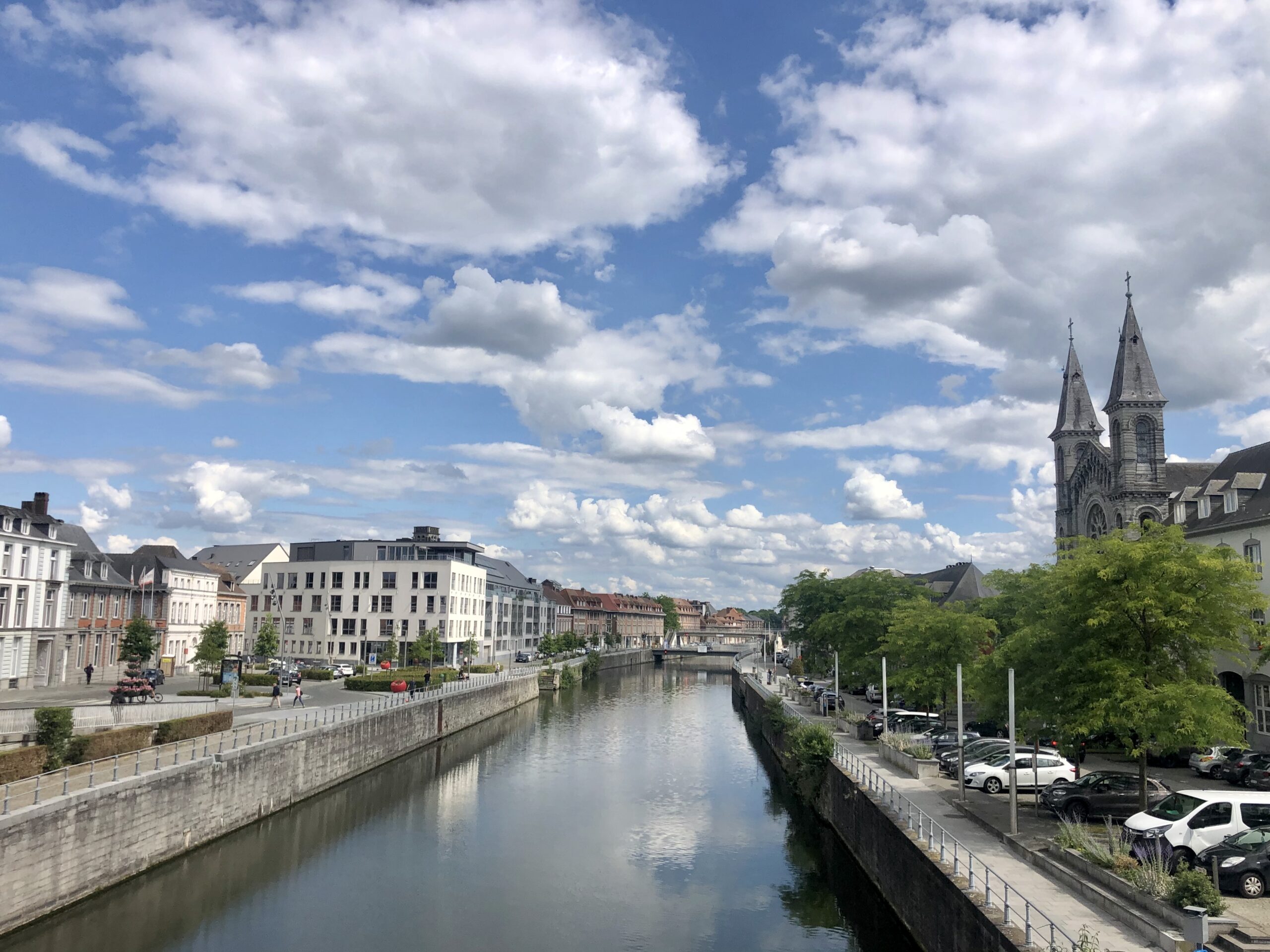
Scheldt River. Credit: Angela Dansby / The Brussels Times
Tournai retains many remnants of its once extensive medieval fortifications, including the Tour Saint-Georges, Tour du Fort Rouge (Red Fort), and Tour Henri VIII (also called the English or Big Tower, the last trace of a citadel built in 1515 by Henry VIII).
The thick Pont des Trous (Bridge of Holes) military bridge from the 13th century is named after a nearby lock for boats, not its three arches. One of Belgium’s most prestigious vestiges of medieval military architecture, its construction took 75 years. It has been rebuilt thrice, most recently in 2023. Tours are available in French every Sunday from May to August at 10:30 am via Visit Tournai.
The elegant Hôtel de Ville (City Hall) stands on the former site of the 11th-century Benedictine Abbey of Saint-Martin. The last trace of the abbey is a cellar that houses an exquisite 18th-century Tournai porcelain collection (Britain’s King Charles III has about 600 pieces of Tournai porcelain in Windsor Castle).
The Musée des Beaux-Arts (Museum of Fine Arts) near City Hall, designed by Victor Horta (his only building in Wallonia), houses a vast art collection bequeathed to the city by Henri Van Cutsem. It boasts the only two Édouard Manet paintings in Belgium, as well as works by Claude Monet, Vincent Van Gogh, Georges Seurat, Henri de Toulouse-Lautrec, James Ensor, Rik Wouters, Felician Rops and Rogier Van der Weyden. The latter – along with his art mentor Robert Campin and fellow student Jacques Daret – was born in Tournai.
The city has striking Art Nouveau architecture in private buildings, including several around the train station, on Boulevard Roi Albert and near the Palais de Justice. Visit Tournai offers an Art Nouveau vs Art Deco guided tour the first Sunday of each month May to September at 3pm, starting at the Museum of Fine Arts.
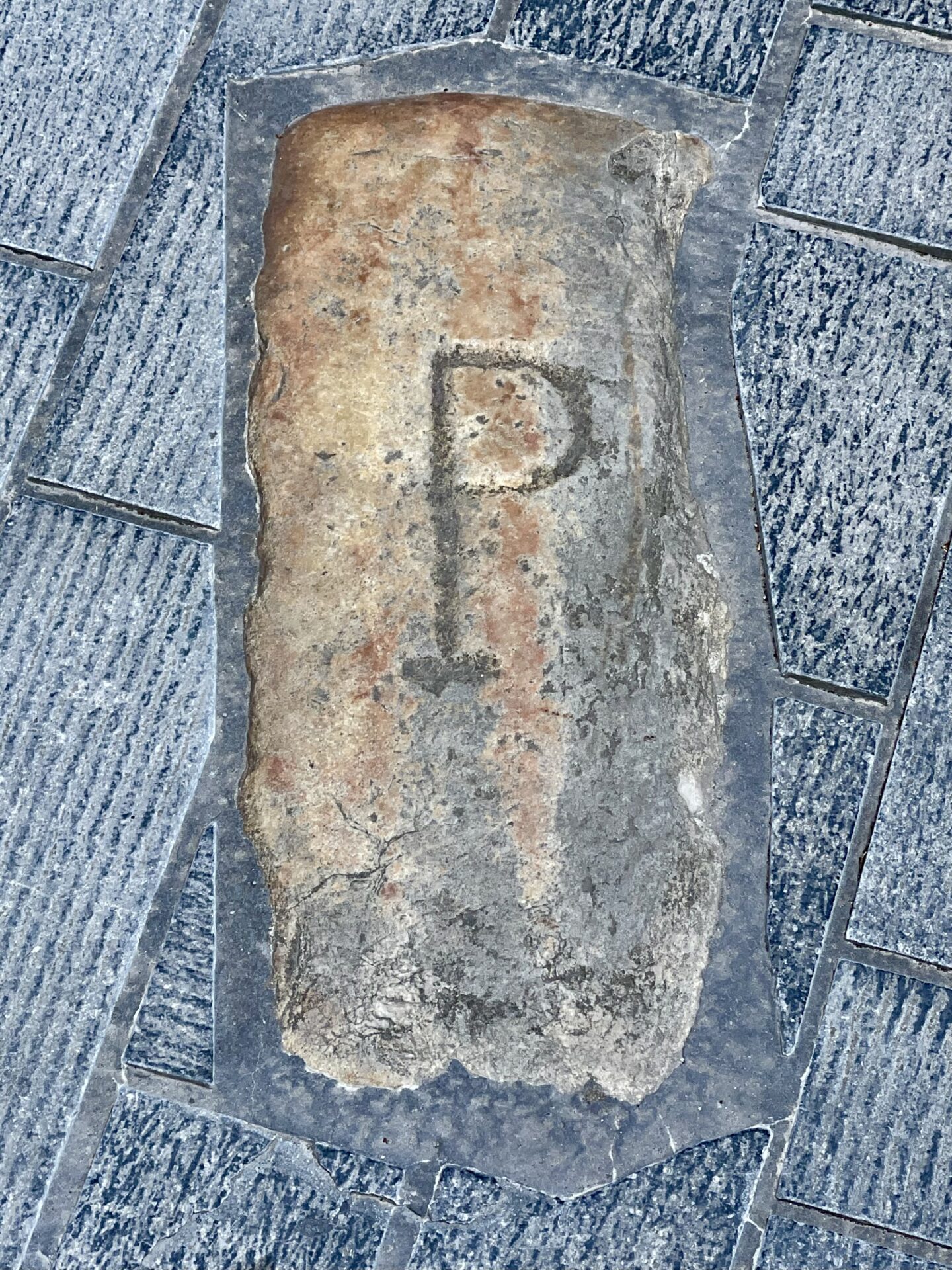
Pax Romana stone. Credit: Angela Dansby / The Brussels Times
The Église Saint-Jacques from the 12th-13th centuries, a historic stop on the pilgrimage route to Santiago de Compostela, has a colourful vaulted ceiling with angel musicians, a rare brass eagle lectern and stunning altarpiece paintings.
The red-roofed Église Saint-Quentin on the Grand Place houses two exceptional coloured sculptures of the Angel Gabriel and Virgin Mary from 1428, painted by Flemish Primitive master Robert Campin of Tournai.
Some of Tournai’s historical buildings have been repurposed. Saint-Jean Barracks, built by Louis XIV’s military architect Vauban, now provide social housing and community spaces. The Académie Beaux-Arts (Fine Arts School) is in a former hospital and the Conservatoire de la Ville (Music Conservatory) in a 19th century rotunda that used to be a concert hall. Nearby is a reconstructed part of a 12th century wall that was a tiny prison.
There are also little pieces of history strewn about Tournai like a treasure hunt. A stone engraved with the letter P on Place du Vieux Quartier, thought to date to the third century, stands for Pax Romana. A false door on a house intersecting with Rue As-Pois has a Latin inscription for "no urinating." Former fish market houses along the river still have wooden fish carved into the frames of single rooftop windows. Gold lines on some streets in the city centre note the historic district (they are supposed to be pedestrian only, but beware, cars drive on them anyway).
The Visit Tournai office, itself architecturally interesting, shows films about the town’s 2000 years of history (“The Passage of Time”) and cathedral (“Heaven Carved from Stone”). It also has a medieval cellar where cannons were once stored.
Arts and crafts
From the 15th to the 18th centuries, Tournai’s tapestries won global renown and many are displayed in museums around the world. The local Musée de la Tapisserie (TAMAT) in a neoclassical mansion has prestigious collections from the 15th and 16th centuries as well as modern and contemporary times. Pasquier Grenier was the most celebrated Tournaisien tapestry maker of 15th century and Piat Lefèvre of the 19th century.
In the 17th century, tapestries were created to look like paintings, a style that revived in the 1940s with local talents like Edmond Dubrunfaut, Roger Somville and Louis Deltour. These men were members of the Force Murales group, a collective that inspired a renaissance in tapestry. The museum also showcases tapestries by contemporary artists and a restoration workshop.
Tournai’s Centre de Recherches, d’Essais et de Contrôles scientifiques et techniques pour l’Industrie Textile (CRECIT), a working tapestry atelier and cultural institution, offers guided tours, workshops and special events.
Georges Grard, a Tournaisien figurative sculptor, made the bronze La Naïade, a large naked woman, displayed on the south side of the Pont-à-Ponts. More Grard sculptures are in the red roof-tiled Église Saint-Brice.
Behind the church is a sculpture of Gabrielle Petit, a Belgian spy and First World War resistance heroine, with her final words before execution at age 23: “I will show them that a Belgian woman knows how to die!” Nearby is a plaque marking the original location of the tomb of Frankish King Childeric – it was accidentally uncovered in 1653 by a mason carrying out repairs.
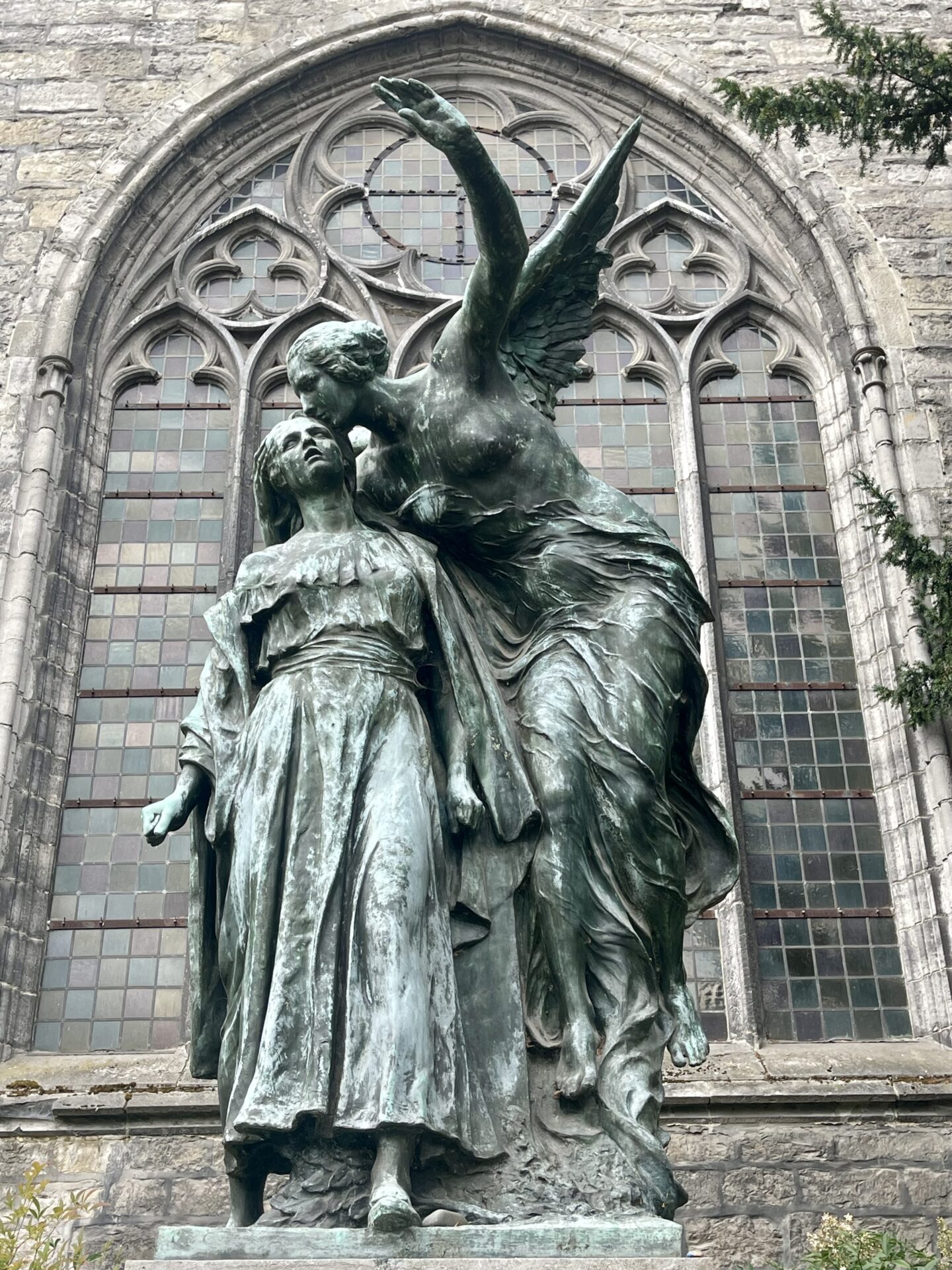
Gabrielle Petit sculpture at Saint-Brice Church in Tournai. Credit: Angela Dansby / The Brussels Times
Another Tournai sculptor was Guillaume Charlier, who studied with Auguste Rodin in Brussels in the early 20th century. He has works atop and within the Museum of Fine Arts, near the belfry (Les Aveugles, of a boy leading blind men), in Square Bonduelle (Monument à Louis Gallait, of a Tournai painter) and near the train station (Monument à Jules Bara, of a local statesman). In Brussels, Musée Charlier houses most of the sculptor’s works.
Christine de Lalaing, married to the Prince of Epinoy, fought Spanish troops during the Siege of Tournai in 1581. Her bravery is honoured by a bronze statue in the Grand Place, showing her in combat armour wielding an axe with her hair flowing in the wind.
A sculpture of another war heroine, Louise de Bettignies, a spy during World War I with the pseudonym Alice Dubois, is in a suburb of Tournai called Froyennes.
A fictitious woman and her dog are represented in the sculpture Martine & Patapouf at the foot of the Red Fort – they were the stars of the children’s books illustrated by Tournai-born Marcel Marlier.
Near the train station is a moving Monument aux Morts commemorating locals who died in the world wars and Elleiba – "abeille" ("bee" in French) spelled backwards – a golden-hued organic form representing the inside of a beehive. It pays tribute to the bee as a symbol of Tournai: the grave of Childeric contained more than 300 tiny golden bees upon discovery. Across from the station are two giant yellow rabbits in honour of Lundi Perdu (Lost Monday), a local feast of medieval origin featuring rabbit slow-cooked in beer.
The Monument aux Français – La Déesse at Place de Lille, commemorates French soldiers who helped Belgium during the Siege of Antwerp in 1832.
Fontaine L'Pichou Saint-Piat, a sculpture fountain in front of Église Saint-Piat, with a bronze statue of a mischievous boy, known as a pichou. It represents the free-spirited and slightly irreverent character of the people of Tournai, humorously spraying water at passersby.
In the same playful spirit, Rue Gallait and Rue de la Cordonnerie have flower “ceilings” in the open air. At night, Tournai train station, the riverbank and other tourist spots are illuminated in various colours.
Other museums
The Military History Museum off the Grand Place includes collections of artillery, weapons, uniforms, equipment and documents detailing Tournai’s fortifications and many sieges over the centuries.
The Maison de la Marionette (Puppetry Arts Museum) in a former residence displays 3,000 pieces of puppetry from around the world. It also has temporary exhibitions, puppet shows and workshops.
The Museum of Folklore and Imagination cover all aspects of Tournai life from 1800 to date, including crafts, games and fashion. Curiosities include the oldest mobile fry shop in Belgium.
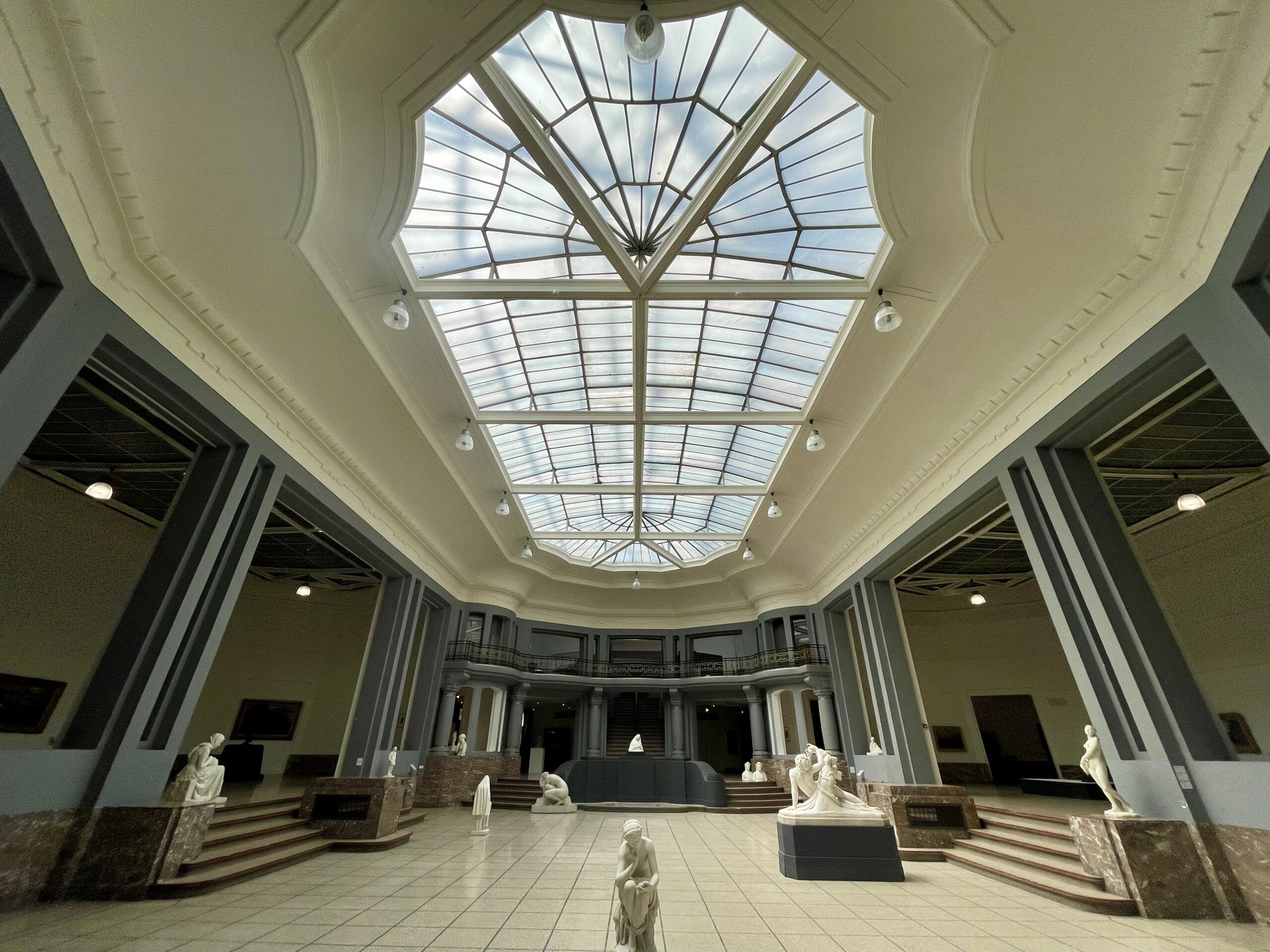
Museum of Fine Arts Interior Tournai. Credit: Angela Dansby / The Brussels Times
Founded in 1828, the Musée d'Histoire Naturelle et Vivarium de Tournai (Natural History Museum and Vivarium), in the former brewery of Saint-Martin Abbey, has a living butterfly house, taxidermy of the first elephant to arrive in Belgium in 1839, other naturalised animals and a cabinet of curiosities (closed for renovation until September 30, 2025).
The first Sunday of each month, museums, the belfry and cathedral treasury are free. From May to October, these Sundays also feature concerts, entertainment and a CréARTeurs market by local craftspeople in alleyways around the cathedral.
Green pleasures
Parc Georges Brassens municipal park behind City Hall occupies the former gardens of Saint Martin Abbey, including French-style gardens, water basins and rare trees, and is adjoined by Parc Reine Astrid.
Aqua Tournai, a large recreational complex on a former quarry, includes indoor and outdoor swimming pools, pedal boats, a spa, café, camping and Ecopark Adventures (which features the longest zipline in Belgium, 12 treetop adventure courses and giant trampolines).
The Tournaisis region also has 1,600km of cycling paths connected to Walloon greenways (RAVeL), two nature parks, waterways and rural roads.
Bevvies & bites
The Tournaisis is known for craft beers thanks to several microbreweries, including: La Pichou, Brasserie de Cazeau (in Templeuve), Brunehaut (Rongy-Brunehaut), Brasserie Dubuisson (Pipaix), Brasserie Dupont (Tourpes), Brasserie Caulier (Péruwelz), Brasserie des Carrières (Basècles), De Ranke (Dottignies) and Grand Mir (Lesdain).
Cave à Tertous allows people to make their own beer and Terre des Fours à Chaux produces wine from its own vineyards. Maison Léger is a chocolatier offering craft chocolate workshops. Other local, tasty creations are:
Ballons Noirs (Black Balloons): Hard, black candies made from three different types of sugar in a unique shape
Couque Abeille (Bee Brioche): A bee-shaped brioche cake with raspberry jam on its “wings” in honour of Childeric’s bees
Gâteau Clovis: A heritage cake filled with frangipane (almond-flavoured pastry cream) and apricot jam
Pichou: A brioche-type bread shaped like a little man filled with candied fruits, baked for carnival and thrown from atop the belfry
Gaufrettes fourrées: Waffles filled with vanilla, brown cassonade sugar or speculoos cream, sometimes with Grand Marnier or rum
Palet de Dames: Soft, round cookies topped with a fruity glaze, often filled with jam or cream
Faluche: A small, flat, slightly chewy white bread eaten for breakfast
Ficelle picarde: A savoury crêpe filled with ham, mushrooms and creamy sauce
Mutiau: A pressed terrine made from pork jowl and beef tongue, flavoured with spices, garlic and parsley, associated with Lundi Perdu
Visit Tournai offers online and on-site a free Time 4 Beer guide, Gourmet Walking Tour and gastronomic map. It also offers a Tournai Insolite walking tour to unusual city artefacts and a new audio tour in French, L'Escaut vous raconte... (The Schedlt tells you about it …) with QR codes along the river.
The City Strip app features a pichou narrating three walking routes animated with games at each touristic stop. Tripster-local.eu is a pilot meet-a-local platform for Tournai (plus Kortrijk and Roubaix), featuring 11 ambassadors who share tips for discovering their town via a chatbot.
EXPERIENCE
Carnival of Tournai: A weekend festival in March with masquerades, parades, processions, burning of the Carnival King and “lancer de pichous” (throwing of brioches from atop the city's belfry)
La Kermesse: A festival the second Sunday of September including La Grande Procession with giant puppets, parades, medieval characters, a large street market, dances, concerts and more
Lundi Perdu: Known as Lost Monday, a medieval feast in January on the Monday after Epiphany featuring mutiau, a 13-ingredient salad and beer-soaked rabbit
Marché aux Fleurs: A huge flower market in the city centre on Good Friday
Tournai Jazz Festival: A late June weekend festival with jazz, soul and blues artists
SAVOUR
Burger Queen: Offers a range of burgers with locally sourced ingredients, including foie gras and camembert, plus a terrace
Comptoir 17: Brasserie on the Grand Place offering French and Belgian specialities, including Lost Monday rabbit and local beers
Les Enfants Terribles: An upscale French restaurant with seasonal dishes in an artsy, sleek atmosphere
NOU: A multi-course, farm-to-table restaurant sourcing regional products for seasonal dishes
Rive Gauche: A grill restaurant along the Scheldt with a terrace
SIP & SNACK
Arthur's Bar: A cosy bar serving creative cocktails
Au Dé Botté: A medieval-looking bar with regional drinks, cheese and traditional games
Chez Eléonore: A cheese bar featuring local specialities and beers
La Botte de Lin: A Grand Place café offering local beers and a terrace
Pâtisserie Quenoy: Last maker of Ballon Noir candies and baker of Clovis and carnival cakes, bee-shaped brioches, Palet de Dames and more with a tasting room
STAY
Floréal Le Panoramique: In Mont Saint-Aubert close to Tournai, a 45-room modern domain, including a brasserie, with magnificent panoramic views
Hôtel Alcantara: Near the Grand Place, a stately address with 32 stylish rooms and four apart-hotels, a breakfast buffet and bike rental
Hôtel Hemera: A new hotel near the cathedral with 57 modern rooms
Marie Pontoise and Don Basco Duplexes: Rented by BGES, two modern family units for up to six people
Villa Tournesol: A renovated Art Nouveau house with a decorative room for two people
SHOP
Biscuiterie Marquette & Fils: Family-run biscuit factory producing Succès du Jour filled waffles (gaufrettes fourrées) for over a century
Boucherie Rue des Maux: Butcher known for authentic, high-quality mutiau terrine
Desobry: Maker of 45 different high-quality biscuits with Belgian chocolate, sold in decorated metal boxes
Le Moine Austère: Beer store selling local and regional brands
Maison Favot: Historic tea and coffee shop in a heritage building known for exterior cartouches, on-site coffee roasting and a wide selection of tea.
