
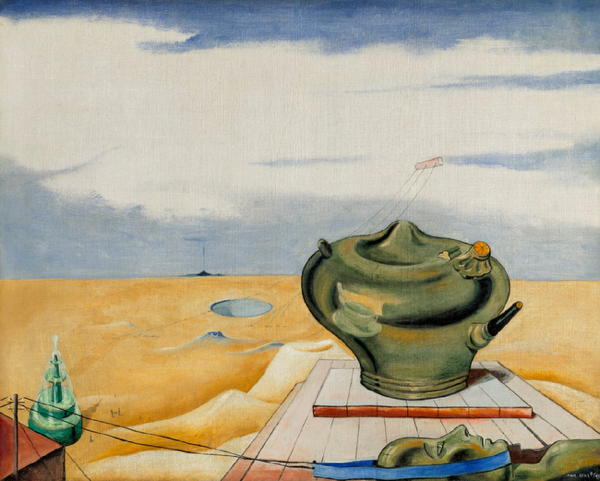
In a quiet corner of West Flanders, far from the salerooms of London or New York, Roger and Josette Vanthournout spent decades building a world around art.
Their home in Izegem was not a showroom but a living environment where paintings, sculptures and objects formed part of daily life. Friends recall rooms where modern masters shared space with carefully chosen furnishings, where art was not collected for status but for conversation.
Now, that deeply personal universe is set to disperse. Christie’s will auction the Vanthournout collection during its March Marquee Week in London, a sale expected to realise around £40 million (€46 million) and bringing to market one of Belgium’s most quietly significant private collections.
The event, entitled, Modern Visionaries - The Roger and Josette Vanthournout Collection, will debut with three dedicated auctions: an Evening Sale on March 5, followed by a day sale on March 6 together with an online sale running until March 12.
At its centre stands René Magritte. His La plaine de l’air (1940), with its enigmatic leaf-tree poised against a stark landscape, carries an estimate of £3.5 to £5.5 million (€4 to 6.3 million). Nearby in the catalogue sits Le lieu-dit(1955), estimated at £2 to £3 million (€2.3 to €3.4 million), another meditation on place and perception. Both works together chart the evolution of Belgium’s most internationally recognised artist across turbulent decades.
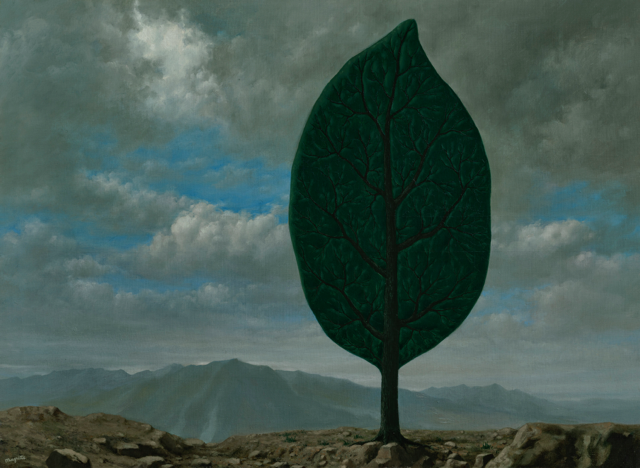
René Magritte, La plaine de l’air (1940)
For a country that has long punched above its weight in the art world – from the Flemish Primitives to the Surrealists – the sale feels like both a celebration and a moment of quiet loss. Private collectors have historically played an outsized role in preserving cultural heritage here, often driven by passion rather than speculation.
Roger, trained as a designer and later a furniture manufacturer, brought an architectural eye to collecting; Josette, herself a painter, contributed an intuitive sensitivity to colour and composition. From the 1950s onward, they travelled widely, meeting dealers and artists, buying what spoke to them.
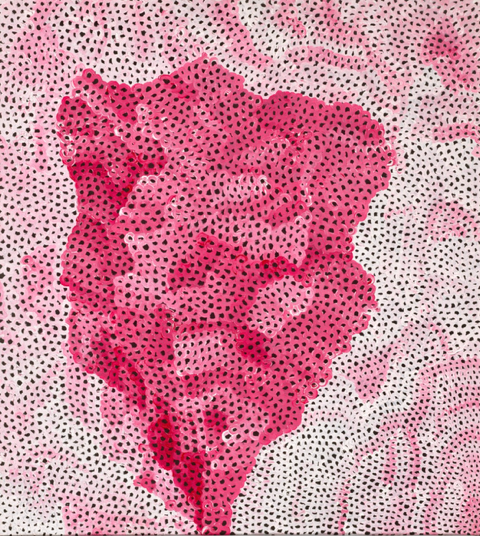
The collection – whether physically or through the catalogue – reveals unexpected dialogues: a Picasso painted in wartime Royan; sculptures by Henry Moore; works by Max Ernst, Lucio Fontana and Yayoi Kusama. Yet again and again, the eye returns to Magritte, whose quiet visual paradoxes seem perfectly suited to the Belgian temperament – at once understated and subtly subversive.
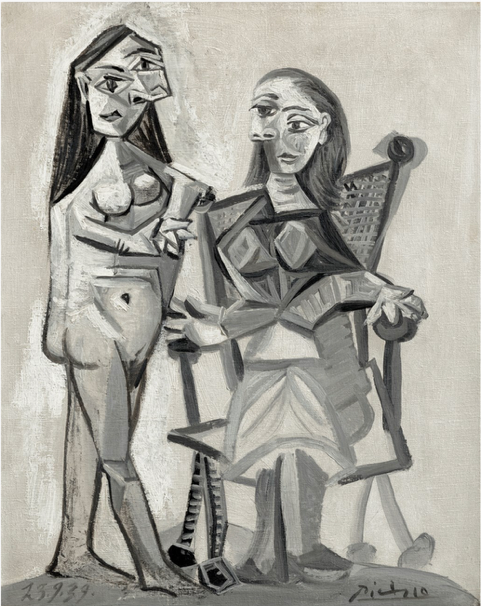
Pablo Picasso, Nu debout et femmes assises (1939)
Peter van der Graaf, senior specialist in Post-War and Contemporary Art at Christie’s, says the collection’s character is immediately apparent. “What’s striking about this collection is that it was never assembled according to fashion or market trends,” he says. “The works form a very coherent group – you can immediately sense a shared sensibility and a strong sense of tradition, but also confidence in individual choices.”
That sensibility extended beyond the walls. “The collection was conceived to be lived with,” van der Graaf adds. “It wasn’t just about hanging paintings on walls – it extended into how they lived, how the house functioned, even how the garden related to the works.”
There is also an emotional undercurrent. Collections assembled over lifetimes often carry the imprint of personal histories – travels taken, friendships formed, tastes refined. “This was not a collection assembled for resale or investment,” van der Graaf says. “It reflects long-term commitment, curiosity, and a willingness to follow instinct rather than the market.”
Meanwhile, as part of its Marquee Week, Christie’s is also set to auction Magritte’s 1961 leaf-bird painting, Les grâces naturelles, with an estimated sale value of £6.5 to £9.5 million (€7.45 to €10.9 million). The highlight of its The Art of The Surreal Evening Sale on March 5, the painting has been on display at the Magritte Museum in Brussels since its opening in 2009.
It is one of 18 canvases Magritte painted over the course of his career using this motif, first explored it in a series of oil and gouache paintings in the early 1940s, beginning with L’Ile au Trésor (1942), possibly inspired by the view of an aviary from the window of his home at 135 Rue Esseghem in Brussels.
