
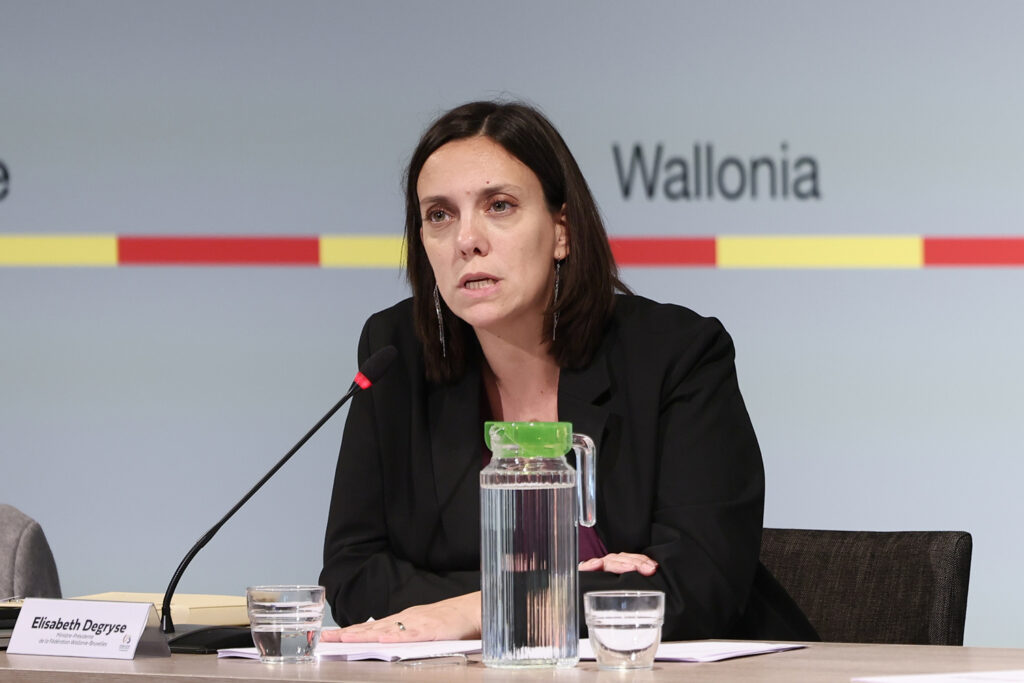
The French Community’s Minister-President, Elisabeth Degryse, and her Walloon counterpart, Adrien Dolimont, will lead a ministerial mission to Canada from 20 to 24 April, visiting Montréal, Québec, and Toronto.
This time around, the academic sector, which had opted out of last October’s economic mission to California, is participating in significant numbers.
The delegation comprises over 140 participants, including nearly 100 representatives of Francophone universities and colleges.
Priority to doctoral and postdoctoral research, internships
Canada, particularly Québec, is seen as an essential academic partner for the French Community, with strong ties established through 202 cooperation agreements involving 26 Francophone institutions and 80 Canadian counterparts.
Despite these connections, there are still barriers in the area of student mobility, with the Government of Canada setting limits to new international student admissions.
The mission aims to address these challenges and promote targeted mobility, prioritising doctoral and postdoctoral research and long-term internships over large-scale student inflows.
Delegation size raises eyebrows
The significance of this mission for higher education is clear, but its scale has fuelled criticism.
On Wednesday, the Belgian Workers Party (PTB) called the size of the delegation “incomprehensible,” given the ongoing budget cuts within the French Community.
Minister-President Degryse (Les Engagés) declined to disclose the total cost of the mission, but noted that invited institutions receive a fixed allowance: €2,500 for colleges and €3,500 for universities, regardless of the number of participants.
Innovation, academia, culture and technology
The mission also involves Wallonie-Bruxelles Internationale (WBI) and the Walloon export agency Awex, focusing on four areas: innovation, academia, culture, and technological partnerships.
In technology, emphasis will be placed on Wallonia’s expertise in sustainable agri-food, green biotechnologies, and biomass energy conversion.
The aerospace sector will also be highlighted, with visits to institutions including Polytechnique Montréal, Bombardier, and Sonaca Montréal.
Québec’s aerospace sector generated over €14 billion in revenue in 2024 and supported 37,200 highly skilled jobs.
Opening new doors, strengthening existing ties
“This mission reflects our clear intent to open new doors, strengthen existing partnerships, and secure promising agreements, especially in culture and academia,” said Minister-President Degryse.
Dolimont (Mouvement Réformateur) emphasised the “real opportunities” in research, innovation, technology, and aerospace.
On Thursday, his government approved - in second reading - a bill ratifying the Canada-EU Free Trade Agreement (CETA), a reversal from the Walloon government’s historic opposition to the deal a decade ago.
Deep historical ties and a robust economic partnership
The two leaders cited Canada’s deep historical ties and robust economic partnership with Belgium as key reasons for this visit.
In 2025, Canada ranked as the 19th-largest importer of goods and services from Wallonia and the 27th-largest exporter to the region, accounting for €546 million in exports and €117.9 million in imports.
Walloon exports to Canada have surged in recent years (+169.8% year-on-year in 2025), driven primarily by pharmaceutical products, which make up 76% of total exports.
