
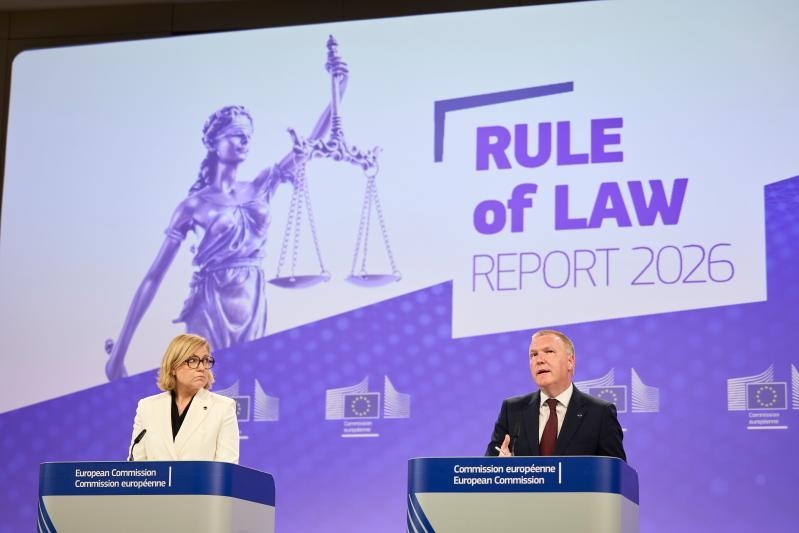
The European Commission published last week its seventh annual Rule of Law Report since 2020, examining rule of law developments in all Member States and four candidate countries: Albania, Montenegro, North Macedonia and Serbia.
The rule of law underpins Europe’s prosperity, democracy and security, protects citizens’ rights and sustains trust in public institutions and democracy, according to the Commission. It also provides the legal certainty that supports investment, competitiveness, and economic growth.
The report covers the independence of the justice systems, the effectiveness of anti-corruption frameworks, the freedom and pluralism of media, and the strength of the system of checks and balances between the executive, legislative, and judicial branches of power. Media and supreme audit institutions are sometimes seen as additional branches of power in democracies.
The good and bad sides
The report does not rank the Member States but mentions problems in individual countries. As in previous reports, Belgium is not spared from criticism.
On the positive side, Belgium is listed among the 21 Member States that included commitments related to the rule of law in their Recovery and Resilience Plans: Belgium, Bulgaria, Czechia, Greece, Spain, Croatia, Italy, Cyprus, Latvia, Lithuania, Luxembourg, Hungary, Malta, Netherlands, Austria, Poland, Portugal, Romania, Slovenia, Slovakia and Finland.
Several Member States implemented initiatives for raising awareness of the rule of law, including a ‘Rule of Law week’ in the Netherlands and Belgium to encourage public debate. While projects to improve the level of digitalisation are advancing in Belgium, Bulgaria, Croatia, Germany, Italy, Portugal and Finland, some gaps and challenges still remain.
Several Member States are taking steps to strengthen their anti-corruption institutions. In Belgium, a legislative proposal to create a new section with earmarked resources within the federal prosecution service for investigating serious financial and economic crimes was tabled in Parliament.
Anti-SLAPP (Strategic Lawsuits Against Public Participation) legislation to protect individuals and journalists from frivolous lawsuits has been adopted in Belgium, Cyprus, Estonia, Lithuania, Latvia, Finland, France, Poland, Sweden and Slovenia.
On the negative side, in Belgium (and Portugal), measures to expedite court procedures are still pending. In Belgium, lawyers continue to call for additional procedural safeguards to protect their independence and legal professional privilege. In Poland, Austria, Belgium, Denmark and Malta, there were no further steps to strengthen lobbying rules.
Other shortcomings or work in progress in Belgium are monitoring and enforcement of police integrity policies, verification of asset and interest declarations, gaps in rules on “revolving doors”, risks of corruption related to public procurement, and access to public documents.
Importantly, compliance by public authorities with final rulings of national courts and the European Court of Human Rights remains a serious issue in Belgium, notably as regards migration. The country's Federal Government has faced thousands of court rulings for failing to provide adequate shelter to asylum seekers.
As further work remains to be done, the report among others recommended Belgium to
- continue ongoing efforts to address the structural resource deficiencies in the justice system,
- step up ongoing efforts to improve the efficiency and digitalisation of justice to reduce the length of proceedings,
- resume work on a legislative reform to increase the transparency of lobbying for both members of parliament and government,
- continue efforts to strengthen the framework for access to official documents, in particular by improving request and appeal processes,
- step up efforts to ensure compliance by public authorities with final rulings of national courts and the European Court of Human Rights.
For a summary of the situation in each country and the recommendations, click here.
Broadly positive
As in last year’s report, the latest one confirms a broadly positive trajectory, showing continued progress in many Member States, with significant reforms completed or underway across all areas monitored under the report. However, the report admits that the picture is uneven across Member States and policy areas and some challenges persist.
Country-specific non-binding recommendations were introduced in the third report in 2022. The Commission says that the report and its recommendations continue to drive reform and change through sustained engagement with Member States. There are no recommendations for the candidate countries as such recommendations are issued in the annual enlargement package in autumn.
The recommendations do not in any way prejudge any proceedings the Commission may initiate under other legal instruments in its tool box. Notably, it can launch infringement procedures against countries that do not transpose EU legislation correctly or suspend funding by applying the Rule of Law Conditionality Regulation to protect the EU budget against fraud and irregularities.
The previous report found that 57% of the recommendations made in 2024 have been followed up by Member States, either fully or partially, compared to the previous year (2023) when 68% had been addressed.
The report was presented by Michael McGrath, Commissioner for Democracy, Justice, the Rule of Law and Consumer Protection and Executive Vice-President Henna Virkkunen. Last year, McGrath commented that a lower figure one year does not indicate a trend.
This year, however, the figure continued to decrease. 47% of the recommendations made in 2025 have been followed up by Member States, either fully or partially, with at least limited progress on a further 23%. The Commission explained that some recommendations may take longer to address, for example due to electoral cycles, or require more funding, changes in attitudes and systemic changes.
In line with the preventive nature of the report, the objective of the recommendations is to support Member States in their efforts to take forward reforms and encourage positive developments. A senior Commission official explained that the recommendations have become more targeted and operational without telling the Member States how to implement them and address the challenges.
