
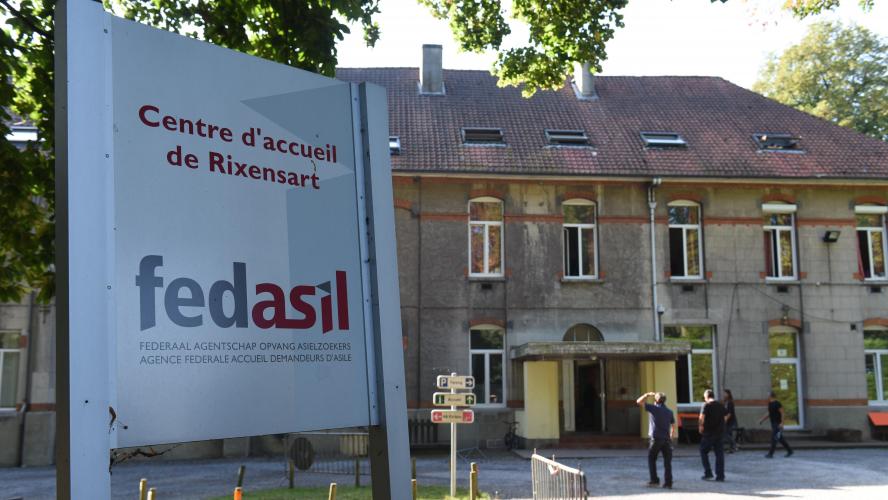
Belgium’s ever-evolving asylum policy was back in the news recently after the European Court of Human Rights condemned the country for failing to provide shelter to asylum seekers.
While much of the public debate has focused on access to accommodation, asylum seekers' rights extend beyond this issue.
A process rooted in international law
To understand how these rights operate in practice, it is first necessary to look at the asylum procedure.
In line with the 1951 Geneva Convention, an individual arriving in Belgium and seeking international protection must follow several steps before potentially being granted refugee status.
The first step is to formally introduce an application for international protection at the Immigration Office. At this stage, authorities determine whether Belgium is responsible for examining the claim under the Dublin Regulation, notably through the Eurodac biometric database.
If Belgium is responsible for examining the claim, the file is then analysed by the Office of the Commissioner General for Refugees and Stateless Persons (CGRA/CGVS), including an in-depth interview assessing the credibility of the claim.
Applicants must then wait for a decision, which may result in refugee status or subsidiary protection. If the application is denied, an appeal is possible before the Council for Alien Law Litigation.
Once all appeal options have been exhausted and protection is not granted, they receive an “order to leave the territory”.
Rights during the asylum procedure
When an applicant for international protection has registered with the immigration office, they normally have access to a defined set of rights, particularly in terms of accommodation and support. In recent years, access to accommodation has been the most controversial of these.
According to Fedasil, the federal agency responsible for the reception of asylum seekers, applicants are, in principle, referred to the agency on the day they register their request, and a place within the reception network is assigned based on their profile, based on criteria such as vulnerability, medical needs or family situation, as well as the availability of places.
Fedasil notes, however, that the reception network, despite offering around 34,000 places – managed both directly by the agency and through partners such as the Red Cross – cannot accommodate all those who have the right to reception.
Access to reception conditions also has direct implications for access to other forms of support. Those accommodated within the reception network benefit from a broad range of services, such as shelter, food, clothing, healthcare, as well as social and psychological support.
Children have access to education, applicants may receive legal assistance, and access to the labour market is possible after four months. By contrast, those outside the network have access only to medical assistance, which is guaranteed to anyone on Belgian territory.
According to Fedasil, priority is given to vulnerable groups, including minors, families and single women, who are in principle offered accommodation from the moment their application is registered.
By contrast, single men without particular vulnerabilities are placed on a waiting list and offered accommodation as places become available, although this is a legally guaranteed right. The waiting time is currently around three months, with approximately 1,250 people on the list.
Difficulties persist
Recent figures, however, suggest that difficulties in accessing accommodation persist despite this prioritisation. A report by a group of humanitarian organisations found that, following policy changes in 2025, not only single men but also families with young children are being left without shelter.
Figures cited in the report show that in the second half of 2025, 62% of requests for emergency accommodation from single men and 75% from families were refused due to a lack of available places, suggesting that pressure extends beyond the reception system.
Meanwhile, the Belgian state has accumulated several million euros in penalties, largely stemming from court rulings under the previous government, for failing to comply with orders to provide accommodation.
The agency attributes the current saturation primarily to the length of asylum procedures, which slows turnover in reception centres and limits the number of places available for new arrivals. More broadly, this takes place within a federal policy context focused on limiting arrivals and accelerating procedures.
According to the agency, around 32,000 asylum seekers are currently within the reception network, out of a total capacity of around 34,000 places, compared to approximately 35,000 outside the system.
It also notes that many of those outside the system are not necessarily excluded from it, emphasising that reception “is a right rather than an obligation”, and that some remain outside the network for various reasons, such as employment or the support of family members in Belgium.
Taken together, these elements point to a central tension: while access to accommodation is a legally guaranteed right, its implementation remains constrained by the capacity of the reception system.
Obligations
Applicants are required to comply with a series of obligations, including providing accurate information, attending interviews and cooperating with authorities. Providing contradictory, incoherent or false information may negatively affect the outcome of the application.
In addition, applicants residing in reception centres must respect the internal rules, which range from maintaining hygiene and respecting shared spaces to following staff instructions and ensuring peaceful cohabitation. Failure to comply with these rules may lead to sanctions, which range from warnings to, in some cases, exclusion from the centre.
These obligations are part of the asylum framework, but they do not alter the practical constraints shaping access to accommodation.
