
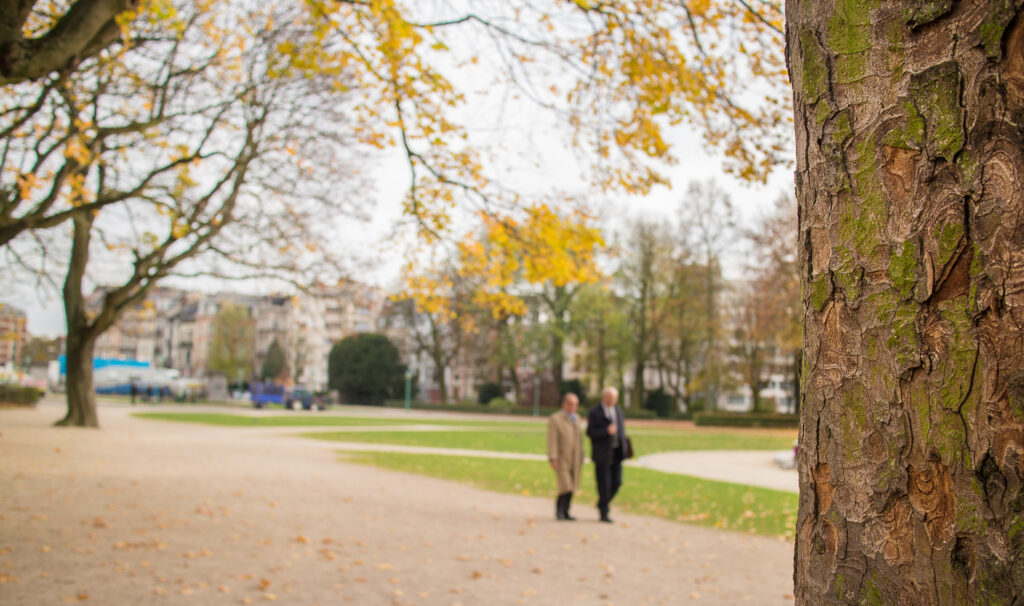
Belgium’s urban residents have limited access to nature, especially in less affluent areas, according to a Greenpeace analysis based on a map created by DataLab.
At least one million people do not have a park at least 0.2 hectares in size within 300 metres of their homes, the environmental NGO reported on Wednesday.
The map assesses urban access to nature for every building in Belgium, using the 3-30-300 rule developed by Dutch urban planner Cecil Koninendijk.
This rule specifies that a building should have a view of at least three trees, the neighbourhood should have 30% greenery coverage, and there should be a public green space within 300 metres.
Greenpeace’s analysis found that in 101 Belgian cities, including Verviers, Mouscron, Wavre, and Etterbeek, no homes fully adhere to the 3-30-300 rule.
In 74 of Belgium’s 100 most populous cities and towns, such as Namur, Charleroi, La Louvière, Antwerp, and Bruges, fewer than one-tenth of buildings meet the rule’s criteria.
On the other hand, in 18 communities, including Genk, Watermael-Boitsfort, Viroinval, Vresse-sur-Semois, and Brasschaat, more than half of the buildings comply with the rule.
“There is a very unequal distribution of trees and parks,” said Ruth-Marie Henckes, biodiversity campaign manager at Greenpeace Belgium.
Wealthier neighbourhoods and municipalities are greener, while poorer ones are trapped in concrete, resulting in unevenly distributed health benefits from green environments.
The NGO urges future local election candidates to address this injustice urgently.
