
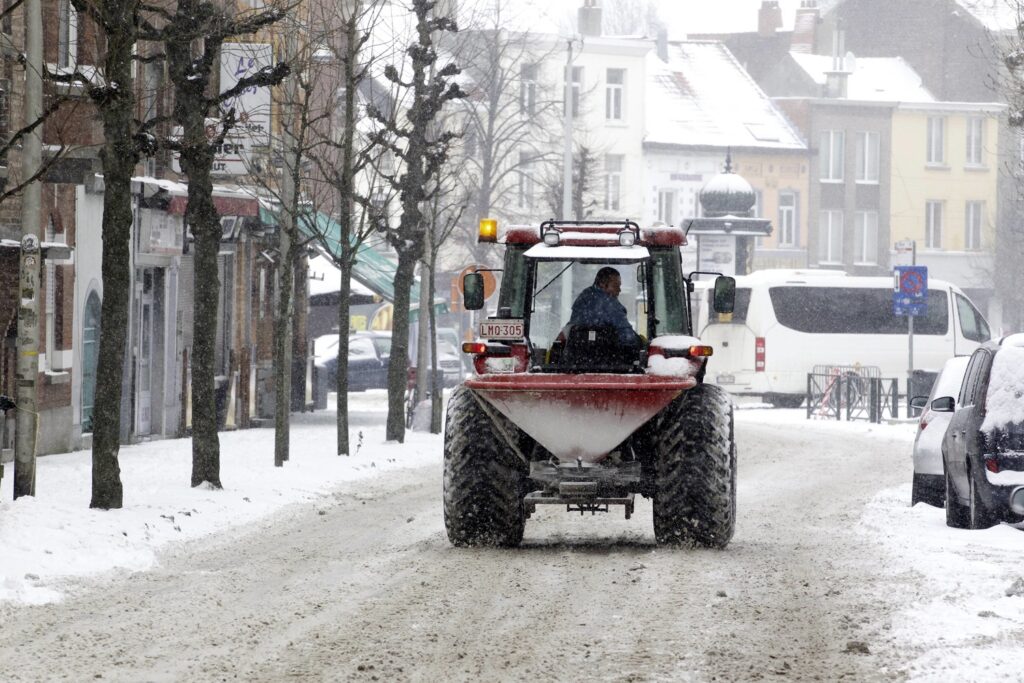
Flemish Minister of Environment and Agriculture, Jo Brouns, has called for further research into the use of urea-based de-icing pellets, which are marketed as an environmentally friendly alternative to road salt.
Urea is commonly used as a fertiliser but can have a negative impact on water quality when used as a de-icing agent.
“I have serious concerns about the use of this product,” Brouns said on Tuesday in a session of the Environment Committee of the Flemish Parliament.
He aims to better inform consumers about the impact of urea-based de-icing pellets and seeks to restrict their use.
Known primarily as a fertiliser, urea converts to ammonium and then nitrate, typically in soil but also in drainage ditches. Despite its primary use as a fertiliser, some apply urea to melt ice and snow, effective to a temperature of -10°C.
Proponents view urea as a ‘greener’ option compared to salt-based alternatives like sodium chloride.
However, Brouns challenges the environmental claims of the virtues of urea as a de-icing agent. In response to questions from Lydia Peeters (Open VLD) and Jurgen Callaerts (N-VA), he called for its restricted use.
“We demand significant efforts from our farmers to mitigate the environmental impact of fertilisers,” Brouns stated. “It is therefore unfair that this product can be freely used as a de-icing agent without any regulation, directly affecting our waterways.”
The minister insisted on better consumer awareness of the environmental effects and has tasked his administration with mapping the use of urea-based de-icing pellets.
This data will enable targeted actions, aiming to minimise its usage as much as possible.
