
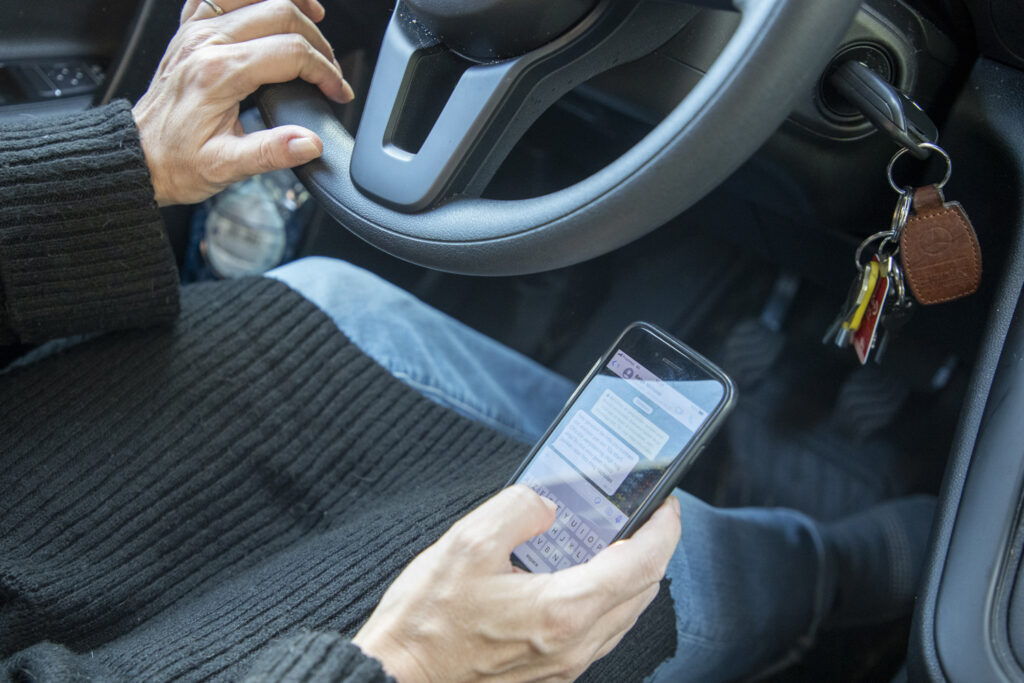
Nearly eight out of ten drivers (77%) in Wallonia admit they often use their phones while driving, according to a survey by the Walloon Road Safety Agency (AWSR) published on Thursday.
Nomophobia, the overwhelming fear of being without a mobile phone, affects approximately seven in ten Walloon drivers (68%), the agency stated. More than half of the 1,000 people surveyed (57%) felt the need to be reachable by phone at all times, with a third (34%) unable to go an hour without checking messages or surfing the internet.
These phone addicts are more likely to use their devices while driving, a behaviour that can have serious consequences.
In Wallonia, an average of 16 accidents per week resulting in injuries or fatalities are caused by phone use at the wheel, according to the AWSR. Unsurprisingly, drivers mostly frequently used their phones while driving to answer calls, a habit admitted to by six out of ten drivers. Making phone calls while driving increases the risk of accidents fivefold.
One in four Walloon drivers (23%) admits to writing texts, emails, or social media comments while driving, and 30% admit to reading from their screens. These distractions are even more risky, and can increase the risk of an accident tenfold.
Not content with just hearing the voice of their work colleagues or loved ones, French-speaking drivers are now increasingly starting video calls behind the wheel, with nearly one in five drivers (18%) admitting to participating in them while driving.
Related News
- Young people more likely to plan their evening to avoid drink-driving
- One Walloon driver in four does not respect safety distances in traffic
Young drivers aged 18 to 34 are the biggest culprits, using their phones most frequently in all contexts while driving. They are twice as likely as older drivers to write on their phones while driving (41% compared to 15% of those aged 35 and over) and to participate in video calls (32% compared to 12%).
In response to these findings, the AWSR recommends that motorists plan their journeys in advance, programming their GPS systems before hitting the roads, using their phone’s “do not disturb” mode, and opting for hands-free systems in case of emergencies.
