

Ingrid Geudens has two babies and a toddler. With two teenage children also at home, she is mother to a brood of five. Currently, anyway. Tomorrow it could be fewer, but then next week it could grow again. Geudens has been a foster parent for more than 16 years now, fostering 25 children along the way.
The founder of the non-profit Foster Parent Forum (Pleegoudererforum), Geudens was recognised last autumn for her service to foster families. The recipient of a BeHeroes award, which celebrates the work of everyday heroes, the 54-year-old was one of a handful of recipients to be granted an audience with Belgium’s King Philippe.
But she’s less interested in talking about that than in talking about what works – and what doesn’t – in foster care. Geudens has one of what she calls a “belly daughter,” but always wanted more children. A single mum living in Kapelle-op-den-Bos – about 14 kilometres north of Brussels – she attended a foster care info session after seeing a flier in a supermarket.
“I decided I wanted to do it – for one child,” she says, laughing. “I talked about it with my daughter, who was 11 at the time. She was very excited, telling me she always wanted a big family. Whoa, I said, just one.”
Within a few months, a three-year-old girl was placed in their home. It became a long-term situation, though Geudens and the child met regularly with the birth mother and her in-the-meantime second child. This built up trust, which led to what happened two years later.
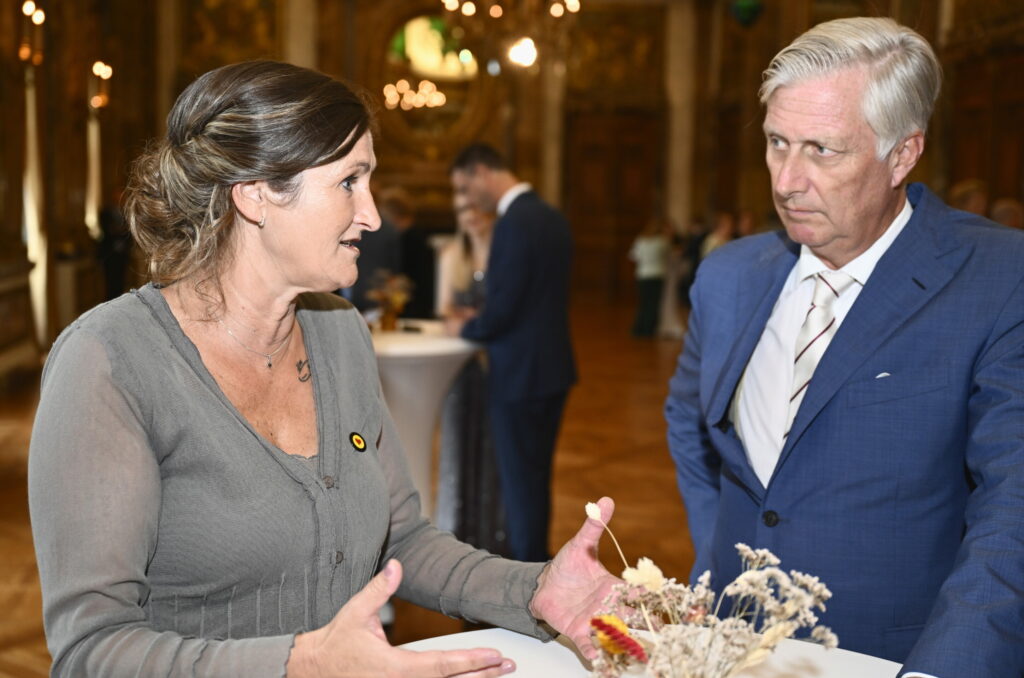
Ingrid Geudens and King Philippe, September 2024. Be Heroes is an initiative that honors Belgians who selflessly go out of their way to help others. Credit: Belga
The birth mother “was pregnant with her third child and couldn’t take care of her second one,” explains Geudens. “She called me on a Sunday evening, I still remember it. She said she was taking a taxi to my place and bringing me her son. Half an hour later she was there with two plastic bags of his clothes and toys.”
The three-year-old boy knew Geudens from the many visits, and he had even spent the night before. But when his mum left, “he started crying and wouldn’t stop. They feel that something is different. It’s not the same as the last time when mama said goodbye, see you tomorrow. He felt that, and he was hysterical.”
Geudens alerted foster care services. “They said I had two choices: Take him in, and we will arrange the administration. Or we’ll call the police and they’ll come to get him. I thought, well no, I’m not going to hand him over to the police.” Now 16, he is still part of Geudens’ family. His biological sister, meanwhile, is 18 and studying midwifery at university-college.
It sounds idyllic, but the journey has been fraught with challenges. “The way my foster daughter behaves at home is not the same as the way she behaves everywhere else. Normal social behaviour outside, trauma at home. When children are damaged, they think differently, they act differently.”
Geudens found it difficult to connect with other foster parents to talk about it all. So she founded Foster Parent Forum, which connects people largely through two private Facebook groups – one for active and one for potential foster parents.
“I cannot explain to other people how and why my daughter is totally different at home, but foster parents, they understand,” explains Geudens. “And they don’t judge.” The Facebook groups allow foster families to ask questions, give advice, compare notes.
The largely Dutch-language group is about 1,300 strong. “When you have a question about foster care, there’s always someone with an answer.” Sometimes that is Geudens herself. Very down to earth in a sweater, jeans and wrist tattoos, her stories about children are peppered with details. The tones of her husky voice might rise and fall, but she is surprisingly calm as she relays what she has seen throughout the years.
Women who have six or seven babies, knowing they will hand them over to social services as soon as they are born. Five-year-olds who have been so severely neglected they cannot speak or feed themselves. Brain haemorrhages in drug-addicted mums during birth. And drug-addicted babies who must go through withdrawal. “I’ve seen babies who have just given up,” she says. “They do not make eye contact, there is no connection, no matter how hard you try. They don’t expect anything anymore and are in a kind of trance. They look right through you.”
Geudens has become an authority on foster care, taken up in Flanders’ Expert Data Bank as a contact for researchers and policymakers and establishing relationships with foster care services. But these relationships can be tested. Social workers have started calling on Geudens in crisis situations when foster care services cannot find a family. Foster families are registered according to their preference: long- and short-term placements, as well as emergency placements, when a child needs to go somewhere immediately (theoretically for a few weeks, but this often turns into months).
The first time Geudens was contacted directly by a social worker, she posted to her active foster family Facebook group that there was a baby in need. “Within half an hour, I had seven families,” she says. “I gave the names to the social worker and told him to pick one. It was an abundance of riches for him. He had no one, and now he had seven.”
This prompted Geudens to start another Facebook group dedicated to crisis placements. So far 113 children have been placed this way. It’s simple but effective – something Geudens says is missing from foster care services. Helping social workers place children – with the official foster services only being told afterwards – is overstepping the boundaries, she has been told. “And I understand that,” she admits. “But we are talking about a child.”
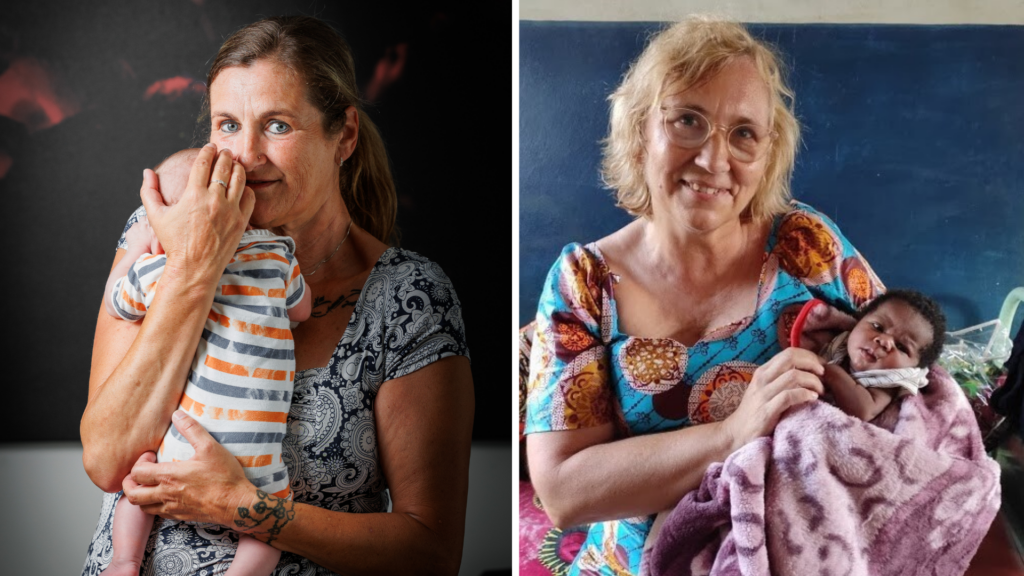
Ingrid Geudens (left); Sabine Van de Vyver (right)
In Flanders, foster care is organized at the provincial level, brought together at the regional level via Pleegzorg Vlaanderen. It’s much the same in Wallonia, with local agencies bundled under Famille d’accueil. Both agencies provide services in Brussels, where authorities and potential foster families can contact either one.
“In a crisis situation, we look for an immediate solution,” says Jeroen Van den Bussche of Pleegzorg Vlaanderen. “We always try to find the best option for the child. Everyone working in fostering starts from that idea: I will take care of children.” But with some 13,000 foster children across the country and only 9,000 registered families, doing fast placements “is not easy,” he says. “We don’t have enough crisis families, we don’t have enough families in foster care in general.”
Considering that, he is grateful to Foster Parent Forum for their help. “But it’s Facebook,” he points out. “We have to respect privacy regulations. The members of the group can take a child in crisis, but afterwards the foster care service checks to make sure that that family can handle another child.”
A foster parent himself, Van den Bussche appreciates the agency’s emphasis on taking care of the families as well as the children. “If a baby is in crisis, of course I would always want to say yes, but it’s the job of the foster care service to see if it’s really possible to put a child into a certain family.”
A lack of crisis families could easily be solved, says Geudens. “Most of the people who react to the calls on Facebook are not actually registered as emergency families,” she says. “Because in all the years that they are available for long- or short-term placements, nobody asks them if they could take care of a child in an emergency.” She looks straight into my eyes and repeats it. “Nobody asks them.”
According to Van den Bussche, foster families are well aware that they can register to be emergency contacts and that his agency is not going to manipulate them into something they might not be ready for. “It’s important to reflect on the engagement you are making,” he says. “It’s not a Christmas tree, it’s a child. We don’t want people to take children and then say after a few weeks, I can’t do this. It’s worth waiting a bit longer to get it right.”
Still, inspired by Foster Parent Forum’s Facebook groups, Pleegzorg Vlaanderen is developing an app to do more efficient outreach to families for emergency placements. “The app will work in essentially the same way,” says Van den Bussche. “But not via Facebook.”

Geudens is relieved that Pleegzorg Vlaanderen is taking the step; she herself is an emergency foster parent – hence the three littles residing in her home. Families can choose what age of children they want to foster. Geudens profile is between newborn and one year old “because of the attachment issue,” she says.
She’s referring to those babies who stare right through you – who through neglect have lost the ability to bond. “A child makes millions of neural connections in their first 1,000 days,” she says. “Or they don’t.”
Which leads us to Knuffies, a programme that sees volunteers heading into neonatal units to simply hold babies. Incorporating the Dutch word for cuddle – knuffel – it is an initiative of the Foster Parent Forum, in response to the well-known adverse effects of touch deprivation.
Some babies born in hospital are not destined to go home with their biological parents. Yet studies have shown that physical touch in the first weeks of life is crucial for healthy brain development. A lack of it can lead to long-term effects on cognition, social skills and bonding. For drug-addicted babies – who already face developmental problems – the problem is compounded.
Hospital staff do not have time to provide this level of nurturing. Now part of a pilot project at Sint-Vincentius Hospital in Deinze, East Flanders, Knuffies matches a baby in hospital to one (maximum two) volunteers, who will hold and feed them daily.
“Children who have not had adequate physical and emotional attention are at a greater risk of behavioural problems,” says Sabine Van de Vyver, head midwife at the neonatal unit at Sint-Vincentius. She also emphasizes that body-to-body contact can help prevent illness, even into adulthood. “These trends point to the lasting effects of the early childhood environment, and the changes the brain undergoes during that period.” Her department has pioneered Knuffies “because we think that this initiative can help babies at risk for touch deprivation.”
Knuffies do not have to be foster parents but are carefully screened and trained. About 800 people have already shown an interest, and three hospital networks have agreed to more pilot projects. Geudens says the ultimate goal is to roll the program out in every hospital in Flanders.
The only hurdle now, she says, is paying for the required insurance. Foster Parent Forum has embarked on fundraising efforts, unable to secure public resources – although Geudens says it will save money in healthcare costs in the long run. Government administrations, she says, don’t think long term. “They are in force for four years. We cannot prove that Knuffies works in four years. You have to wait 12 or 16 years to see these results.”
