
The price of a typical Belgian house has risen by more than 60% over the past 14 years, outpacing wages, inflation and even the expectations of many homeowners.
Figures published last week by Belgian statistical agency Statbel show the median price of a terraced or semi-detached house in Belgium reached €260,000 in 2024, up from €160,000 in 2010. Detached homes, some of Belgium’s most expensive properties, now average €370,000, while even a modest apartment will cost around €243,000.
Behind this data is the growing trend of regional inequalities. A detailed analysis of quarterly property price data by The Brussels Times reveals a housing market increasingly divided between booming Flemish towns, a still-expensive but cooling Brussels, and wide swathes of Wallonia where prices have barely budged in real terms.
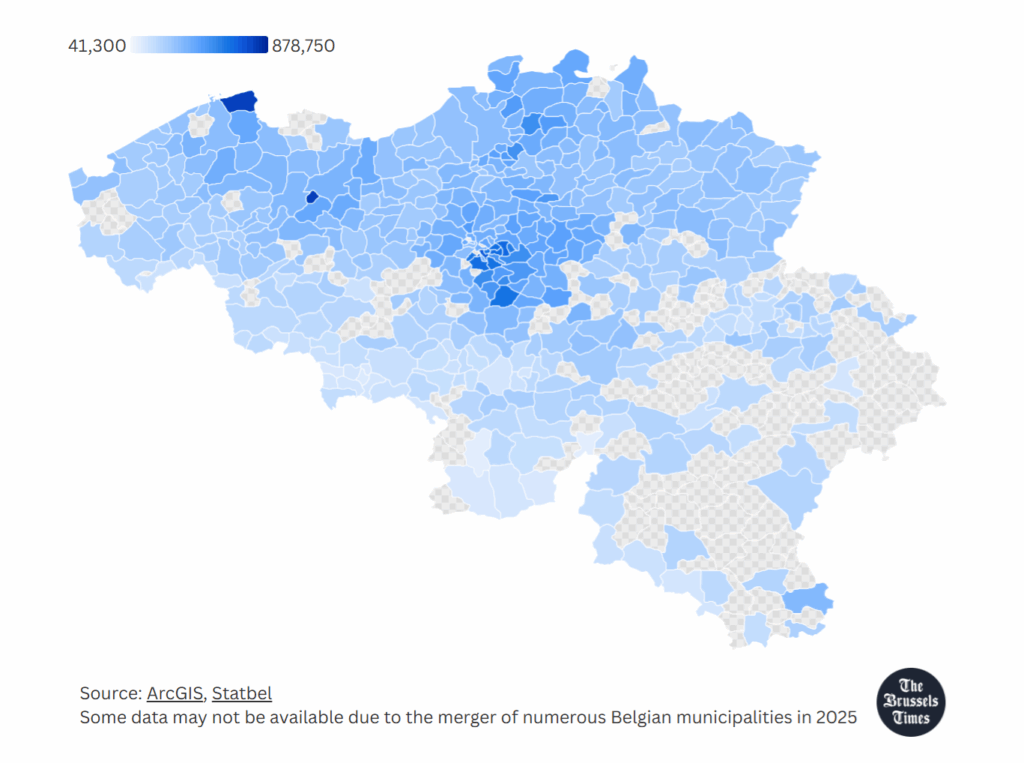
Using Statbel’s quarterly data for houses with two or more façades, The Brussels Times compiled annual medians from available data from each of Belgium’s 526 communes. The picture that emerges is striking.
In 2010 the typical house in half the country could still be bought for under €185,000. By 2024, the nationwide median of municipal medians had climbed to just under €300,000. Over the same period, Statbel’s consumer price index rose by more than 40%, showing that house prices have clearly outpaced inflation.

The map accompanying this article takes the median of the four quarterly medians for each year, producing slightly different results to the official Statbel statistics.
These rising prices, however, are not felt equally across the country. In 2024, both Sint‑Martens‑Latem and Knokke‑Heist again appeared at the top of the national rankings, with median house prices approaching or exceeding €800,000. While official Stabel figures are based on all transactions over the year, The Brussels Times data uses a median of quarterly medians.
At the other end of the property price table (for which data is available) is Hastière in Namur, where the median house still changes hands for about €92,000, less than an eighth of the Sint‑Martens‑Latem price. In 2021, the average Hastière resident made just €16,875 per year.
Inside the Brussels‑Capital Region the price ladder is equally steep. Earlier this year, The Brussels Times reported that the average price of a detached house in Brussels had topped €1.1 million, with terraced houses reaching €485,000. But a closer look at the 2024 data reveals that this varies dramatically by commune.
According to our analysis of quarterly Statbel data for all housing types, Ixelles remains the capital’s most expensive municipality, with a median house price of €708,750. Close behind are Woluwe-Saint-Pierre at €662,500, Woluwe-Saint-Lambert at €650,625, and Uccle at €650,000. At the other end of the spectrum, Berchem-Sainte-Agathe remains the cheapest commune with a median of €425,000.
Looking at median percentage price changes since 2010, rural villages rather than big cities lead the pack.
Ledegem, between the cities of Roeselare and Kortrijk in West‑Flanders, has more than doubled in price over the period, climbing from €156,000 to €320,000. Ham in Limburg shows a similar pattern, with its median house price shooting past the €330,000 mark.
Related News
- Real estate company Ghelamco lost over €320 million in 2024
- One-fifth of Brussels residents want to move out of the city
By contrast, house prices in parts of Hainaut and the Ardennes have barely kept pace with inflation. Lessines added just 12% to its median price in fourteen years; Stavelot and Froidchapelle posted gains of roughly 15% and 16%, respectively.
The national averages remain buoyant partly because Flanders, with its higher incomes, dominates transaction volumes. In Brussels the scarcity of building land props up prices even as sales numbers slip whenever interest rates edge higher. Wallonia, by contrast, has both space and limited purchasing power, keeping prices subdued.
Statbel’s data show that the increases have slowed but not stopped. According to their yearly calculations, between 2023 and 2024 the median for terraced or semi‑detached houses rose one percent in Brussels, stayed flat in Wallonia and climbed two percent in Flanders.
Detached houses followed the same script, with Brussels posting a hefty 17% jump as the pandemic‑era preference for gardens and home offices solidified.
