
From the cost and the different contracts to solar panels and more, matters related to energy concern everyone. And oftentimes, they can be confusing. To shine a light on the complexities, consumer protection organisation Testachats dives into a topic affecting customers for The Brussels Times. This month, the focus is on solar panels and home batteries.
Understanding where your electricity comes from and how it is used is key to understanding how much customers are paying for their energy usage. Previous explainers delved into energy bills and how (and when) to switch suppliers, this one focuses on how best to use solar energy.
"In this case, it is simple: solar panels are always a good idea, and will always earn you more than you spend on them. However, there are a few things that are important to mention if you are just starting out," Laura Clays, spokesperson for consumer protection organisation Testachats, told The Brussels Times.
What to look out for when getting solar panels
It may seem obvious, but the key is having an available roof (without asbestos), preferably one with enough space to lay panels to cover your entire electricity consumption. "Especially in Brussels, that may not always be possible."
For an average consumption of 3500 kWh, you need to count on 25 m² of panels, or 14-16 panels. "That roof should preferably also face south and incline 30-35°. However, a roof facing east or west with a good pitch still achieves 85% of the efficiency of an ideal south-facing roof."
There are three directions to go in with the produced electricity: either clients use it immediately by consuming electricity, or it goes into the grid, or clients store the electricity in a battery (see below).
"The best way is to use the electricity immediately. So make sure you can power enough appliances: run your washing machine or dishwasher when the sun is shining, and charge your bike's battery when it's sunny," Clays explained.
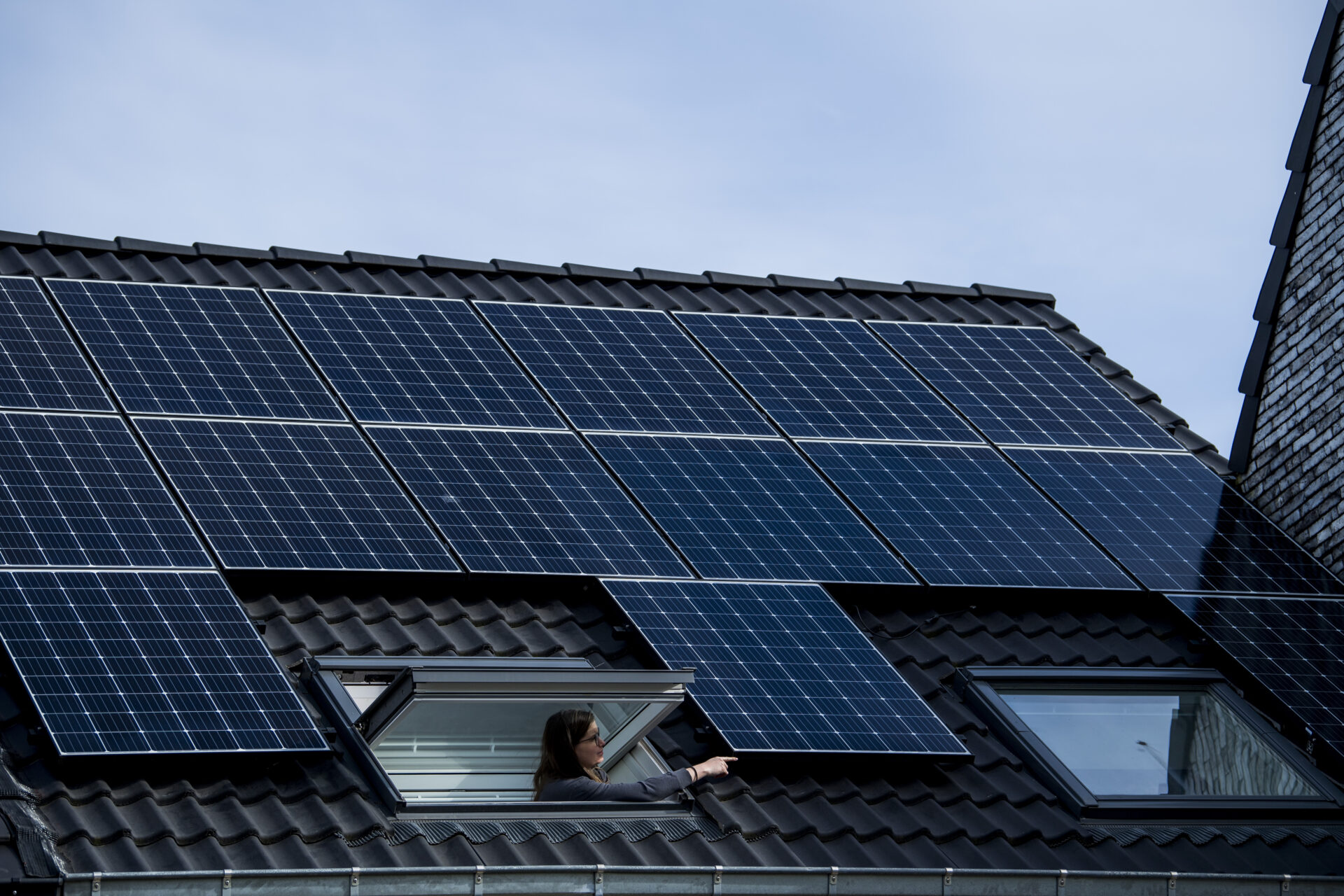
Credit: Belga / Jasper Jacobs
In general, clients can consume about 30% of their produced electricity themselves, but that can go up to 50% if they can power many appliances. The rest goes into the grid – for which clients get an 'injection fee' from their supplier.
"However, this fee is very low: three to four times lower than what you pay for the energy you take from the grid," she said. "That is because electricity costs very little at the times you inject it, because many solar panel owners also put electricity on the grid at those times. Hence, it is best to bet as much as possible on self-consumption."
The Brussels-Capital Region is the only region in Belgium where the production and injection of electricity still earns clients 'green certificates'. "For ten years, you get an extra payment for your installation."
In Flanders and Wallonia, for existing installations, there is also the option of a 'reverse counter', whereby your electricity meter is set back each time you inject. "You then obviously get much more back than if you only get the injection fee. But this hasn't been possible for a while."
How quickly will you earn back the money you have spent on solar panels?
Clays stressed that much of this depends on how much you paid for the panels in the first place. "That price is expressed as an amount per 'kilowatt-peak' (never pay more than €1,500 per kilowatt-peak). It also depends on how well your roof is situated, and how high your self-consumption is."
With an optimal location and high self-consumption, your panels can pay themselves back in ten years. "With a less optimal location and lower self-consumption, it will be towards 20 years. In any case, an installation should last at least 20 years, so you can assume that you will recoup the investment, whatever happens."
In Brussels, with green certificates, clients can count on a much shorter payback period of eight years, to even five years in the most ideal circumstances.
Home batteries: what are they, and how do they work?
While solar panels are usually an obvious way to save money in the long term, the home battery story is much more complicated. "Home batteries are not profitable yet, their installation still costs quite a lot, and you do not save very much," Clays said.
Of course, the principle is attractive: the electricity generated by your solar panels during the day that you do not use right away is stored and released in the evening. "That way, you can increase the consumption of your own electricity a lot, and avoid having to take expensive electricity from the grid."
In general, clients would be able to increase their self-consumption by about 30%. However, Clays warns that there are a few snags.
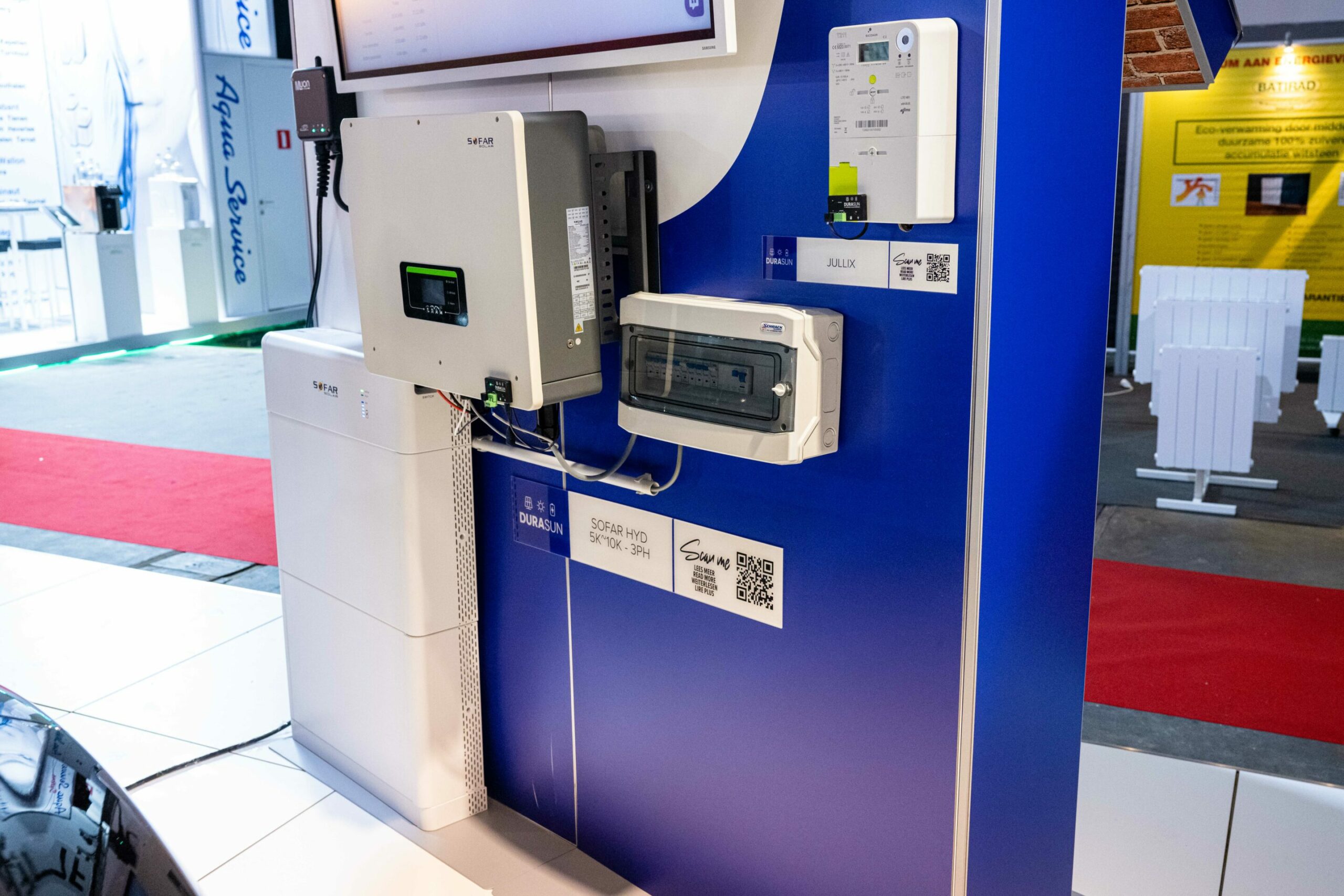
A home battery during the opening day of the 2023 edition of Batibouw. Credit: Belga/Jonas Roosens
"The battery can also only store a limited amount, with the rest going into the grid. So you cannot fully charge the battery in summer to use it in winter. While you can count on the fact that you can fully charge the battery in summer, it might only drain 10% to cover your consumption at night."
In winter, the opposite is true: the battery might only be able to charge a little, and then clients would still have to draw a lot of (expensive) electricity from the grid.
"Additionally, prices are still quite high at around €850/kWh," she said. "So if you want a 6 kWh battery (an average capacity, which fits a normal installation for average consumption), you already end up over €5,000. The profit you make from this is not really worth it."
And importantly, these devices currently only last for about ten years before the battery weakens too much to work properly. "All in all, the price of a home battery would still have to halve before it is worth installing them."
Plug & play devices
Since 17 April, consumers have been allowed to plug in 'plug&play' solar panels and batteries at their homes. In practice, this means that people can just buy a solar panel and a home battery, plug them in, and that is it.
"No costly installation, no adjustments to your electricity, no notification requirements. Just a convenient system to enjoy solar power or store energy more cheaply. That's the theory anyway," Clays said. "In practice, however, there are many snags again."
You cannot just plug in any solar panel or home battery yourself. Only devices homologated by Synergrid can be used in Belgium. "Synergrid has a list online, but it is unreadable for the average consumer. You cannot just look up the make and model number of your panel or battery, you have to look up the work of the inverter in your device," she said. "Most of the time, however, people don't know that."
This is frustrating for consumers, as it means people cannot simply know whether the device offered online or in the shop is even allowed to be used in Belgium. "We already advocate a label that can be placed on the packaging or on the website, indicating whether it is 'approved for Belgium'."
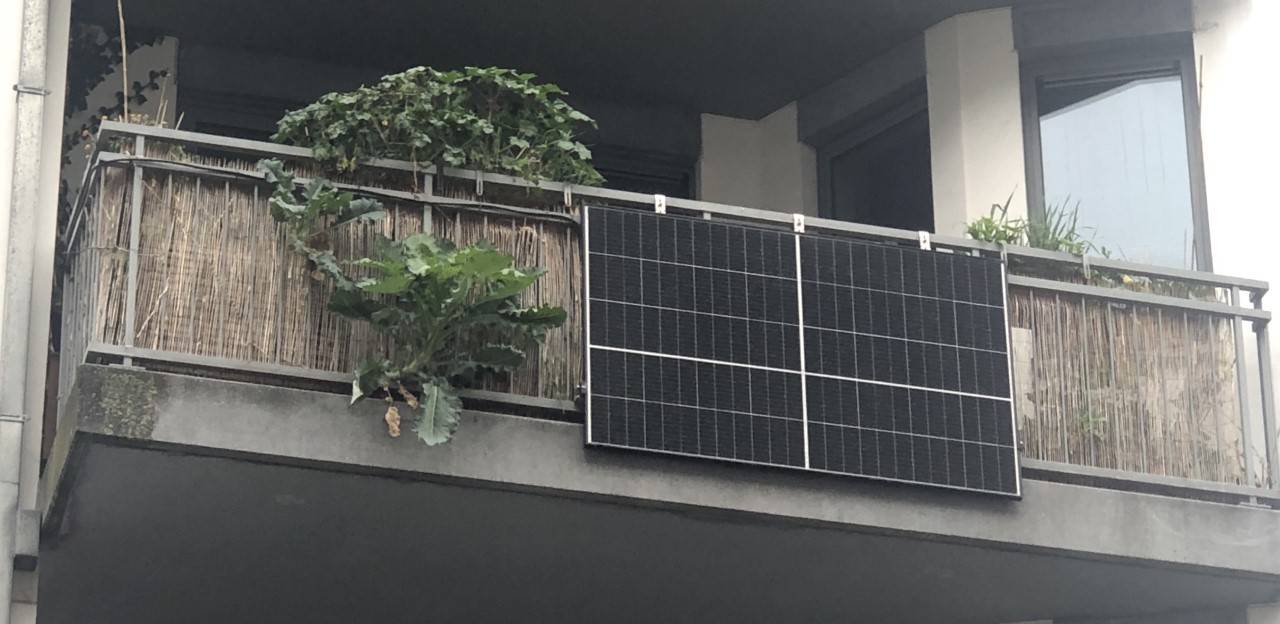
Solar panels hanging off a balcony. Credit: Social media
Secondly, you need space to install the solar panels. If you live in a flat, you can hang them on a balcony and still use solar energy that way. But you have to be sure it is allowed: some municipalities do not allow it (for the view), and you also need permission from the owner of your flat and the co-owner association of the apartment block.
"If you can hang the panels on the balcony, please make sure they are secure. You really would not want it to fall down five floors with a gust of wind, or blow away against a window."
Additionally, the panel needs to be close enough to plug into a wall socket: either you have a socket outside (with a cover, so it is all safe), or you have to pull the wire inside.
Safety concerns?
Plug&play batteries are currently only homologated if you buy a separate sensor with them, which has to be mounted in your electricity cabinet. "For that, you have to get an electrician to come over, which of course also costs money."
The idea behind this is that the batteries need to know when to charge and when to release the electricity. In theory, this can be done via a small meter attached to your digital meter, as the Netherlands already does with the plug&play batteries.
"But here, this is not allowed 'for safety reasons'. We question this: if it can be done safely in other countries, why is Belgium making a fuss?" said Clays. "Why does our country have extra barriers to optimally using electricity at a more affordable price? We hope that this rule can be revised soon, so that plug&play batteries will also be able to be fully used here."
