
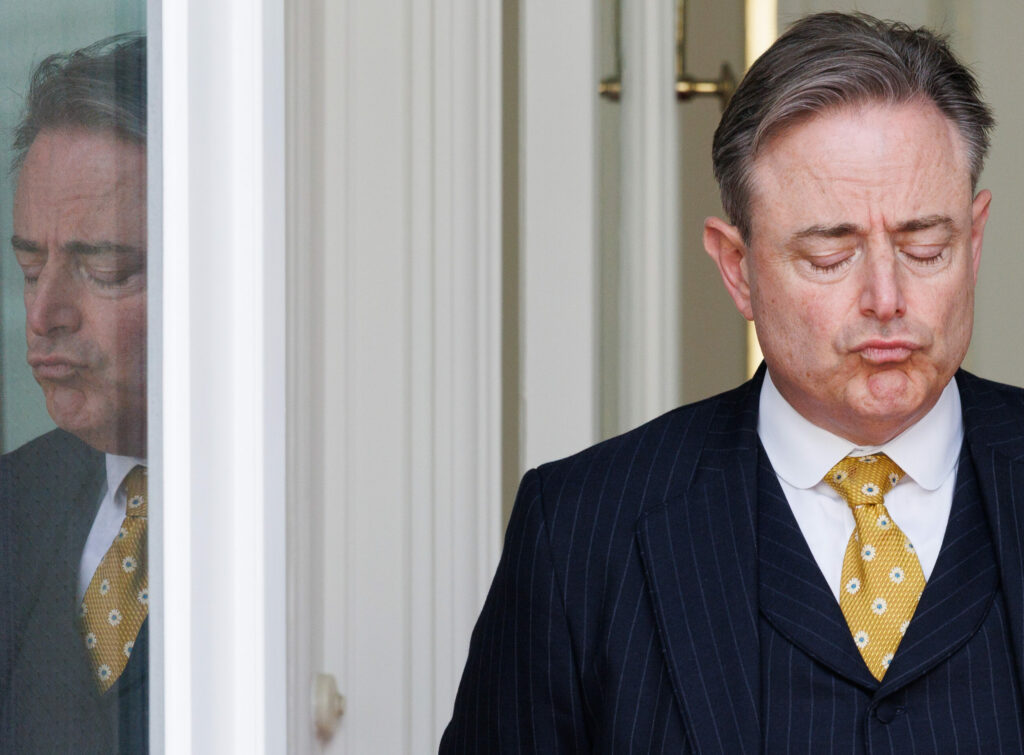
The Federal Government, led by Prime Minister Bart De Wever (N-VA) has been in power for 100 days. In a string of TV interviews, De Wever looked back and ahead at the state of the country and what lies ahead.
While De Wever usually does not give many interviews, he invited television crews from many of Belgium's channels to his office in Rue de la Loi 16 to take stock of his first 100 days at the helm of the country.
"The country's budgetary situation is dramatic. The Titanic is sinking. She is almost at the bottom," he said.
However, De Wever waved away the criticism that his first budget exercise would only lead to more spending. "Do you think we would turn the situation around in a few months? Getting the budget right will take ten years. Otherwise, you risk social dramas in your society or seriously damaging your economy. The first thing is to stop the rot."
Impossible sum
At the same time, he also had a warning in store for his coalition partners, Flemish socialist Vooruit and Christian-Democrats CD&V, and Francophone liberal MR and centrist Les Engagés. "The coalition agreement will not suffice [to get the budget in order], I am telling you already."
In addition to fixing the budget deficit, the Federal Government also has to look for ways to boost defence spending. For this year, this will be possible with several one-off measures, but that is not sustainable.
At RTBF, De Wever by no means rules out the possibility of a tax being involved. "In a coalition of five, you have some who say 'no taxes,' others say 'no cuts in social security,' still others say 'no debts,' like the N-VA. The sum of all those positions is impossible."

A demonstration as part of a national strike to protest against the austerity and pension reforms of the federal Arizona government. Credit: Belga/Timon Ramboer
De Wever also clarified some savings that have been agreed: for everyone working in the public sector, the automatic indexation will be paid after three months (instead of immediately). "I don't think that's the end of the world."
Additionally, he is sticking to the major reforms that have been implemented. Pension reforms are much needed, Belgium is now just doing what every other European country is doing, he said. "Everyone knows we have to do this. Then I think: save yourself the trouble. You might be organising political strikes because [the Francophone socialist] PS is not in government."
"With the railway strikes, this is just becoming absurd," De Wever said. "It contributes nothing, and it is also disproportionate to what we are doing."
Becoming the IMF
Speaking of Brussels, De Wever said that Brussels politicians should not count on much leniency. To RTL, he openly speculated about bankruptcy. "In the very short term, we may be faced with a situation where the region can no longer finance itself and I will be waiting for them to bail them out."
That would amount to a "guardianship," even though purely legally, that does not exist. "I will behave like the IMF," said De Wever.
In theory, this means that the Federal Government could bail out Brussels (the same way the international community saved Greece), but only if they scrupulously implement the reforms imposed on them.
