

It begins with a message: a discreet notification on the 'dating' app Grindr. A mix of emojis, abbreviations, and unspoken codes: "PnP? (Party and Play) T? (Tina) Chill ?" But behind these euphemisms lies a more profound and expanding public health and social crisis.
József Szájer, a Hungarian MEP who made headlines in November 2020, fled a gay sex party fuelled with illicit substances by sliding down a drainpipe as police arrived to shut down the illegal party. He was acquitted of possession by a Belgian court, resigned as an MEP, left the political party Fidesz and paid a €250 fine for breaking lockdown rules in the wake of the scandal.

Illustration showing the Hungarian MEP Josef Szajer as a new gay icon. Credit : Laika McMliv
On the evening of 10 February 2023, French comedian and actor Pierre Palmade got behind the wheel to 'run some errands', after several days of partying, having sex and heavy drug use. While driving on a road in the south of the Seine-et-Marne department, his car collided with an oncoming vehicle. In addition to the 54-year-old, the crash left three members of the same family seriously injured: a 38-year-old man, his six-year-old son and his 27-year-old sister-in-law, who lost the baby she was expecting.
Two separate events that made national headlines share a common denominator: Chemsex.
What is Chemsex?
Chemsex refers to the intentional use of certain psychoactive substances (such as 3-MMC, methamphetamine, GHB/GBL, or cocaine) in a sexual context, often among men who have sex with men (MSM).
In Brussels, they mainly take place in private party settings, sometimes in apartments or hotels, but also in specific venues where sex is permitted. In recent years, there have been a shift in the way some gay people approach sexual relations and the profiles of people practicing it are diversifying: whereas Chemsex used to mainly involve caucasian gay or bisexual men aged between 30 and 45, it now also includes younger people, people of colour, those in precarious situations and members of the transgender community.
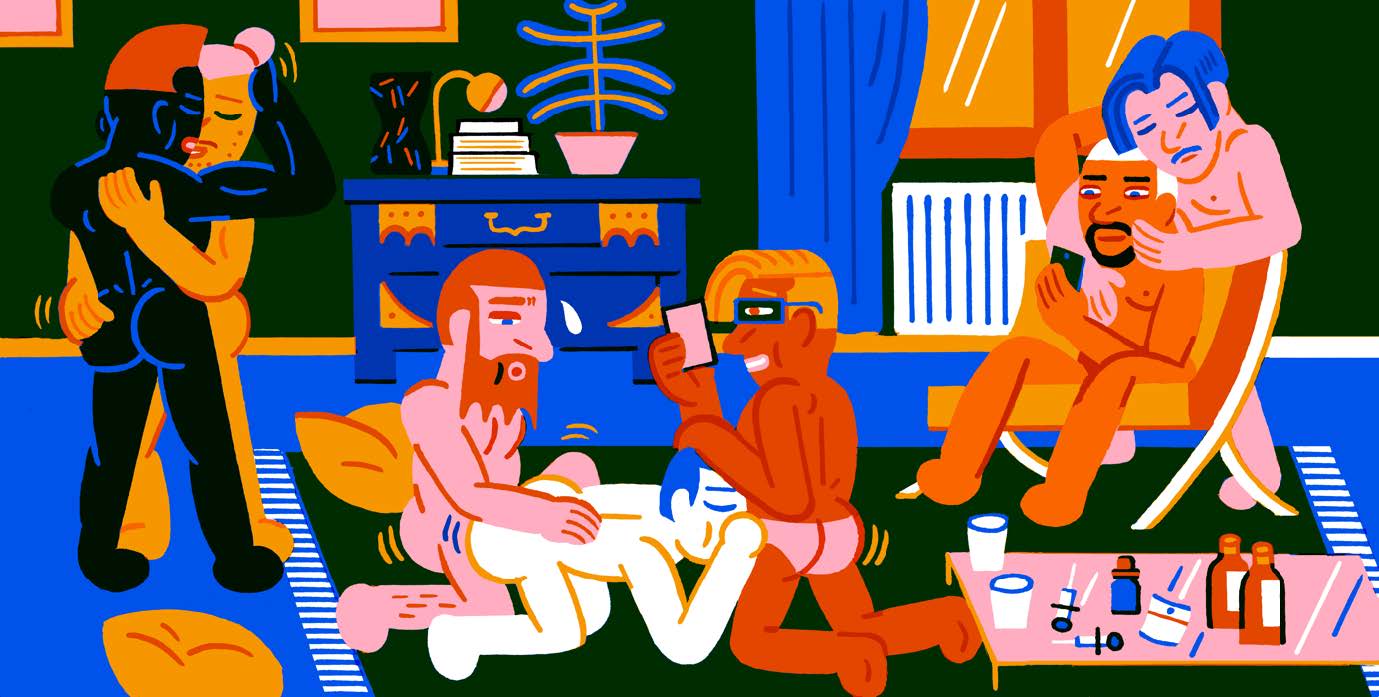
A drawing shows a group of men in a Chemsex session. Credit : Alias
One of the things that ignited this practice in the capital was also the unprecedented lockdowns and restrictions during Covid-19. These meetings used to happen in public or community spaces, they've shifted to apartments, hotels and especially digital spaces. Dating apps, encrypted messaging, and online platforms became key channels for organising sessions and accessing substances.
Many people assume Chemsex only concerns "junkies" or "extreme partiers". Others equate it entirely with promiscuity or depravity. However, there are deeper motivations related to coping with stress, social rejection and most importantly: isolation and loneliness. Stigma often makes it harder for these individuals to seek help.
At first glance, Chemsex offers what some describe as liberation: the abandonment of inhibitions, euphoric highs, and a sense of connection. Beneath the surface lies a darker reality: overdoses, addiction, sexual trauma, the spread of STIs (including HIV), dehydration, psychiatric disorders and sometimes, death.
Credit: Pexels
Jean-Luc Roméro, Deputy Mayor of Paris, in charge of culture and tourism since May 2014, experienced this firsthand. When interviewed by The Brussels Times, he described himself as "collateral damage" of Chemsex. His husband was trapped in an apartment in Paris, after spending the night sipping and sniffing a cocktail of GBL, 3-MMC and alcohol. He eventually overdosed at a certain point, and ended up dying there without the proper help or any help. The guy he was with was too high to react and never called the emergency services.
When sex is work
The Brussels-based NGO Alias released in 2020 an exploratory report based on answers to the lived experiences of MSM and trans sex workers involved in Chemsex. The results are staggering, as the practice of Chemsex in this context is even murkier. When sex is a transaction, and drugs are part of the package, the dynamic changes. Some clients demand the use of Chems.
"Sometimes I pretend to take them just to keep them calm", one respondent says. The drugs involved in this case are potent, with the top substances consumed being Viagra or Kamagra, alcohol and poppers, GHB/GBL and crystal meth (T or Tina).
The use of GHB (rape drug, notorious for its narrow margin between high and overdose) which the risk of G-holes (sudden unconsciousness) is almost present in every encounter. The modes of administration ranged from oral to injection, also known as "slamming".
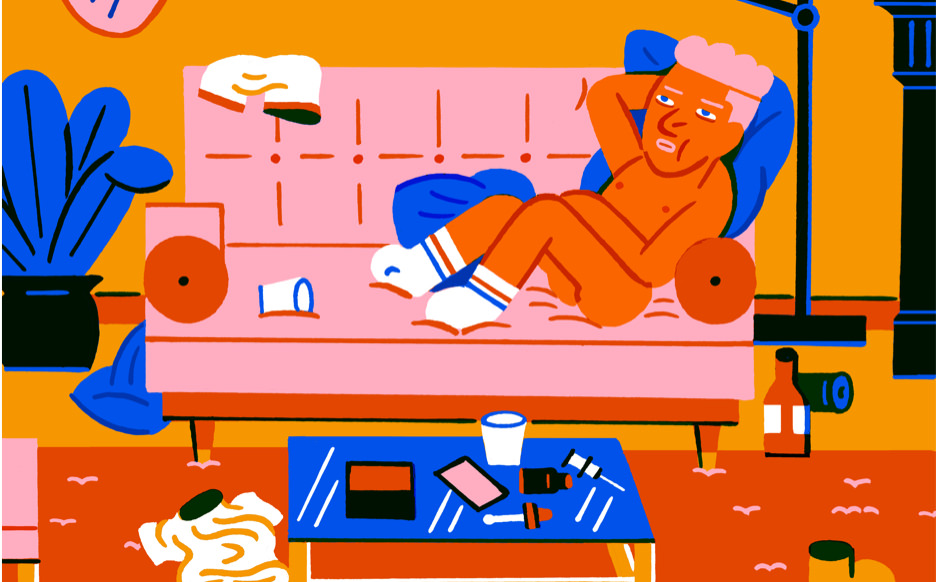
A drawing shows a men after a Chemsex session. Credit : Alias/Chemsex.be
What is being done?
Not much. Chemsex is mainly absent from the core priorities of Belgian public health policy, as well as in France. "It's the same thing when the HIV/AIDS epidemic erupted, because it concerned gays, nobody cared. We can't even assess the situation to know how many deaths, comas and other damages," says Roméro.
"There is no dedicated national strategy or structured funding to support affected individuals or the organisations working on the ground", confirms Jeremy Minet, a social and outreach worker at Ex Aequo, a Brussels-based association that offers community-based welcome through free testing and prevention materials.
The issue is often handled in a fragmented way, at the intersection of sexual health, mental health, and drug policy, which complicates a holistic, coherent, and coordinated approach.
At the European level, some countries are taking more proactive steps. Spain, for example, recently introduced a proposal for a European policy on Chemsex, which could serve as a model or catalyst. This kind of initiative shows that it’s possible to see Chemsex not just as a fringe issue, but as a genuine public health concern, requiring cross-sectoral, integrated responses tailored to the realities of those involved.
"Belgium would benefit from following such examples to move beyond sporadic reactions and build a structural strategy in collaboration with associations, frontline professionals, and the communities concerned", Minet says.
Many healthcare professionals are unfamiliar with the realities of Chemsex, which leads to fear or rejection. As the practice shifts into more private and digital spaces and as new substances complicate harm reduction, the focus must move away from moral panic, demonisation or caricature.
The complexity of this practice is not only limited to gay people, but is quickly spreading to other parts of society. Reducing harm related to Chemsex is not defined by abstinence, but by informed choices and working on emotional well-being. What started as a marginal issue is now a mirror reflecting broader social, psychological and structural realities. Those realities could also be the predominance of sexual culture in the gay community as a form of freedom and self-expression. But an existential question arises: What is real freedom?
If you are struggling with your relationship to chemsex, drug use, or experiencing suicidal thoughts, you are not alone. Support is available, without judgement :
In case of an emergency
Ex Æquo offers confidential advice and harm reduction tools: www.exaequo.be
Drugs Info Service (Belgium): 02 227 52 52
Suicide Prevention Lifeline (Belgium): call 0476 53 00 84 or visit www.preventionsuicide.be
Reaching out is not a sign of weakness, it’s a step toward care, dignity, and support.
