
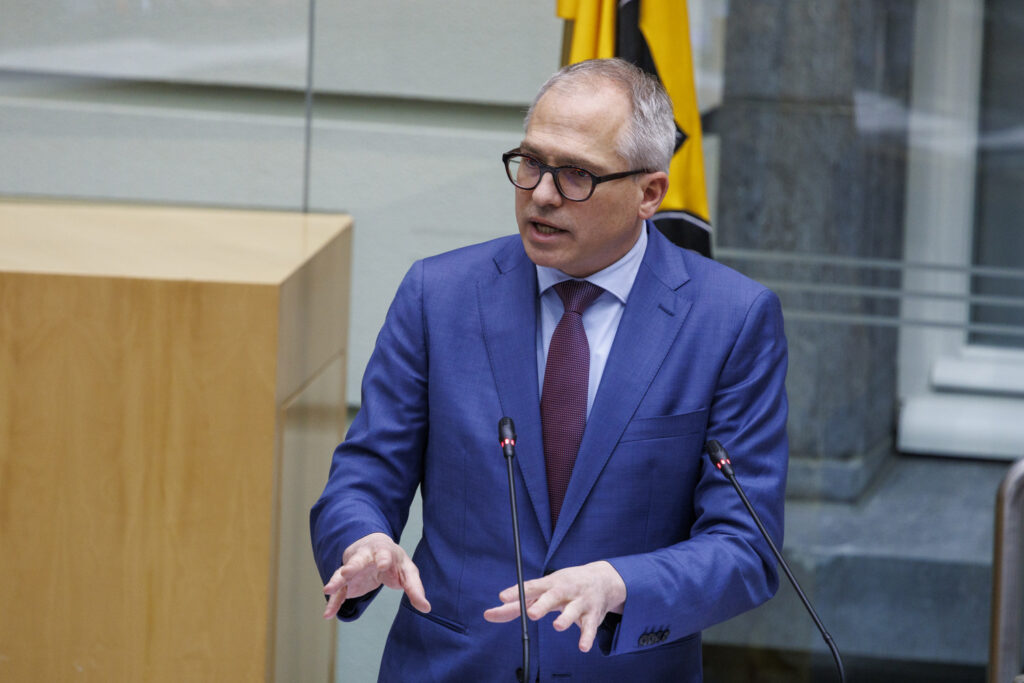
The Flemish government is urging the European Union to concentrate on its core responsibilities, emphasising security and competitiveness, as reflected in the future EU vision presented on Wednesday by Flemish Minister-President Mathias Diependaele (N-VA).
The vision document, which will serve as a guide for assessing European legislative and other initiatives, outlines how the Flemish government believes the EU should evolve in the short and medium term. It calls for the EU to return to basics by protecting security, enhancing competitiveness, and respecting Member States' individuality, according to Diependaele.
In the document, the Flemish government advocates for a stronger migration policy. It suggests that illegal migration must be tackled firmly with border control and efficient repatriation procedures. Non-EU countries wishing to collaborate should participate in the return of illegal migrants, and internal activation within EU countries should precede legal migration from outside the EU.
Top priority is Europe's economic project, its 'backbone'
For defence, Flanders seeks increased European cooperation without duplicating NATO, focusing on joint investments in defence research, weapons production, and protection against cyber-attacks.
The top priority for the Flemish government is the economic project, described as "the backbone of the EU."
The IMF has calculated that internal trade barriers for goods within the EU are equivalent to a 45% tariff, rising to 110% for services.
"We might get upset about US president Donald Trump's tariffs, but the real threat lies within, with much work needed on the internal market," Diependaele argues. "We can achieve significant economic growth without relying on Trump or China."
'A more realistic environmental and climate policy'
Flanders also calls for a more realistic environmental and climate policy, with rules that do not prescribe specific technologies, but allow feasible and effective solutions. It wants adjustments to the ETS1 emission trading system reduction pathway, which currently requires CO2 reductions that are "technically and economically unfeasible" for heavy industry.
According to Diependaele, the European Commission has made some "right choices," like limiting the scope of the directive on sustainability reporting (CSRD) and allowing partial delays, but challenges remain. "We are cautiously optimistic and will observe the final actions and how they translate into regulations," he said.
"The Schuman Declaration is 75 years old this year," Diependaele added in a press release. "The founding message of the European Coal and Steel Community (ECSC) remains relevant: peace through economic cooperation.
The subsidiarity principle
"The Flemish government is asking the Union to revisit this goal: deepen the internal market, turn innovation into jobs, and support rather than drive away our industry with climate policy."
Finally, as a federal region that participates in European decision-making, the Flemish government seeks more influence in the process. Simultaneously, the subsidiarity principle, whereby the EU acts only if more effective than national, regional, or local actions, remains "essential."
Flanders also opposes EU expansions into education and culture.
"An EU that focuses on its core tasks is an EU that works for the Flemish people," Diependaele stresses.
