
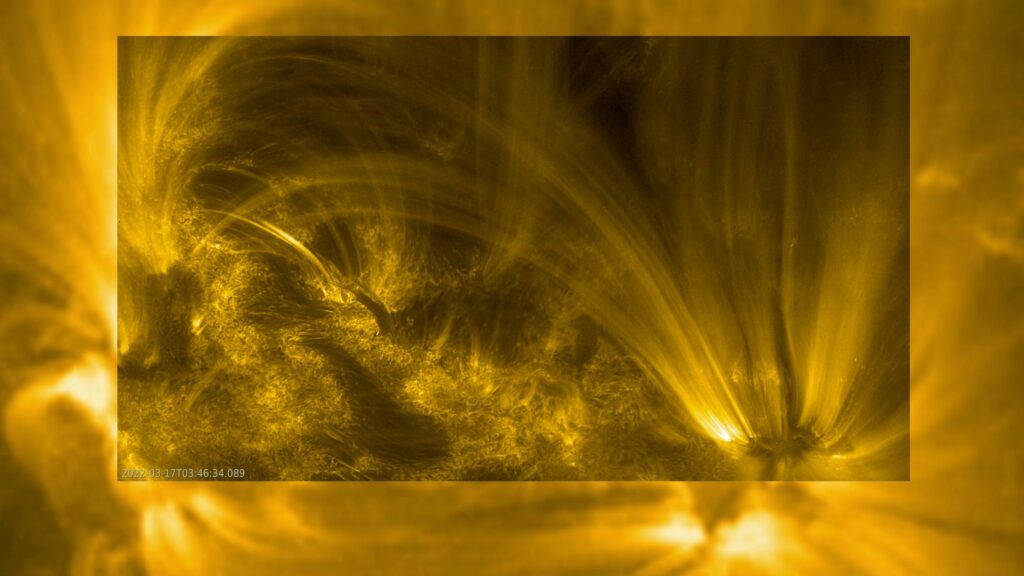
Three telescopes on the Solar Orbiter space probe that were largely constructed in Belgium have captured top-down images of the Sun’s north and south poles for the first time ever.
These images are expected to enhance understanding of the solar cycle, according to the Royal Observatory of Belgium.
Solar Orbiter has been orbiting the Sun since 2020, and in five years its Extreme Ultraviolet Imager (EUI) telescopes have taken nearly a million images.
The probe recently completed a manoeuvre around Venus, slightly altering its orbit through gravity assistance, granting the telescopes a novel vantage point of the Sun’s poles.
“Until now, humans have only viewed the solar poles from the side, with the Sun’s rotation axis at an angle of about 90 degrees to our observation direction,” explained David Berghmans, lead researcher for EUI. This perspective is now changing. “We observed the Sun’s south pole for the first time in March and its north pole in April, at a modest angle of 17 degrees.” This angle is set to increase to 34 degrees in the future.
The initial images from this new perspective of the solar poles are yet to be analysed but are anticipated to provide “essential information to explain the 11-year solar cycle,” according to Berghmans.
The EUIs were constructed primarily at the Liège Space Centre, with assistance from French, Swiss, German, and British partners.
