
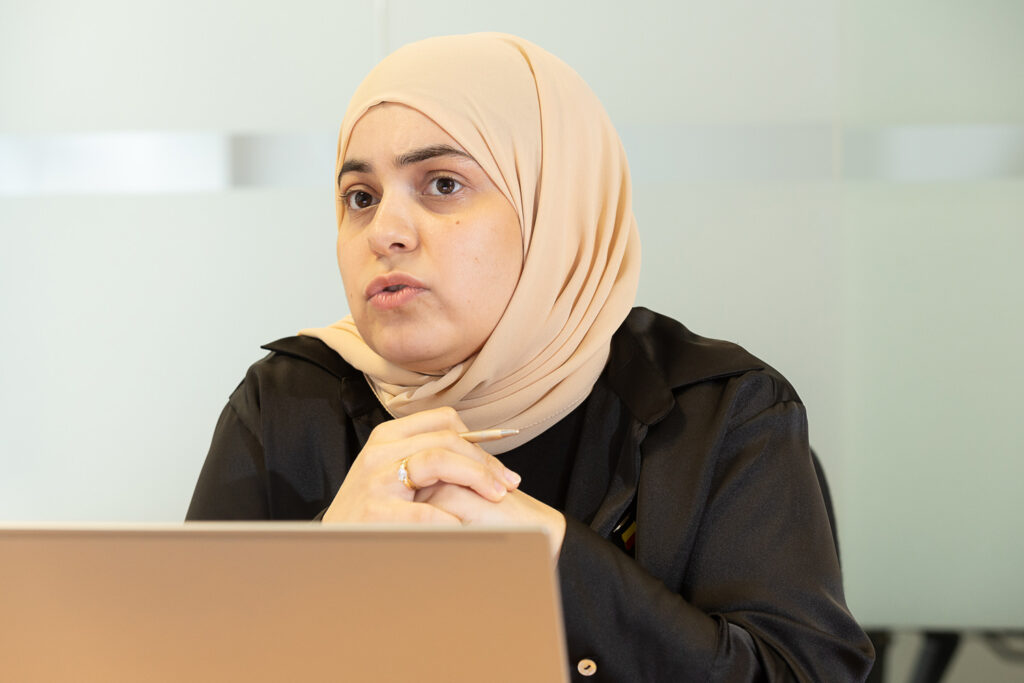
The Muslim Council of Belgium (MRB) is approaching Federal Justice Minister Annelies Verlinden (CD&V) to request definitive recognition as a representative body for Islamic worship in Belgium – following the much-criticised Muslim Executive.
Over the past two years, the MRB's chair Esma Uçan has worked hard to ensure the council's representativeness within the Belgian Muslim community. The organisation is the successor to the Muslim Executive, which came under fire due to foreign interference, among other things.
In June 2023, former Justice Minister Vincent Van Quickenborne (Open VLD) gave the MRB temporary recognition (for two years) as a representative body for Islamic worship in Belgium.
However, as this recognition expires in June, current Justice Minister Verlinden must decide on definitive recognition of the MRB. The Council sent Verlinden a letter to point out the renewal process of the past few years.
'Up to our own community'
The establishment of the new body led to harsh criticism within the Muslim community (particularly from 22 Ghent mosques), but chair Esma Uçan has taken that criticism to heart. "I have a temporary mandate. I am not here as a great theologian who tells you how things should be, but as a reconciler," she said.
She emphasised that the mosque umbrella organisations are also represented in the renewal process, including the Ghent one. The MRB worked with a renewal committee from January to June 2024, consisting of representatives from almost all Muslim communities in Belgium, on a new general meeting. "The harshest criticism came from our own community, so we said: now it's up to you," said Uçan.
The new general meeting consists of 45 members; 30 seats are reserved for representatives of all mosques and communities (from Bosnian Muslims to sub-Saharan Muslims, and the Shiites, a minority within Islam, also get a few seats, as do converts). The remaining 15 seats go to imams, Islamic teachers and Muslim chaplains in prisons – a group that was previously not represented.
The new assembly met for the first time on 19 April. On 31 May, they will elect a new board of eleven members, including a new chair. Uçan is not a candidate.
Remarkably, the Turkish Milli Görüs and Diyanet mosques did not participate in the renewal process. Their reserved seats will remain empty for the time being. The Diyanet umbrella organisation has more than 60 mosques in Belgium, 43 of which are in Flanders, and is managed by the Turkish Ministry of Religious Affairs. It has often been criticised for foreign interference.
Meanwhile, the conservative Turkish Islamist Milli Görüs movement has also been the subject of controversy. It has around 29 local branches, mainly in Flanders.
"Milli Görüs and Diyanet have voluntarily abstained," said Uçan. "Our door remains open and we are keeping their seats free. It is human nature that there are difficulties. That is part of the process. However, we can work well with the religious communities. It is a pity that this is not reflected higher up," she said.
It is unclear what this means in the long term for the recognition of the Milli Görüs and Diyanet mosques.
"Islam is organised differently than, say, the Catholic Church. There is no 'natural' hierarchy in the Muslim world," said Uçan. "That has consequences for our way of working. We mainly want to take on a service-providing role. The preparation for the recognition of a mosque is done through us. We submit the file to the government. The politicians make the final decision."
Rift with the past
Previously, the Muslim Executive sometimes pretended to be the only representative body of all Muslims in Belgium. "Perhaps that is the biggest rift with the past. We are a consultative body that represents the administrative interests of the Islamic religion," Uçan said.
The services provided by the MRB include the management of plots of Islamic cemeteries, the support of chaplains and the training of Islamic teachers. The latter is currently only provided in Brussels and Wallonia.
Former Flemish Education Minister Ben Weyts (N-VA) designated the Centre for Islamic Education (an organisation linked to the previous Muslim Executive) as the competent authority in 2023. The MRB is currently contesting this decision at the Council of State.
"I do not want to pre-empt the facts. Since the case is still ongoing, I cannot say much about it. Although it does indicate that the influence of the Executive is still present," said Uçan. While the Executive has officially lost its recognition, its website is still active.
A new royal decree must seal the definitive recognition of the Muslim Council by 25 June at the latest.
