
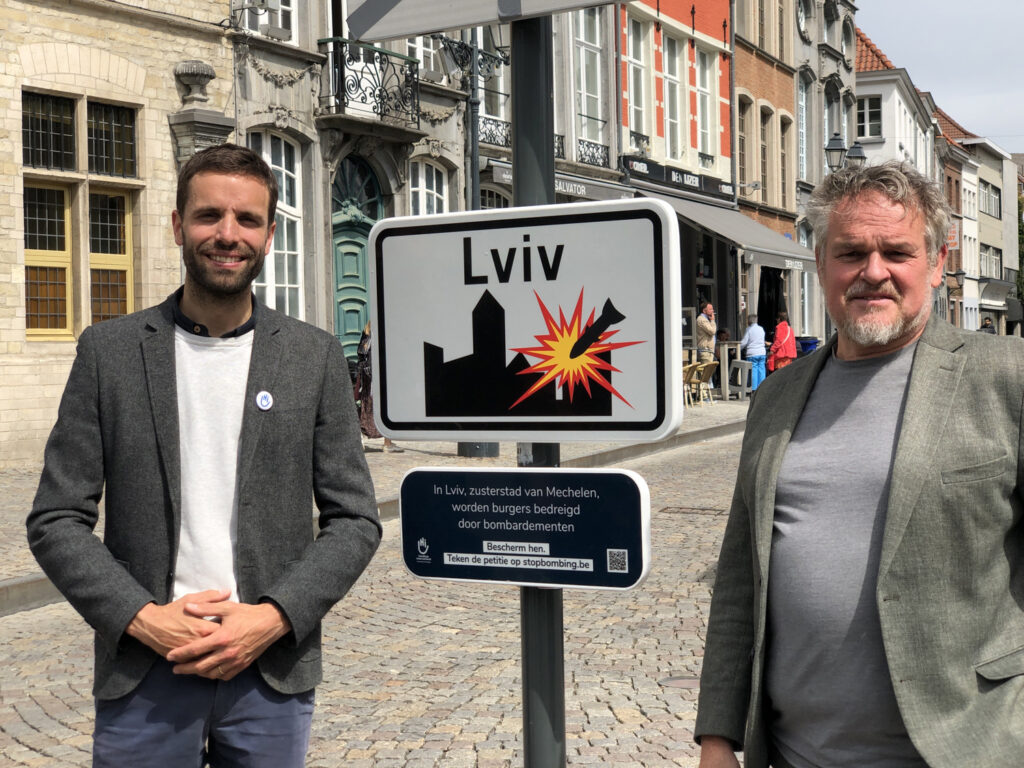
In several Belgian cities, street name plaques from war-torn paired cities have been installed by Handicap International to raise awareness about the impact of explosive weapons and encourage citizens to sign a petition urging the Belgian government to enhance protection for civilians in conflict zones.
In Mechelen, street plaques from Lviv, a sister city in Ukraine, were unveiled at five locations, featuring a link to the online petition “stopbombing.be,” which calls for Belgium to strengthen civilian protection in war zones.
“We are asking our governments to assume a more significant role,” said Antoine Sépulchre, director of Handicap International. “Ninety percent of the victims of bombings, landmines, or cluster bombs are civilians.
While some die, many more are injured. Handicap International has been campaigning against the use of explosive weapons for over forty years. Our country must play a larger role in ensuring international treaties are respected.”
Approximately 160 countries have banned landmines, yet Handicap International notes that some nations are reconsidering their use. “Poland, as well as some Baltic states and Finland, have indicated intentions to recycle or even produce landmines,” Sépulchre continued. “Their use is simply catastrophic.”
Handicap International stresses the ties between Belgian cities and their counterparts in war zones to highlight the issue. “We must take responsibility; there are many deaths, but even more injuries,” remarked Patrick Princen, Mechelen’s alderman for international relations. “We must ensure the respect of human rights everywhere.”
Elsewhere in Flanders, Edegem in the province of Antwerp has installed street plaques from the Ukrainian city of Novovolynsk, with which it is twinned, while Tournai has done the same with plaques from Bethlehem.
Handicap International hopes its petition will gather around 25,000 signatures by the end of October, ahead of the international conference on the use of explosive weapons in Costa Rica, which Belgium will also attend.
