
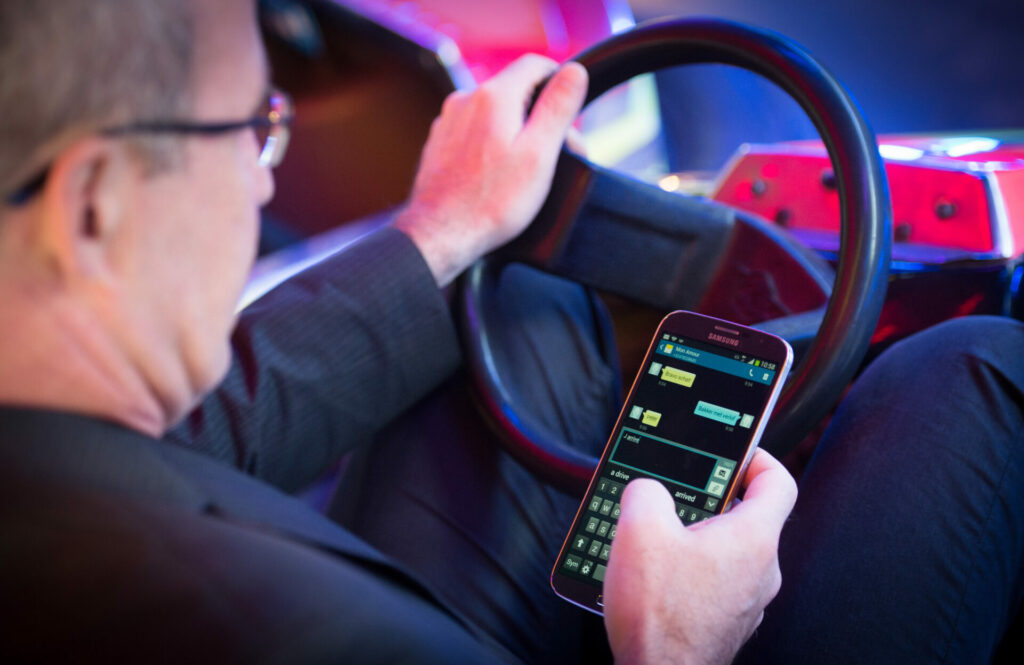
The 'focus flasher' is the latest gadget being used in the Netherlands to catch drivers using their mobile phones behind the wheel. Anyone caught is fined €430. Across the border, road traffic institute Vias has been campaigning for Belgium to start using this technology for years, but privacy concerns remain an obstacle.
After months of testing, the first new 'focus flasher' is now up and running in the Netherlands. The device has a camera that can detect whether someone is holding a mobile phone 24 hours a day. The photos are then checked again by an authorised person.
The cameras had been tested in The Hague since February to assess the quality of the images, and finally came into service at the start of this week. Other Dutch cities are due to follow suit in the coming months. Some 40 cameras will be installed along the roads this year to catch drivers holding their smartphones while driving. Another ten will be added next year. Anyone caught – including foreign nationals – will be fined €430.
Up to 14 offences per hour
In Belgium, Vias has been calling for such cameras to detect mobile phone use while driving for years. Five years ago, a two-month trial was conducted at the Oosterweel roadworks in Antwerp. According to the institute's spokesperson, Stef Willems, "up to 14 offences were recorded per road per hour, mainly by truck drivers." Police officers would never be able to catch this many drivers without the technology, Willems confirmed to VTM Nieuws.
"Distracted driving, often linked to mobile phone use, remains one of the leading causes of death on the road. Increasing the chance of being caught, especially in dangerous areas such as roadworks, can lead to fewer accidents."
Regarding privacy concerns, the spokesperson underlined that the General Data Protection Regulation (GDPR) is the same throughout Europe. "This should therefore also be possible in Belgium. However, it must of course be clearly described how data is handled."
However, an amendment to the Highway Code would be necessary. The Federal Government plans to adopt a similar measure: the coalition agreement mentions "a legal framework, complying with all applicable privacy rules [to] make it possible to detect the use of a phone while driving using an automatic and autonomous device."
The office of Mobility Minister Jean-Luc Crucke (Les Engagés) said this is a "clear political priority" for Belgium. On privacy, Crucke added that the cameras do not use facial recognition, that images in which no violation can be seen are automatically deleted, and images showing a violation are always checked again by a police officer. "With this project, we want to use technology in a proportionate, transparent, and privacy-friendly way to combat distraction in traffic – a major cause of accidents."
Related News
- Nearly 80% of Walloon drivers admit to using phone behind wheel
- 'Taking more risks': 80% of road traffic fatalities are men
- Brussels police launch crackdown on distracted driving
The De Wever government wants to speed up implementing the legislation on these cameras so that they can be operational by 2027.
Willems emphasises that the measure could have a major impact, which is needed as a staggering 75% of drivers reportedly use a phone when behind the wheel.
If someone is driving at 50 kilometres per hour and looks at a screen for three seconds, they have already travelled 42 metres. As a driver, you may not notice a red traffic light or pedestrians crossing the road in time, according to Het Laatste Nieuws. "Those three seconds can cause life-threatening situations," the spokesperson said.
