
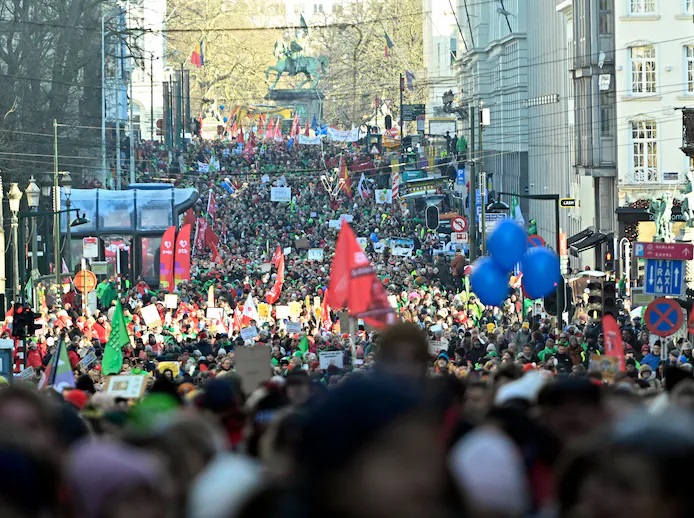
In recent months, a wave of strikes has swept through Belgium. The power of trade unions remains strong in international terms, even though there is growing pressure at the political level in Belgium to limit it.
Last Tuesday saw what is likely to be the last major trade union strike against the federal government's plans. A relief for some, and yes, a shame for others, but it was ten years ago that trade unions last organised such large-scale protests against the government.
“The strike action of the past few weeks is not unusual, except in the railway sector, where there was an escalation, mainly driven by small trade unions that want to assert themselves. You only need a small group of train conductors to strike to have a big impact,” says Noah Vangeel, affiliated with the Labour, Organisation and Social Dialogue research group at HIVA (KULeuven).
“Train strikes are also the actions that are most noticeable to the general public, even if there is minimal service. The main reason for the strike action is the federal government's pension plans, but there are others: the government wants to limit unemployment benefits over time and introduce measures relating to flexibility, night work and the minimum number of hours that must be worked," Vangeel tells The Brussels Times.
"There is an additional aspect: many of these measures are already laid down in collective labour agreements (CLAs), which companies negotiated with the trade unions. The government is disregarding this social dialogue, which is causing additional concern.”
Stan De Spiegelaere, professor of Social Dialogue at Ghent University: “The last major wave of strikes, in 2014, was directed against the Michel I government, but at that time there was also a clear progressive demand: the tax shift, which in a distorted form has become a tax cut. The demands are today less offensive; it is mainly a protest against the plans of the current government.”
The harsh trade union action of the past few months has now (temporarily) come to an end. A trade union meeting is planned for 25 June, although it is not yet clear whether this will be a strike or a demonstration. But even now that the trade unions have pressed the pause button, Belgium is still one of the European leaders in strikes.
Data from the international trade union organisation ETUI show that Belgium ranks third in Europe in terms of the number of strike days for the period 2010-2019. Only Cyprus and France score higher, with the caveat that data are not available for all countries.
Stan De Spiegelaere: "Broadly speaking, it is true that we are the European frontrunner. In terms of working days, we are usually in the top three. But it is a bit like comparing apples and oranges: we have a tradition of occasional general political strikes and occasional national demonstrations linked to strike days. In many other countries, this is not the case, firstly because there is no strike pay or because large political strikes are prohibited, or at least not protected by the law.”
Belgium is one of the countries with the strongest trade unions in the world. Almost half of all employees (49.1%, according to the latest figures) are members of an association that defends their interests. In neighbouring countries Germany, France and the Netherlands, this applies to less than 20% of employees.
“The strength of the trade unions is embedded in our system,” says Noah Vangeel. “They play an important role in the collective labour agreements that are established for each sector. Ninety-six per cent of employees are covered by such an agreement.”
Stan De Spiegelaere: “Every company with more than 50 employees must organise social elections. This means that many companies have trade union representation. Trade unions are also very present in other ways: they are responsible for the payment of unemployment benefits and also play a social and political role. When there are important social debates, they make their voices heard.”
Almost half of Belgian employees are therefore members of a trade union, but in recent years this figure has been falling slightly.
Stan De Spiegelaere: “The trade unions sense that the exceptional Belgian situation, where you have a stable number of affiliated employees, may be coming to an end. This is partly due to political pressure. Some parties want to significantly curtail the power of the trade unions. But there are other reasons too. We have a more service-based economy than in the past, whereas trade unions have traditionally been strong in factories. There are also more small businesses, which do not always have union representation. In addition, the flexibilisation of the labour market is also having an impact.”
Noah Vangeel: “Today, 40% of the labour market consists of highly educated people. They are more assertive and more likely to believe that they are better able to negotiate their own terms of employment. The fact that we are doing well economically in Belgium also plays a role. For this reason, people see fewer reasons to join a union, although unions still play a different role. For example, they check whether all the rules are being followed.”
In the wake of the recent strikes, there are doubts as to whether the population has much sympathy for the trade unions’ actions. Employers’ organisations in particular have been highly critical of them.
Stan De Spiegelaere tells The Brussels Times that “there are no recent polls that tell us anything about public opinion on trade union action, but confidence in trade unions remains high and is even on the rise. It is greater than that in political parties."
"That does not mean that people approve of every action, of course. Many people support them because they receive good help with legal questions or because they have a good representative,” he adds.
The extent to which strike action is effective is another question. It is difficult to answer that, says Noah Vangeel. “The strike on 13 January, for example, did have an effect on the coalition agreement. Strikes often mean that things are not as bad as they seem. But in general, trade unions also find it more difficult to exert political influence. The political climate is not favourable for them.”
Stan De Spiegelaere: “In the past, there was broad support for strong social dialogue. The predecessor of the employers’ organisation Voka, for example, was in favour of strong trade unions. Today, the N-VA and MR are taking decisions that make things more difficult for trade unions. But we are not in the same situation as in the United Kingdom in the eighties, where trade union membership crashed in ten years.”
