

The Federal Government's so-called "core cabinet" (the Prime Minister and his five Deputy PMs) are meeting about the introduction of a capital gains tax for the first time on Friday, but the road to an agreement is expected to be long and winding.
The issue almost led to a collapse of government talks last summer, and the different government parties are still not in agreement on many points in the bill. On Friday, the intention is to exchange ideas for the first time, with a view to reaching an agreement by the summer.
On Wednesday night, the government reached an agreement on the programme law, which contains a first series of the socio-economic reforms agreed on in the Easter agreement – including the phased introduction of the limitation of unemployment benefits over time.
However, the Flemish socialist Vooruit party has always stated that this reform of unemployment benefits would only be possible for them if a capital gains tax – which should make "the strongest shoulders" contribute more – was introduced as well.
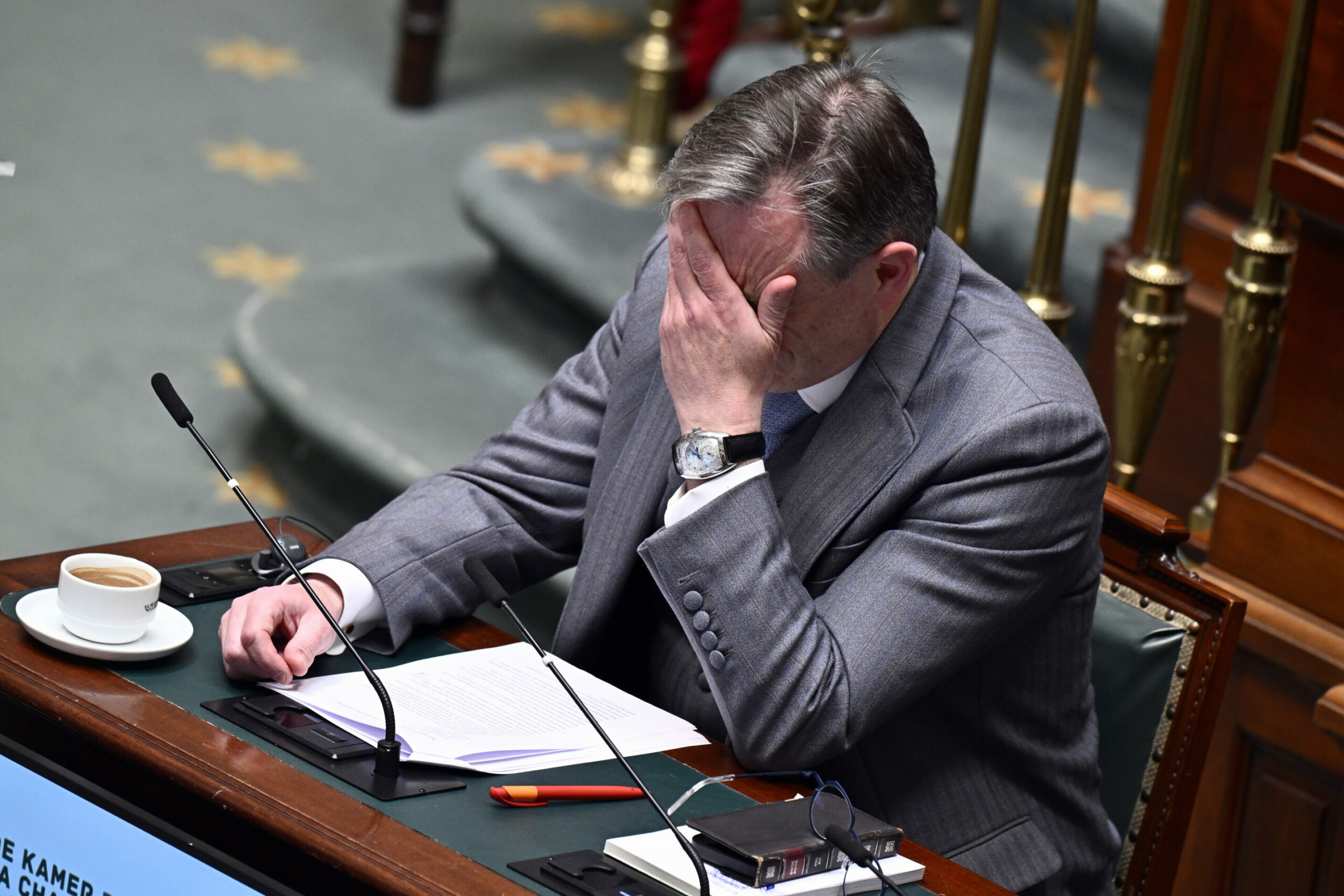
Prime Minister Bart De Wever pictured during a plenary session of the Chamber at the Federal Parliament in Brussels, 3 April 2025. Credit: Belga/Eric Lalmand
While the agreement was reached on the unemployment benefits, it has not yet been voted on in Parliament. And on Thursday evening, Vooruit made it clear that such a vote will not happen until an agreement on capital gains is reached as well.
"There will be measures that affect everyone or none at all," Vooruit leader Conner Rousseau said on VRT in the evening.
He warned that his party would neither accept a capital gains threshold of €20,000 (as proposed by the Flemish Christian-Democrats CD&V), nor an exemption after ten years (as desired by the Flemish right-wing N-VA and Francophone liberal MR).
What is the capital gains tax?
The coalition agreement states that a 10% tax on capital gains will be levied on financial assets, insurance contracts, crypto assets and currency.
These financial assets include listed and unlisted shares, bonds, money market instruments, derivatives, mutual funds and ETFs (stock market trackers). The insurance products include savings insurance (branch 21, branch 26) and investment insurance (branch 23).
The draft provides for a general abatement for the first €10,000, De Tijd reports. For shareholders with a 20% stake in a company – the substantial interest – there will be an exemption of up to €1 million, followed by a graduated rate scale from 1.25% to 10%.
Immediately after the coalition agreement was concluded, however, it became clear that MR read that provision differently from Vooruit – making for difficult negotiations.

MR leader Georges-Louis Bouchez. Credit: Belga / Benoit Doppagne
On Thursday, the socialists stressed that Belgium is the OECD country with the largest difference between the taxation of earned income and capital income, but also that the wealthiest percentile pays proportionally much less tax than the middle class.
Therefore, the party insists on the "fair introduction" of a capital gains tax, pointing out that the measure is widely supported in the polls.
Additionally, this 10% capital gains tax on the table is still "quite generous," they argued. Rousseau referred to the average capital gains tax in the EU, which is 18.6% – and even 30% in France and the Netherlands. They added that an exemption for amounts up to €10,000 is provided in the coalition agreement.
Several other adjustments and exemptions have been proposed, but these are deemed "unacceptable" by Vooruit. The party stressed that there is (almost) no room for negotiation, as the government agreement remains the only legally binding text.
