
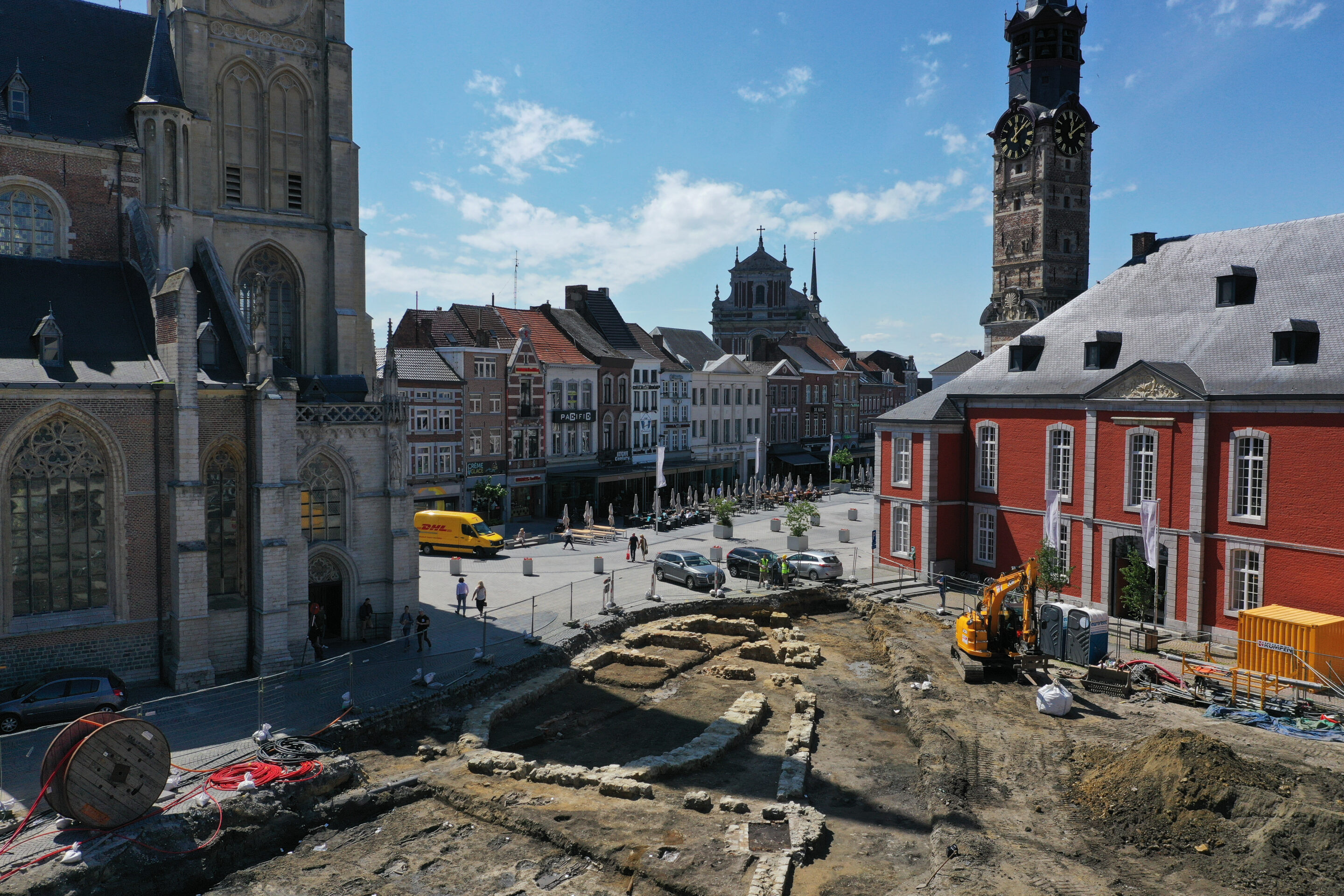
Skeletons, black death and migration: the discovery of thousands of skeletons in the main square of Belgium’s Sint Truiden ignited the largest DNA study in the world for one single cemetery – unearthing thousands of years of Belgian history in the process.
During archaeological excavations in 2019, over 3,000 skeletons saw daylight for the first time, in (what later was understood to have been) the city’s medieval cemetery. It is linked to the ancient abbey, which was built by the Sint-Truiden’s founder, the eponymous patron saint.
Buried between the 8th and 18th centuries, around 400 individuals were selected by KU Leuven researchers for DNA testing, with the results finally published this week. They retrieved the remains from the two archaeological sites ‘Groenmarkt’ and ‘Sint Trudo’.
Some of the findings are monumental: the discovery of the first ever traces of Black Death in the Low Countries; the unexplained presence of 5 individuals with Irish and Scottish DNA; and the vast genetic difference between Flemish regions in the early Middle Ages (8th to 10th centuries).
From this, we gauge new insights into how migration, urban development, family structures, and epidemics shaped the genetic landscape of this medieval city and of the broader Low Countries.
Gallic or Germanic
“It's fascinating to see the genetic data from thousands of years here in one little city,” says KU Leuven professor and genealogist Maarten Larmuseau, who co-led the study. “We could sample so many individuals from such a long period and same place, making it the biggest study ever for one location.”
The archeological site had its place as a cemetery for over 1,000 years, dating back to the 8th century. The city itself was founded in the 7th, which led to the construction of the city around the abbey.
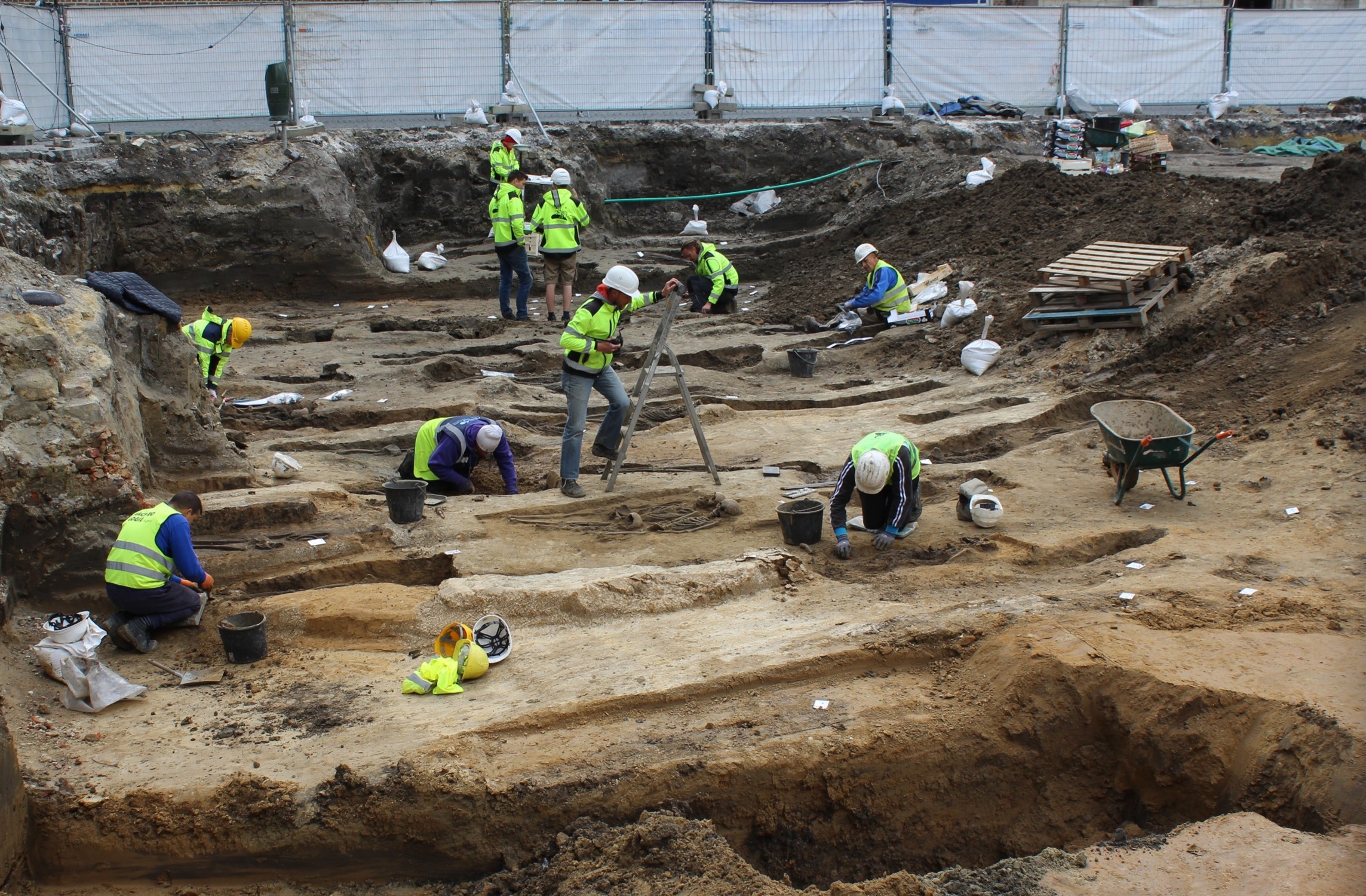
The archeological site in Sint Truiden, where 400 skeletons were tested for DNA in the world's largest DNA test for one single site. Credit: Aron bvba.
The findings show how the genetic structure of the Low Countries resulted from centuries-long mixing between two major ancestral groups: one of ‘Gaulish’ origin and one of ‘Germanic’ origin.
In the cemetery, it was found that individuals, from all studied periods, were found to have a higher level of Gallic ancestry than Germanic. This is also reflected across Belgium, Larmuseau continues.
“Today it's a little bit more Gallic than Germanic and if you go to the Netherlands and to the north, you always see less and less gallic DNA,” he continues. The picture is not always clear, however, as a previous study in West Flanders revealed higher Germanic proportions, even if geographically, it is further away from the Germanic heartlands.
“We also want to understand why there is a language border in our country,” the professor continues. “Is it because more Gallic people stayed here, and that's why in the south of Belgium, they speak French and in Flanders we speak Dutch?”
Walloons and Flemings have closer DNA origins than that of Flemish people and their Dutch neighbours. Larmuseau explains that this is also partly down to geography and how close together ancestors lived, yet it does not in itself help understand the language difference.
Humans on the move
“Migration in the early Middle Ages can explain the language border – and we think that by doing this kind of research, also in Wallonia and in France, we can reconstruct the migrations in those early Middle Ages.”
The Sint Truiden cemetery study also reveals how migration was clearly much higher in the early medieval period than in the later centuries. This is proven by the vastly different genetic composition of skeletons found in the older parts of the cemetery.
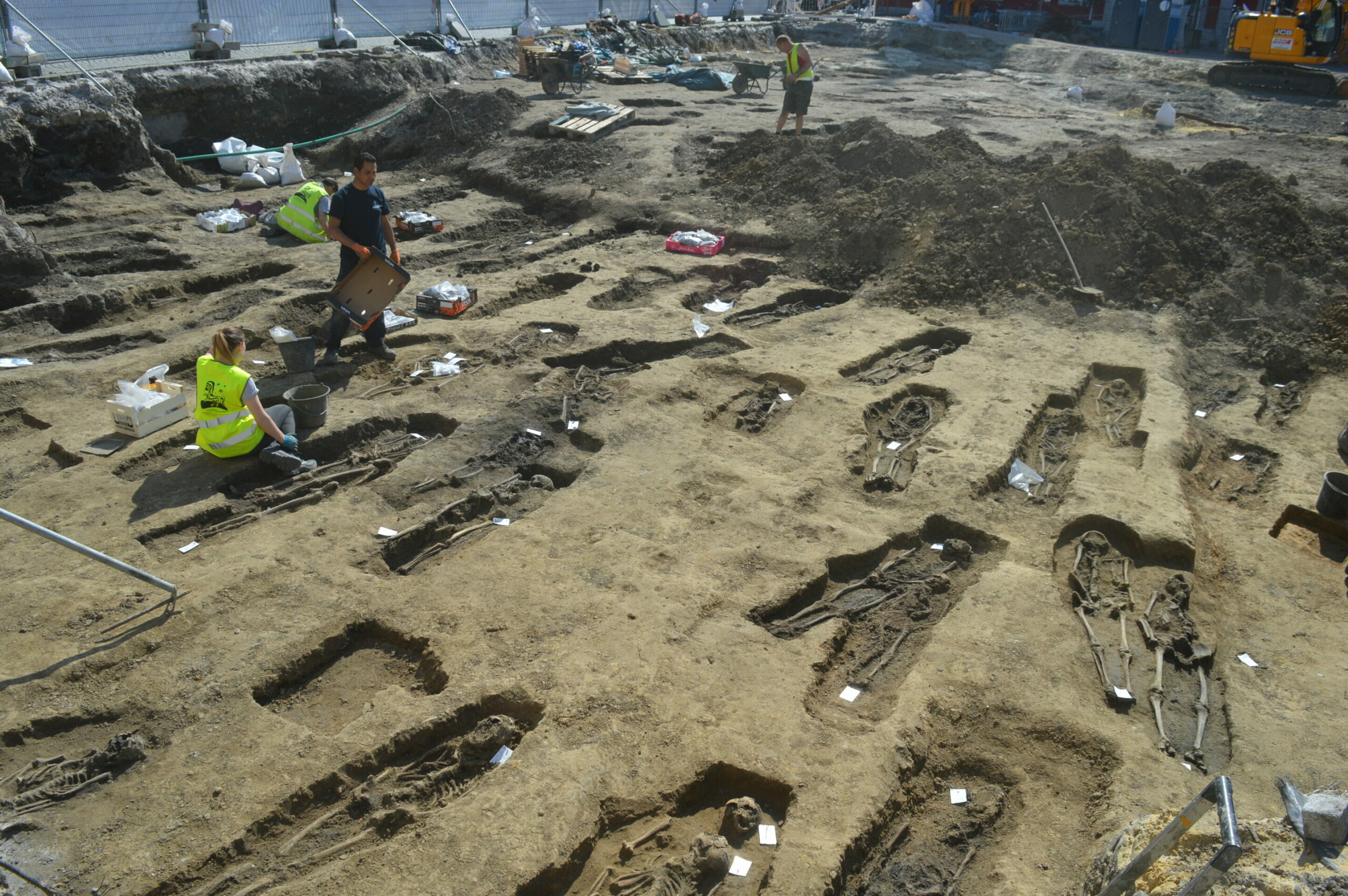
The archeological site in Sint Truiden, where 400 skeletons were tested for DNA in the world's largest DNA test for one single site. Credit: Aron bvba.
“At that time, the genetic differences between regions within present-day Flanders were almost as large as those between present-day Belgians and Spaniards," says Owyn Beneker, PhD student at KU Leuven and first author of the study.
The great human migration seen in the early medieval period is further documented by KU Leuven’s DNA evidence. After the 11th century, researchers did not find one person with DNA from outside the region – not the Mediterranean nor Ireland or England.
Yet it is the discovery of five individuals inside the Limburg cemetery with Irish or Scottish ancestry (from the early period) that has puzzled researchers – but the higher migration levels between the 8th and 10th centuries may help explain this.
All “completely match” with genetic profiles of Ireland and Scotland in the Middle Ages and today. They were buried in the older part of the cemetery and were all unrelated to each other. Only one was found in the vicinity of the abbey. There is no mention of an Irish or Scottish presence in the early period, even if the history of Sint Truiden is detailed thanks to the well-preserved chronicles of the abbey.
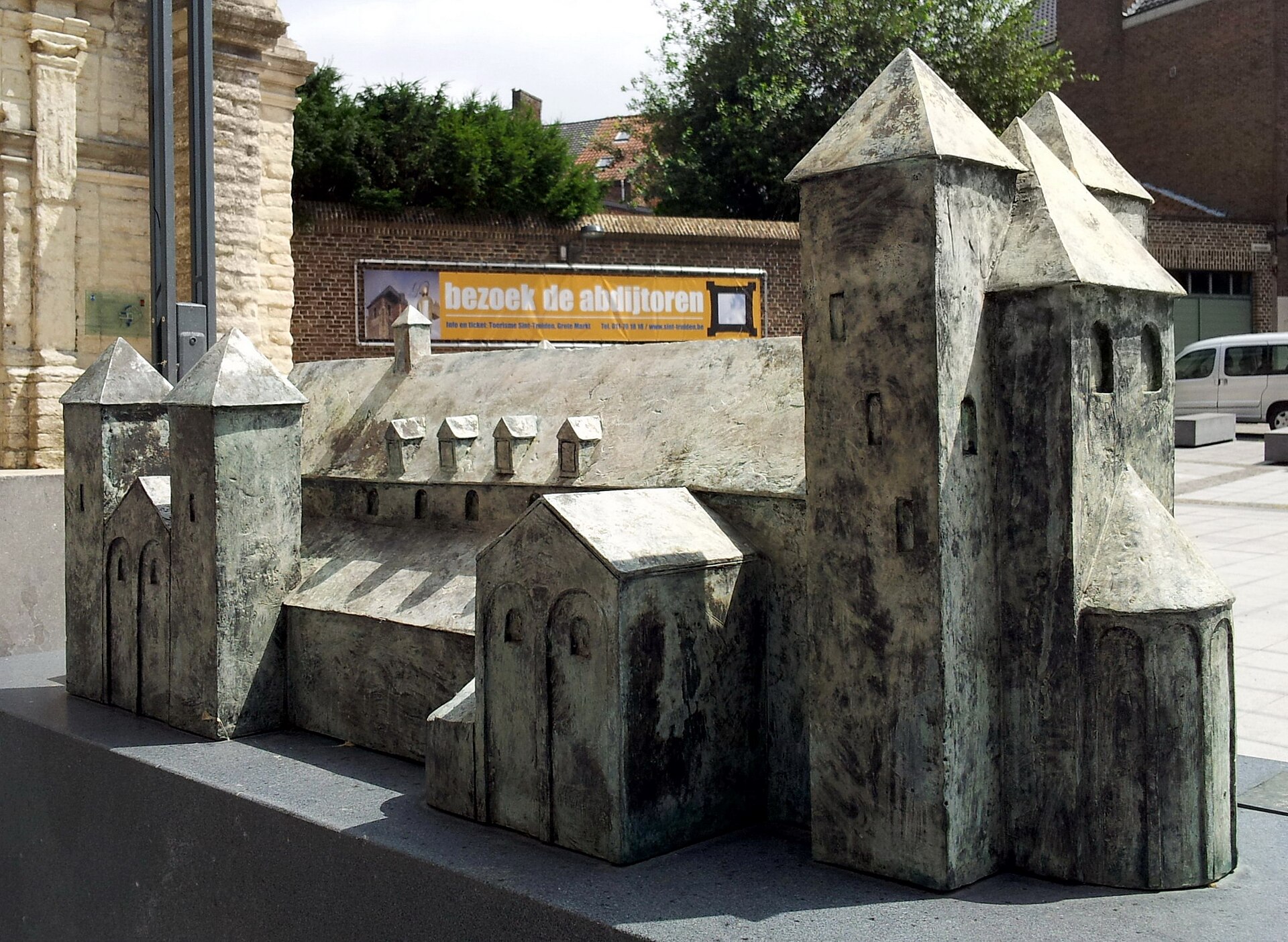
Model of the former abbey of Sint Truiden, demolished in 1798.
Another curious aspect of their DNA was the lack of mixing with locals or others. It can suggest they were the ones who migrated, or at most their parents and grandparents, as older generations would have had higher DNA merging with other places.
This posits the question: why were five unrelated individuals with Irish/Scottish ancestry in Sint Truiden in this period? The presence of the abbey could explain it. Professor Larmuseau argues that they may have been carpenters employed to build (or rebuild) the abbey. Maybe they were even monks of the abbey itself – but more research is needed. Either way, projects leaders are pleased with the discovery of the first remains of individuals from Ireland and Scotland in the Low Countries in this period.
Plagues & family trees
Another landmark discovery was the first trace of the 14th-century Black Death in medieval Flanders. It was known to be found in England and in Germany, but this is the first time it has been found in the Low Countries or in Flanders. The individuals were buried in scattered, individual graves.
“What was really interesting was that they were not buried in a mass grave, but really separated from each other. So maybe people at that time didn't know why they were dying,” Larmuseau continues.
There is no mention of the plague in the chronicles of the abbey and in the city records in the 14th century, but it is then found in the DNA – which is “amazing” , says the researcher.
The study of so many individuals, from the same place, has also allowed researchers to find family connections between the buried individuals.
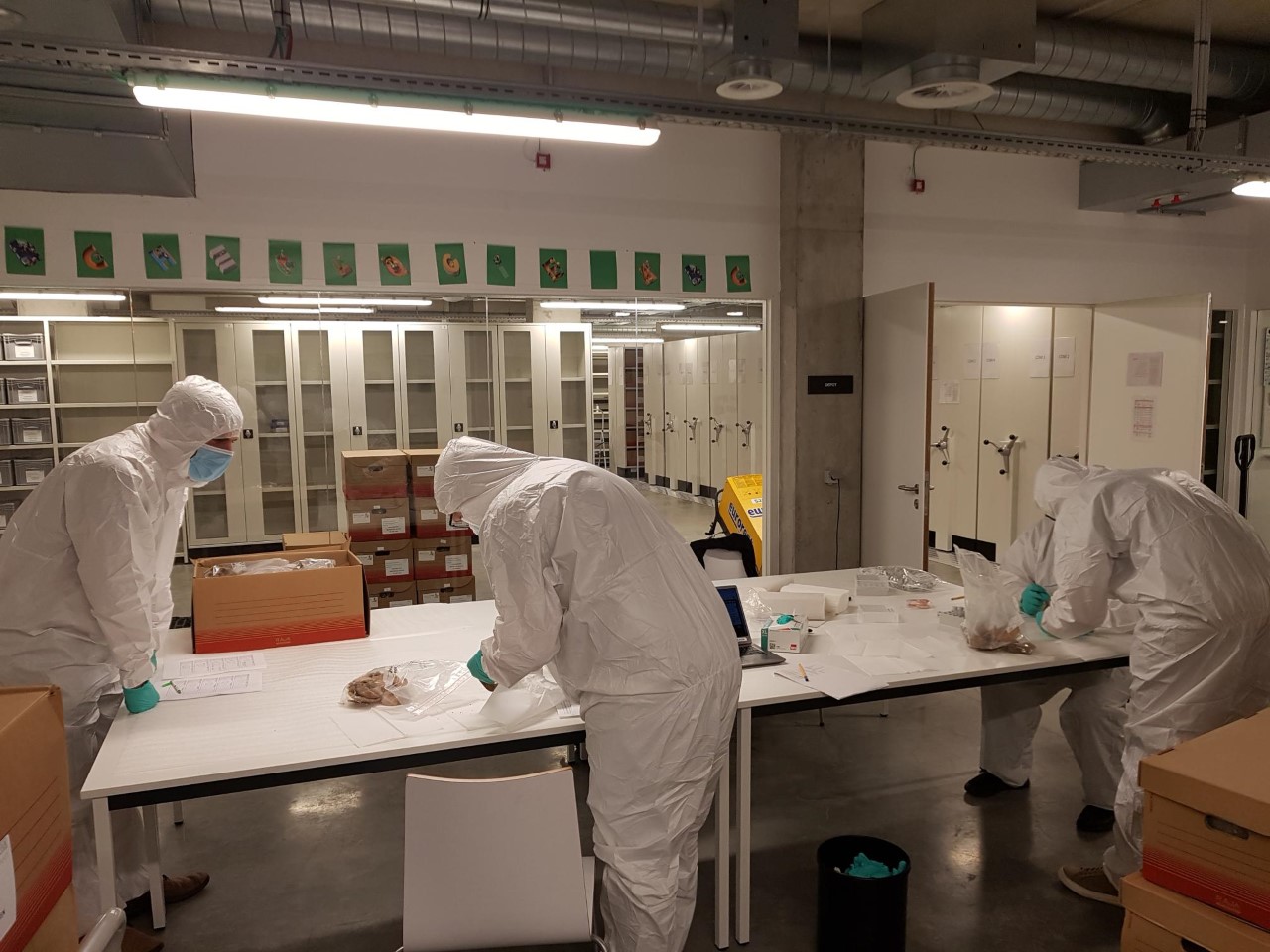
DNA testing by KU Leuven on skeletons from the Limburg cemetery. Credit: GAZO, Anneleen Mombaerts
“Purely thanks to DNA, we can see brothers, sisters, mothers and fathers, but also third cousins or second cousins,” Larmuseau says, adding it is fascinating for him as a genealogist.
In the Sint Truiden cemetery, relatedness was much lower than in another study from Cambridge, England, which was undertaken by fellow project leader at KU Leuven, professor Toomas Kivisild. During a similar time period, they found much higher relatedness in the English study.
Curiously, family members were found closer to Sint Truiden’s Abbey and the church. “That's because we think people and families from higher class will be buried very close to the church, and therefore we found much more relatedness closer to this part of the site.”
Not so Spanish
The study also seeks to compare the genetics found with similar studies in England, France, the Netherlands, Germany. This is to see how these medieval Limburgish folk relate with people from elswhere, while also helping redraw human migratory patterns in Europe.
For example, Belgians have always assumed, due to years of Spanish rule between 1556 and 1713, that many will have Iberian genes. Yet this is not proven by DNA evidence in KU Leuven’s landmark study.
“We still think that we have Spanish genes because it's so common in our history courses. We all presume, but on the other hand, those Spanish armies were very diverse and did not have many Spanish people.”
Indeed, Spanish genes are not found in the Limburg population, nor in current samples of contemporary Belgians, Larmuseau adds. He points to possible propaganda (connected to the religious wars) against the Spanish, particularly coming from the Netherlands. The same questions are not asked about Austrians, French or Germans, who also all ruled over Belgium and its previous iterations, he adds.
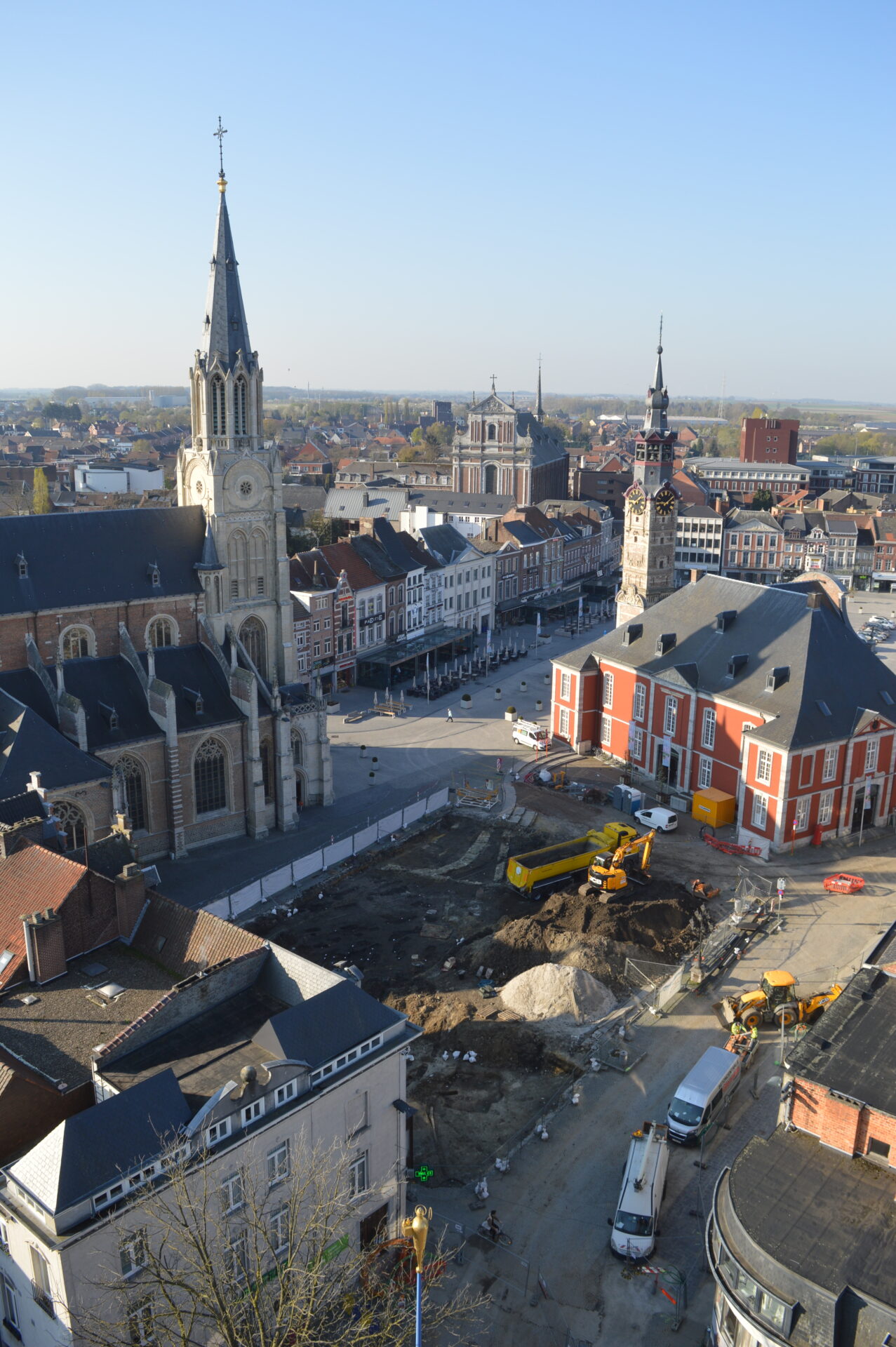
The archeological site in Sint Truiden, where 400 skeletons were tested for DNA in the world's largest DNA test for one single site. Sint-Truiden 2025. Credit: Aron bvba.
Moreover, these DNA studies can help people construct their family trees. Larmuseau is a genealogist who has traced his own family back to the 16th century in France, fleeing to West Flanders due to religious persecution. Genetic testing offers exclusive insights into migratory movements, particularly in periods where little documentation exists – such as the early medieval period, also known as the Dark Ages.
“We know of course about the migrations after the fall of the Roman Empire. Unfortunately, we don't have many skeletons from that period because people were cremated at that time. And of course, then there is no DNA left.”
On this, the KU Leuven professor explains that if everyone chose to burn their bodies, there would be no more DNA. “So today, we want to ask people not to cremate themselves but choose inhumation,” he said before quickly adding: "That was a joke!”
